Get Full Government Meeting Transcripts, Videos, & Alerts Forever!
Get email alerts on the Sunshine Ordinance Regulations topic
No spam. Unsubscribe anytime.
Ethics Commission advances amended definitions, pauses on broader Sunshine Ordinance enforcement rules
Summary
The San Francisco Ethics Commission voted to adopt amended definitions for proposed rules governing referrals from the Sunshine Ordinance Task Force but deferred final action on broader show‑cause procedures, penalties and adjudication questions after extensive public comment and commissioner debate.
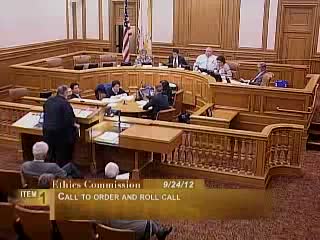
The San Francisco Ethics Commission took its first formal step toward new regulations for handling referrals from the Sunshine Ordinance Task Force on Thursday, voting to adopt amended definitions but agreeing to revise key sections after sustained public criticism and commissioner questions.
Commission staff introduced a package of proposed changes broken into six decision‑point groups intended to speed enforcement of Sunshine referrals while the task force is largely dormant. “The staff feels that time is more of the essence and that, we should go ahead and move these forward so we can move some cases that are stalled here,” said Mr. St. Croix, a member of the commission staff, as he opened discussion.
Why it matters: The rules being debated would govern whether and how the Ethics Commission responds to task force findings that city officials failed to disclose records or otherwise violated public‑access rules. The stakes include whether the commission can order document production, how to treat findings by the task force, whether referrals are treated as new complaints, and what penalties the commission could impose.
Public commenters pressed the commission to proceed cautiously. Richard Nee of the Sunshine Ordinance Task Force urged that the rules reference the city’s Sunshine Ordinance. “I would suggest that instead, you use … Sunshine Ordinance section 67.24 because it’s broader in what it defines as a public record,” Nee said during public comment, arguing that task‑force definitions should govern local practice.
Commissioners debated several structural questions: whether elected officials and department heads should face a different procedural standard than rank‑and‑file employees; whether show‑cause hearings should be held by the full commission or delegated to a hearing officer or single commissioner for speed; and whether the commission’s review would amount to a second chance to relitigate task‑force findings.
A recurring point from the public and commissioners alike was the risk of re‑adjudicating matters the task force already litigated. Bruce Wolf, a former vice chair of the Sunshine Task Force, cautioned the commission against converting the review into an appeals process that would replay earlier hearings. Several speakers also warned the draft’s enumerated mitigating factors could be read as excuses that soften accountability.
Penalty and enforcement questions drew particular attention. The draft included a provision authorizing a monetary penalty (discussed at $5,000) to be paid by a respondent department into the general fund; staff and the city attorney’s representative said moving departmental money would likely require an ordinance and budgetary action, not simply a regulation. Commissioner Rennie, other commissioners and commenters questioned whether a modest fine would provide sufficient leverage and suggested alternative remedies.
The commission voted by voice to adopt amended definitions in decision 0.1 — notably adding an explicit reference to Sunshine Ordinance section 67.24 alongside the Public Records Act — but did not finalize the larger package. Chair and commissioners agreed to send specific drafting questions back to staff for revision and to flag issues to be reconsidered once the Sunshine Task Force can consult.
What’s next: Staff will redraft the contested sections (including referral language, hearing procedures, and enforcement remedies) for a future meeting; commissioners asked for clearer options on timing, notice and whether an outside hearing officer model should be used. Several public speakers urged the commission to make related materials more accessible before any final vote.
The action taken Thursday keeps the process moving while preserving room for further changes: the commission signaled it wants rules that are both practical for prompt enforcement and careful not to usurp the task force’s fact‑finding role.