Get Full Government Meeting Transcripts, Videos, & Alerts Forever!
Get email alerts on the Operations Ems topic
No spam. Unsubscribe anytime.
SFFD reports fatal structure fire, rising Narcan use and clears path for department drone purchase
Summary
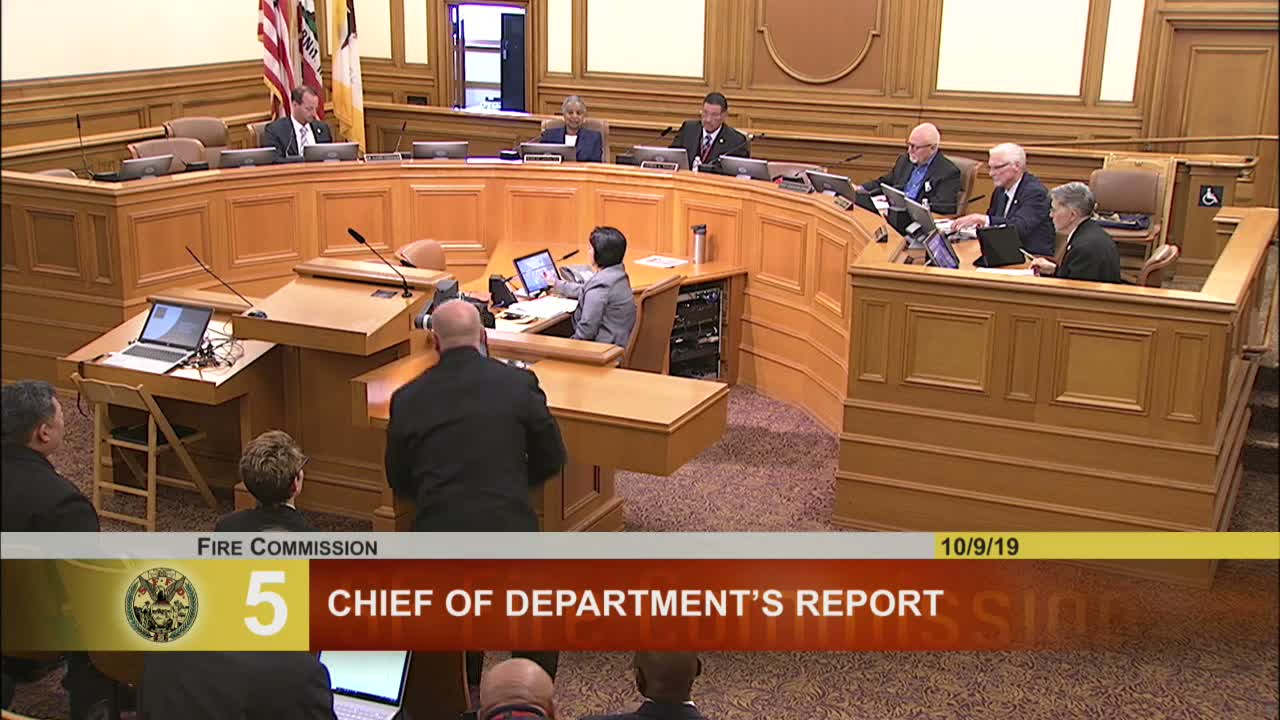
Deputy Chief Victor Worsch reported a September second-alarm fire with civilian fatalities, summarized EMS success stories and statistics on high-frequency callers, and confirmed the city cleared the department to purchase a drone; commissioners asked about a spike in Narcan administrations and ambulance availability metrics.
Deputy Chief Victor Worsch presented the operations report for September, describing one second-alarm incident on Sept. 25 at 29 Thornton (no injuries) and a first-alarm at 88 Delano where two civilians died despite rescue efforts. Worsch reported 17 first-alarm fires, four wildland fires and multiple rescues including surf and cliff rescues; the division also tracked community outreach and academy graduations.
The EMS report included statistics on frequent callers: 1,046 calls tied to 58 unique individuals during the reporting period, with 48 of the top callers self-identifying as homeless. Staff highlighted success stories of individuals placed into treatment and housing with follow-up support.
Commissioners focused on a steep increase in Narcan administrations reported in the EMS metrics. One commissioner noted a jump in May to about 191 administrations and a further rise to roughly 214 by September. Deputy Chief Worsch and staff said fentanyl is likely a contributing factor, that Narcan reversals indicate opioid involvement, and that definitive lab identification (fentanyl vs. heroin) often occurs later at hospital labs.
On resource readiness, staff walked the commission through a daily "level" chart showing minutes per day with different ambulance-availability levels; for example, on Sept. 30 the department recorded roughly 99 minutes at level 0 (no ambulances available) and 490 minutes when 7 or fewer ambulances were available across the 24-hour day.
On technology and procurement, the commission heard that the city attorney's office, COIT and Office of Contract Administration have cleared the SFFD to move forward with a drone purchase. Finance and planning staff said federal and homeland-security approvals are in hand and that procurement specs were being prepared for submission; the next steps cited included a Certificate of Authorization and pilot training.
What happens next: Staff will provide follow-up briefings on EMS trends and proposed operational tactics to address high-frequency callers and fentanyl-driven overdose responses; procurement staff will return with procurement timetables and funding details for the drone program.