Get Full Government Meeting Transcripts, Videos, & Alerts Forever!
Get email alerts on the Witness Testimony topic
No spam. Unsubscribe anytime.
Campaign manager testifies she supported Eliana Lopez, denies dissuading witnesses in Mirkarimi probe
Summary
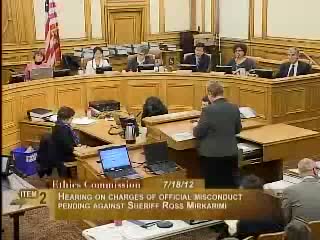
Lynette Peralta Haynes told the San Francisco Ethics Commission she spent much of Jan. 4 offering emotional support and referrals to Eliana Lopez, sent texts to Sheriff Ross Mirkarimi asking him to call, and denied coaching witnesses or urging anyone not to talk to police.
Lynette Peralta Haynes, who served as campaign manager for Ross Mirkarimi’s successful sheriff campaign, testified before the San Francisco Ethics Commission that she communicated repeatedly on Jan. 4 with Eliana Lopez and also texted Mirkarimi during the day, but she denied trying to dissuade witnesses or obstruct investigators.
Haynes said she conducted a domestic-violence danger assessment when Lopez called and concluded Lopez did not report ongoing danger. "I wanted to support Ileana and make sure she was safe," Haynes testified. She described giving Lopez a referral number for Spanish-language domestic-violence services and offering to help arrange counseling or legal referrals if Lopez wanted them.
Under questioning from Deputy City Attorney Sherry Kaiser, Haynes reviewed exhibit materials admitted into evidence and confirmed she exchanged a series of calls and texts with Lopez that day. She read two outgoing texts to Sheriff Mirkarimi that she sent in the afternoon: "can you call me? it is urgent regarding Ileana," and later, "I need to talk to you. To protect you, call me." Haynes said the phrase "protect you" reflected her view that the family might benefit from legal counsel and protections, not an effort to obstruct the police. "My thinking was that they needed legal protection, both Ileana and Ross," she said.
Defense counsel Eric Saphire argued before the hearing that Haynes’ testimony was limited in relevance to the one-page declaration she submitted. The city attorney’s office questioned Haynes at length about what Lopez told her by phone — including a roughly 40-minute call in the late morning and subsequent 14-minute and longer calls in the afternoon during which Haynes said she heard Lopez cry "help me" and was briefly handed the phone to an unknown woman later identified as Ivory Madison.
Haynes said she asked direct and open-ended questions drawn from prior domestic-violence training to determine whether Lopez was in a cycle of abuse. "I asked if she had been going through verbal abuse, emotional abuse, physical abuse," Haynes testified, and said Lopez answered no to follow-up questions about prior assaults and ongoing danger. Haynes described the calls that followed — including moments when Lopez drafted and sent emails to third parties — as primarily emotional support and check-ins, not tactical planning to influence witnesses.
The cross-examination also probed whether Haynes drafted emails for Lopez, advised Lopez or others to avoid police interviews, or coached witnesses about what to say. On each point Haynes answered, "No, I did not." She said she recommended that both parties retain their own attorneys so that each person would be represented and protected.
Commissioners pressed Haynes about why she, as Mirkarimi’s former campaign manager, did not recuse herself from counseling Lopez. Haynes said she considered the conflict but believed the right action was to provide immediate support when Lopez called: "My spirituality is the first and most important thing to me, above politics," she said, and she described acting out of duty to support someone who reached out in distress.
Procedural matters consumed part of the hearing: the commission ruled on multiple evidentiary objections to parts of the Lopez declaration and discussed whether to allow additional rebuttal witnesses. The commission also cautioned the public not to record in close proximity to counsel so as to protect attorney–client communications.
The commission scheduled continuation of Eliana Lopez’s testimony for the next day and estimated the city’s examination would take about two hours. The Ethics Commission said it would weigh the evidence it allowed and asked counsel to proceed accordingly.