Get Full Government Meeting Transcripts, Videos, & Alerts Forever!
Get email alerts on the Official Misconduct Hearing topic
No spam. Unsubscribe anytime.
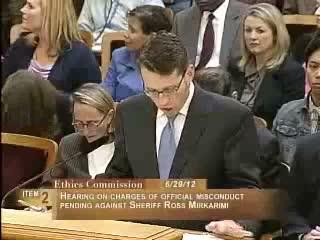
San Francisco Ethics Commission continues hearing on removal of Sheriff Mercarini after testimony on texts, media strategy and weapons
Summary
At a continued Ethics Commission hearing, Sheriff Mercarini testified about January phone and text records, a disputed media strategy framing the case as a "political witch hunt," his apology in criminal court, and the surrender of three registered firearms; Mayor Ed Lee later defended filing removal charges under the San Francisco Charter. The hearing was adjourned and will resume at a later date.
The San Francisco Ethics Commission held a continued special hearing on official-misconduct charges against Sheriff Mercarini, hearing hours of testimony from the sheriff and later from Mayor Ed Lee about communications, media planning and the legal basis for removal.
Under questioning, Sheriff Mercarini described a string of phone calls and text messages on January 4 that he said he did not initiate to influence the investigation into an incident involving his wife. Counsel introduced exhibit 83, a compilation of AT&T phone records and text logs the mayor—s office provided, and reviewed a 9:33 a.m. call, a 12:03 p.m. text the sheriff sent to his wife, and later messages from Lynette Peralta Haynes urging the sheriff to "call me" and saying she needed to "protect you." The sheriff denied seeing the Peralta Haynes messages before speaking with his wife and said his communications with Peralta Haynes before Jan. 4 were "very minimal" and related to campaign and transition matters.
The commission also reviewed January 12 text exchanges between the sheriff and Peralta Haynes (exhibit 81). The sheriff confirmed he sent a message saying he felt "guilty until proven innocent" and that he had discussed with Peralta Haynes the idea of generating a public "vibe" that the controversy was a political "witch hunt." He testified that while those exchanges reflected concern and discussion about messaging, he "did not instruct at all" anyone to implement an attack-oriented media campaign and said he "did not take any action to implement that media strategy." He also acknowledged in some of those messages that he knew at the time he had injured his wife on Dec. 31.
Counsel sought to play a short clip from the sheriff's inauguration (identified as exhibit 84) to probe whether he had made a joke about the police inquiry; the chair allowed the clip as a potential party admission and prior inconsistent statement. The sheriff called the remark a reference to media attention and said, "I did not make a joke about domestic violence." He told the commission he regretted an earlier public description of the matter as a "private family matter," calling that phrasing a mistake.
The hearing also covered the sheriff's arrest and the handling of his firearms. The sheriff testified that inspectors from the San Francisco Police Department served him with an emergency protective order when he was taken into custody and told him he had to surrender three registered firearms (a Smith & Wesson revolver, a SIG Sauer and a Beretta). He said the two semiautomatic pistols were stored in a locked cabinet in a private storage area, had their slides taped and were not loaded, and that his attorney arranged logistics with police inspectors for turnover.
Counsel read the sheriff's statement from his criminal proceeding (exhibit 36), in which he apologized "to Miss Madison, her family, my neighbors, my department, the sheriff's department, and the people of San Francisco" and said he "truly regret[s]" any suffering caused. When asked on the stand whether he meant the apology, the sheriff answered, "Yes."
Commissioners pressed the sheriff on the factual basis for the false-imprisonment plea (which he described as including turning the van around during an argument on Dec. 31) and about when he learned his wife had spoken to a neighbor and that a videotape existed. The sheriff said he first learned about the police investigation after a call from his wife after 4 p.m. on Jan. 4 and that when they met outside City Hall he was processing the information and trying to determine an appropriate response.
In the afternoon session, Mayor Ed Lee was sworn and testified about his decision to file written charges under the San Francisco Charter. Lee said the Charter gives the mayor a duty to consider removal for official misconduct and that the decision is made case by case. He told the commission he had consulted the city attorney and other advisors before filing and that he believed, based on the record and legal review, there was a basis to pursue the formal misconduct charges.
No final disposition on the removal charges was reached at the session. The commission took a lunch recess and, after further questioning, the chair adjourned the hearing and said commissioners and the press would be notified when proceedings would resume.
The commission's evidence record in this session includes exhibit 81 (text messages between the sheriff and Lynette Peralta Haynes), exhibit 83 (phone and message logs), exhibit 36 (the sheriff's criminal-court statement), and a proposed inauguration clip (exhibit 84). Commissioners asked factual follow-ups about timing, who was present when the sheriff received calls on Jan. 4, whether anyone implemented a media strategy, and the logistics of turning over firearms after an emergency protective order was served.
Next steps: The Ethics Commission adjourned and will notify parties and the press about the date and time for continued proceedings.