Get Full Government Meeting Transcripts, Videos, & Alerts Forever!
Get email alerts on the Evidence Admissibility topic
No spam. Unsubscribe anytime.
Ethics Commission admits parts of mayor’s evidence, excludes other declarations and reserves video ruling
Summary
At a special Ethics Commission hearing on misconduct charges against the sheriff, commissioners admitted the declaration of acting Sheriff Vicky Hennessy in full, excluded the Paul Henderson declaration in its entirety, sustained and limited multiple paragraph-level objections across several declarations, reserved a ruling on a disputed video, and set short deadlines for exhibit exchanges and briefs.
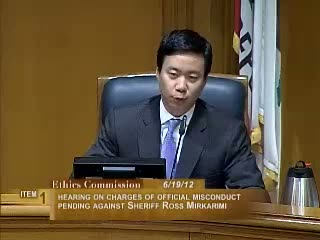
The San Francisco Ethics Commission on the evening convened a contentious evidentiary session over official-misconduct charges the mayor brought against the sheriff, admitting some of the mayor’s proffered testimony while excluding other material and holding a disputed video for later review. The commission also set a compressed schedule for exhibit exchanges and witness subpoenas.
At the start of the hearing the presiding commissioner said the commission would take no public comment during the evidentiary portion and would continue until the matter’s evidence phase could reasonably be completed. Mayor’s counsel, Sherry Kaiser, asked the panel to admit a series of declarations that outlined the duties of the sheriff’s office; the commission first addressed the declaration of Vicky Hennessy. After argument on scope and relevance, a motion to admit Hennessy’s declaration and associated exhibits carried on a voice vote.
The sheriff’s team, represented in the record by counsel identified as Mister Copp, repeatedly objected that several declarations expanded beyond duties spelled out in the city charter and therefore were irrelevant. Counsel for the mayor responded that several declarations were offered to show how the sheriff’s duties and agency interaction are carried out in practice and therefore bear on whether alleged acts related to official duties. After paragraph-by-paragraph debate, the commission sustained the sheriff’s objection to the Paul Henderson declaration and excluded it from evidence.
The commission split rulings on other declarations. It sustained objections to early paragraphs (largely paragraphs 1–18) in a number of declarations but admitted targeted portions of later paragraphs (for example, portions of paragraph 26 and paragraph 27 and exhibits 36 through 41) as relevant. The panel excluded paragraph 25 and sustained multiple foundation and relevance objections when counsel pressed that certain passages were speculative or lacking personal foundation.
Inspectors’ and witnesses’ accounts touching on weapons, chain of custody and court orders drew extended attention. Mayor’s counsel argued a declaration by an inspector describing a court order and the sheriff’s department’s retention of weapons was relevant to law-enforcement standards of honesty; the sheriff’s counsel objected that the issues had not been in the original charges and that the evidence risked morphing the case. The commission excluded some paragraphs and exhibits tied to that line of evidence and reserved a ruling on exhibit 4 — a disputed video — for separate consideration.
The commission repeatedly emphasized it would admit some hearsay material for limited purposes (state of mind, administrative-hearsay allowances or to give context to expert opinions) but cautioned that admitted hearsay would be given less weight than live, non‑hearsay testimony. On multiple contested paragraphs the chair made narrow redactions rather than wholesale exclusion, stressing that the panel must avoid undue prejudice.
Commissioners urged counsel to file narrowly tailored written objections and to meet and confer to bundle disputes, with the chair recommending written exchanges so the panel could rule efficiently at the next scheduled hearing date. The commission directed parties to exchange exhibit lists promptly and set a short briefing schedule for the reserved video issue.
The next procedural step is briefing and exchange of exhibits: counsel were ordered to exchange exhibit lists by the close of business the next day and to file objections by the end of the following Monday so the commission could rule before upcoming live testimony dates. The commission adopted the evidentiary and scheduling decisions made during the session and adjourned.
The hearing record shows the commission is applying a narrow, paragraph-level approach to admissibility: many declarations were pared down rather than accepted or rejected wholesale. That approach will shape what evidence the panel may weigh when live testimony resumes and when it considers the disputed video.