Get Full Government Meeting Transcripts, Videos, & Alerts Forever!
Get email alerts on the Governance topic
No spam. Unsubscribe anytime.
Fire Commission adopts Ramaytush Ohlone land‑acknowledgement after brief debate and public comment
Summary
The San Francisco Fire Commission voted 3–1 to adopt Resolution 2021‑01 requiring a short land‑acknowledgement paragraph to be read at the start of public commission meetings; Commissioner Ken Cleveland voted no and a public commenter asked the commission to verify historical tribal names.
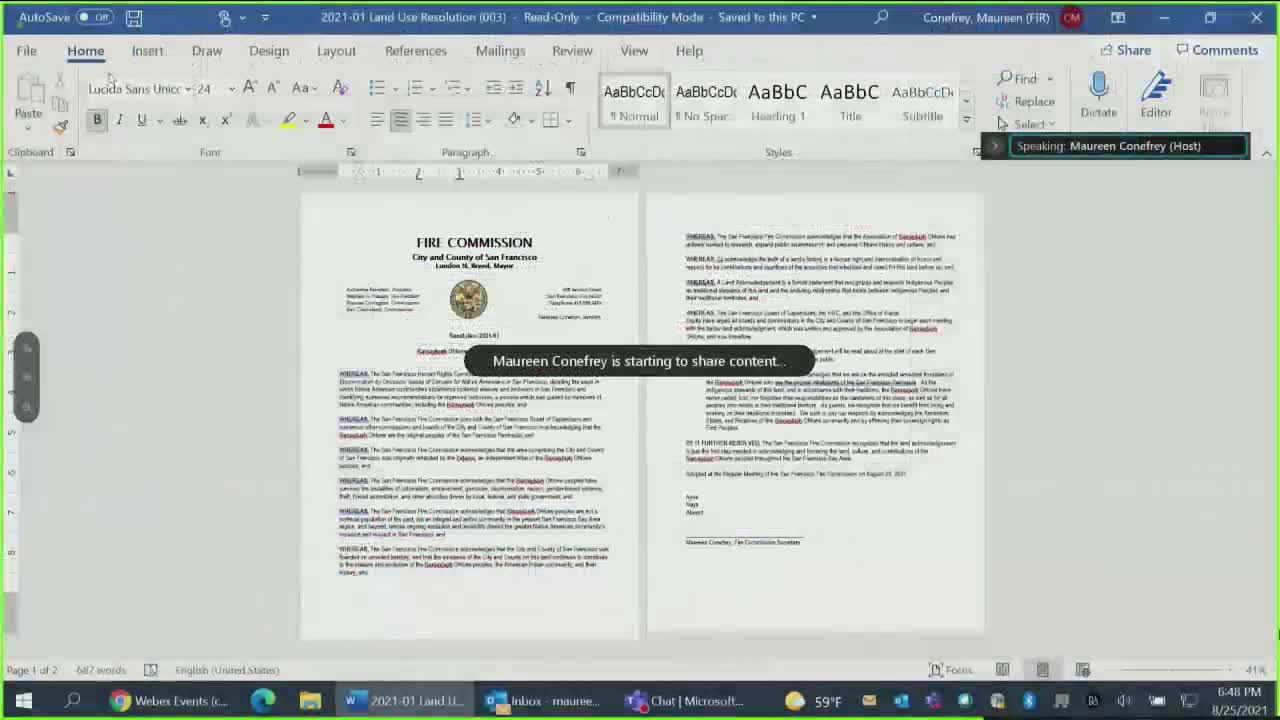
The Fire Commission adopted Resolution 2021‑01, which directs that a brief land‑acknowledgement paragraph recognizing the Ramaytush Ohlone be read at the start of each Fire Commission meeting that is open to the public. Secretary read the resolution text, which the motion called the Ramaytush Ohlone land‑acknowledgement and cited prior Board of Supervisors and Human Rights Commission guidance and language approved by the Association of Ramaytush Ohlone.
Commissioner Francie Covington moved adoption and said she supported acknowledging the people who stewarded the land for thousands of years. Commissioner Ken Cleveland opposed the motion, saying the item was outside the Fire Commission’s core purview (personnel, procedures and equipment) and argued the commission should not be required to read the longer resolution at every meeting; he suggested adding the language to the commission's annual statement of purpose instead.
After discussion and a roll call vote, the motion passed 3–1. The transcript records President Feinstein voting aye and Commissioner Cleveland voting no; other commissioners voted to adopt. Following the vote a caller from the public, Francisco DeCosta, asked the commission to verify tribal designations and historical records (he cited Muwekma/Muwekma Ohlone references) and suggested staff research whether the acknowledgment language requires adjustment. Commissioners agreed to pursue additional historical review but did not reopen the vote at this meeting.
The adopted resolution requires the commission president to read a single paragraph of acknowledgement at roll call for meetings open to the public; the full resolution text and supporting materials will be included in commission records.