Get Full Government Meeting Transcripts, Videos, & Alerts Forever!
Get email alerts on the Response Times topic
No spam. Unsubscribe anytime.
Fire commissioners flag slow-street barriers and speed humps after Page Street delay
Summary
San Francisco Fire Commission members raised concerns that slow-street barricades and speed humps are slowing apparatus and may be damaging vehicles, citing a July 10 Page Street incident and an uptick in broken leaf springs; staff said they will gather data and coordinate with MTA and DPW.
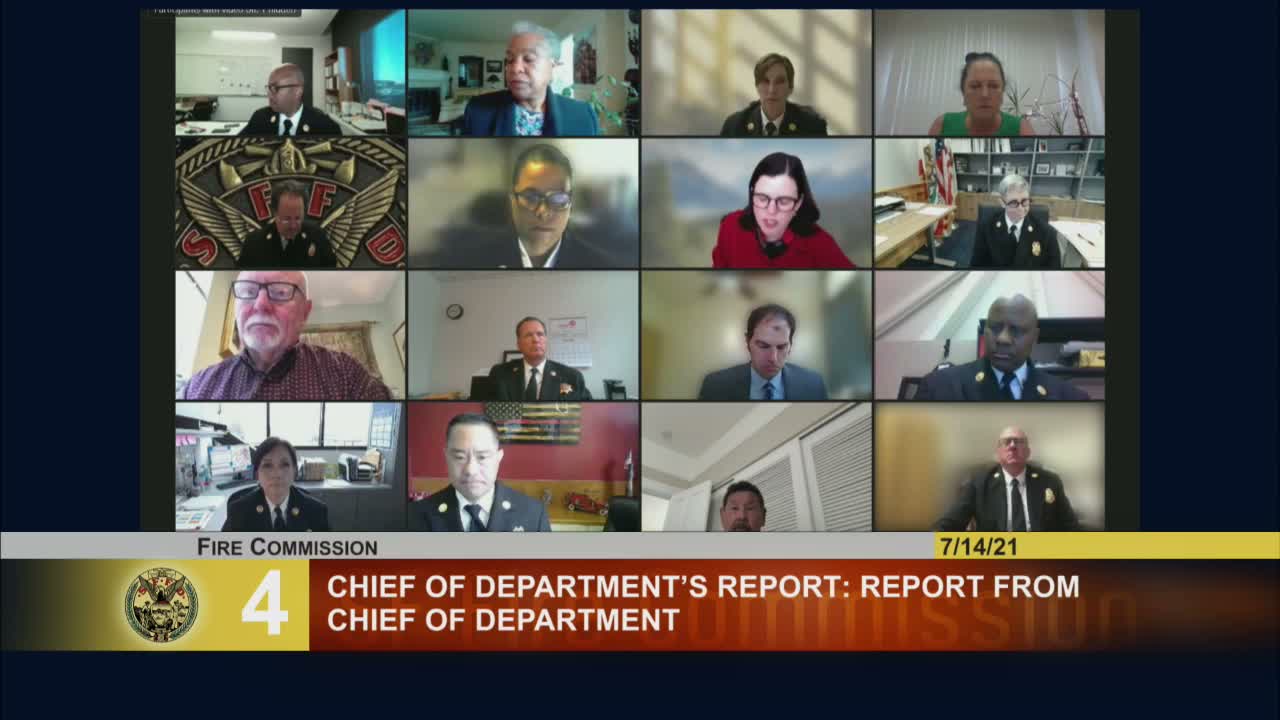
San Francisco’s Fire Commission pressed department leaders on July 14 about growing evidence that slow-street barriers and traffic-calming features are delaying emergency response and damaging apparatus.
President Tessa Feinstein read a Nextdoor account of a July 10 Page Street response in which a large engine could not turn onto the block because of a slow-street barricade and crews had to back and guide the vehicle into position. "One large truck came from Masonic and pulled up in front of the burning house. Another truck came down Central, but was unable to turn left onto Page because of the slow street barrier," Feinstein said, reading the resident’s post.
Support-services deputy ADC DeWitt said fleet staff have seen an increase in broken leaf springs—basic suspension components—concentrated in areas with many speed humps, but cautioned that correlation does not prove causation: "There does seem to be a pattern in the areas where companies respond more frequently on those streets with the speed humps," he said. "Whether or not the speed humps are the cause of that we don't know."
Deputy Chief Brian Rubinstein told commissioners the department has measured a modest increase in response times since 2019 and is tracking the impacts of traffic-calming measures. "For our perspective, any delay is problematic," Rubinstein said, noting it can take about 32 seconds to get a paramedic to a bedside and an additional roughly 40 seconds to get a transport unit ready.
Rubinstein said the department’s public information officer documented materials stacked at some slow-street intersections and that he has asked Public Works to remove illegal obstructions. He also said the department will bring the Municipal Transportation Agency back to the commission for a focused discussion and follow up with additional compiled data.
No new policy was adopted at the meeting. Commissioners requested more precise timing definitions and asked staff to report back with clearer on-scene metrics, photos and coordination steps with MTA and DPW.
Next steps: staff will compile on-scene data, remove obvious illegal obstructions with DPW, and schedule MTA to return for a meeting on traffic-calming impacts in late summer.