Get Full Government Meeting Transcripts, Videos, & Alerts Forever!
Get email alerts on the Budget And Programs topic
No spam. Unsubscribe anytime.
Mayor—s proposed budget boosts SFFD funding for community paramedicine, equipment and training
Summary
Deputy Director Marc Corso told the commission the mayor—s proposed two‑year budget would set the department—s total at about $439 million, fund expanded community paramedicine (more SCRT/EMS teams and new street wellness/opioid teams), add fleet and equipment money and allocate $5.8 million for land for a new training facility.
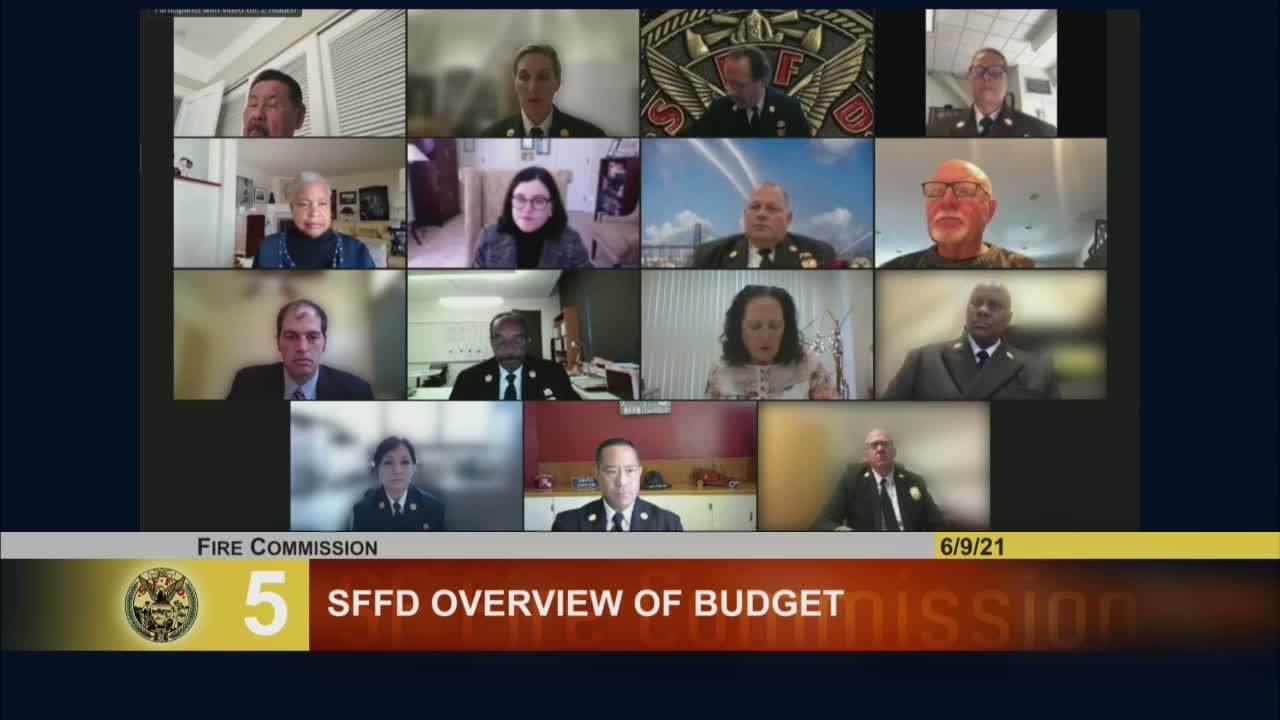
The Fire Commission heard a detailed presentation on June 9 from Marc Corso, Deputy Director of Finance and Planning, on the mayor—s proposed FY2021–22 and FY2022–23 budget for the San Francisco Fire Department. Corso said improved revenue projections and federal stimulus funding shrank a previously projected two‑year city deficit from roughly $653 million to about $22.9 million, enabling new investments in the department.
Corso said the mayor—s proposal would set the department—s total budget at about $439 million, an increase of roughly 6.5 percent from the current year. Major proposed investments include an expansion of community paramedicine programs — increasing Street Crisis Response Teams (SCRT) toward seven teams per day, ramping a new street wellness response team to five teams, and creating an opioid response team — along with administrative and data staff to manage the growth. "For once, good budget news," Corso said as he introduced the plan.
On capital needs, Corso said the mayor—s proposal commits a minimum of $3.5 million per year for a five‑year equipment and fleet replacement program, plus an additional $3 million in one‑time allocation in the first year for vehicles and medical equipment (about $6.5 million total in year one). He also said the mayor—s budget includes a one‑time $5.8 million allocation to acquire port‑owned land needed for a planned training facility, subject to interagency and legislative steps.
The department plans two firefighter academies, one beginning in August and a second around January, supported in part by a SAFER grant, Corso said. He also said procurement for five host tenders resumed after pandemic pauses; contracting paperwork and insurance matters were pending with the Office of Contract Administration but the department hopes to begin orders once funding is available in August.
Commissioners pressed department staff on implementation details: how SCRT and the wellness/overdose teams will be housed, whether Station 49 can absorb additional staff and equipment, and how hospitals and EMS coordinate follow‑up for frequent utilizers. Assistant Deputy Chief Sandy Tong and Assistant Deputy Chief Dawn DeWitt explained that SCRT currently operates out of the Evans Street (BOE) warehouse while the new Station 49 is at capacity and that Evans Street requires a multi‑year reconfiguration funded through the capital/budget process. "We are maxed out at this time," Tong said about on‑site parking and administrative space at Station 49; DeWitt said warehouse consolidation and reconfiguration have begun.
Corso and Chief Nicholson said they are working with the Board of Supervisors— budget and legislative analysts; a public hearing was scheduled for June 25 and the Budget and Finance Committee hearings would precede full Board action in July. "At this time I don't foresee anything that we need from you all right now," Chief Nicholson said of the commission's role in the process.
If approved, the spending would allow the department to phase in the new community paramedicine teams, purchase vehicles and defibrillators, and hire additional administrative and uniform staff needed to operate the expanded programs. The commission did not take a final vote on the budget at the meeting; staff will continue negotiations with the Board of Supervisors and the budget and legislative analysts.