Get Full Government Meeting Transcripts, Videos, & Alerts Forever!
Get email alerts on the Street Crisis Response topic
No spam. Unsubscribe anytime.
S.F. Fire Department expands community paramedics as Narcan use rises
Summary
The San Francisco Fire Department told commissioners it is expanding community paramedic training and street crisis response units while tracking increased Narcan administrations; officials said staffing, dispatch changes and toxicology limits make immediate causes unclear.
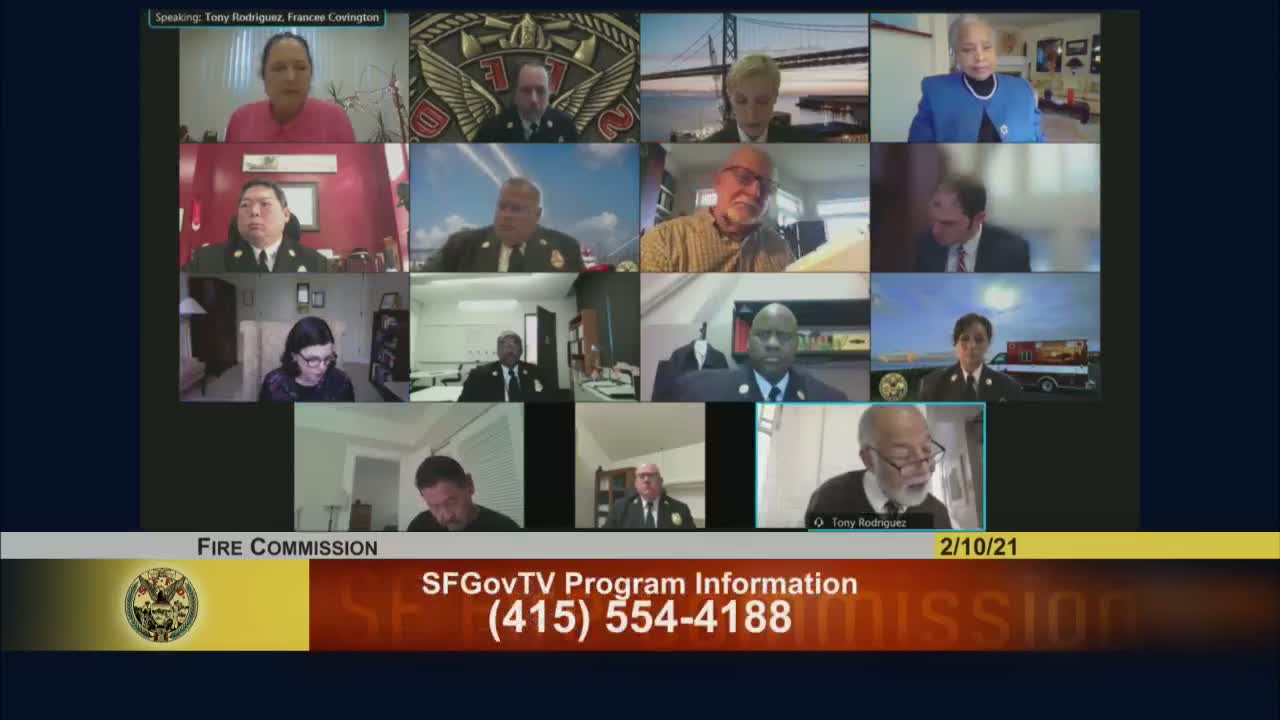
SAN FRANCISCO — The San Francisco Fire Department told its Fire Commission on Feb. 10 that it is scaling up community paramedic training and Street Crisis Response Team (SCRT) deployments even as paramedics administered more naloxone (Narcan) calls in January.
Deputy Chief Bridal Rubinstein said the department's EMS work is "busy," with "Average over 295 calls a day," and noted the department has been asked to take on responses previously handled by police. "Any of those could fall under the umbrella of calls that are being reimagined from police calls to different forms of intervention," Rubinstein said.
Assistant Deputy Chief Sandy Tong described the department's community paramedic program and training: "We have 19 that have chosen that are going through this course right now," she said, and that the course is a multi-week didactic program focusing on behavioral health, substance use and homelessness-related care. Tong said the department plans relief pools and an eventual increase to six crisis-response units to expand geographic coverage as training and staffing allow.
Commissioners pressed for data. Rubinstein and Tong said dispatch changes must be implemented before the department will have clear, consistent metrics to show how many calls moved from police to the SCRT. "The clearest answer to that would be to look at the calls that the SCRT is going on," Rubinstein said, adding the SCRT's current deployments cover a narrow geographic and case subset while the unit scales up.
On overdose response, Tong cautioned against equating increased Narcan administrations directly with a single cause. "The administration of Narcan is when any paramedic suspects that there may be an opiate involved," she said, adding that crews sometimes give Narcan to "rule out" an opioid overdose for an unconscious person. She noted toxicology results are not always immediately available, so short-term trends can be hard to interpret.
Commissioners raised safety concerns for responders, asking what protocols are in place if an SCRT team encounters violent or volatile situations. Rubinstein and Tong outlined de-escalation training, radio alarm buttons that summon nearby units and police backup, and procedures to call for assistance when needed.
The commission asked staff to provide more detailed training curricula and longitudinal station-level call data. Department leaders said they would provide additional documentation and continue to pursue reimbursements and funding for the SCRT as staffing and dispatch changes proceed.
The commission discussed the operational implications of shifting calls from police to health-oriented teams and emphasized that funding and staffing remain central to any expansion. No formal policy change was adopted at the meeting; commissioners and department staff agreed to follow up with further briefings and data.