Get Full Government Meeting Transcripts, Videos, & Alerts Forever!
Get email alerts on the Sffd Grants And Ems6 topic
No spam. Unsubscribe anytime.
San Francisco Fire Department wins major FEMA grants, outlines EMS/critical-response pilot
Summary
The Fire Department reported multiple federal grant awards — including a $13.7 million FEMA academy grant and a $600,000 grant for mini-pumpers — and described a phased rollout of a Critical Response Team pilot beginning December with a goal of six teams by March.
The San Francisco Fire Department told the Fire Commission on Sept. 23 that it has been awarded several federal grants and is moving forward with a pilot of a new critical-response program aimed at reducing police responses to nonviolent 911 calls.
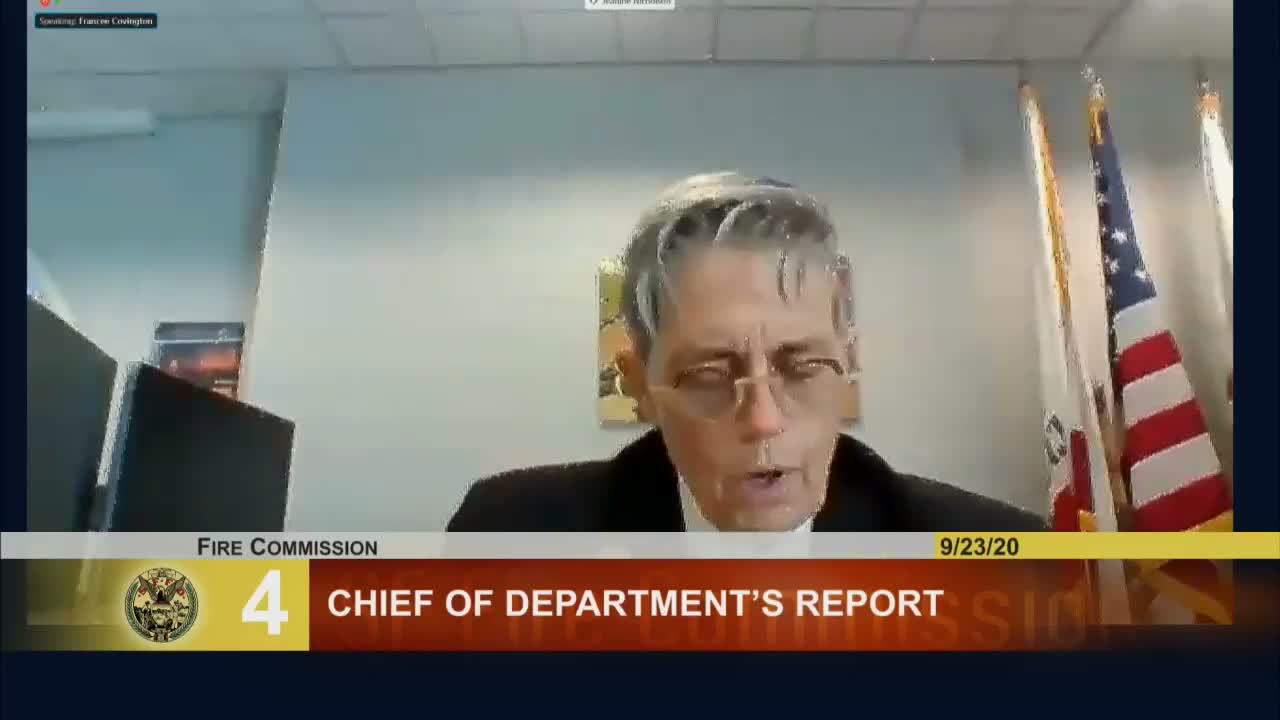
Chief of Department Janine Nicholson reported the department has recorded 28 COVID-19 positive staff since the pandemic began and said seven remain off work or in quarantine. “We have had 28 COVID positives, in all since this pandemic began,” Nicholson said, and described tightened screening and testing protocols for wildland deployments.
Nicholson described two recent awards from the Federal Emergency Management Agency: a $13,700,000 grant intended to fund an academy class of 36 recruits and pay their salaries for three years, which Nicholson said would avoid general-fund impact; and a separate award of “over $600,000” to buy three mini-pumpers for fires in parks and other small-access locations. Finance and planning lead Mark Corso and the department said the grants still require final approval from the mayor’s budget office.
The commission pressed the department on the new community-based response model. Department staff said EMS6 is a community-paramedicine unit that works one-on-one with frequent 911 users, while the Critical Response Team (CRT) will pair an advanced health-care practitioner and a peer-support worker with a community paramedic to respond to many calls where a police response may not be necessary. “EMS6 is sort of a small slice of the pie that deals with our most frequent users of 911,” Nicholson said. Niels, a department planner, said the first CRT team will begin in December as a pilot with a ramp-up to six teams and 24/7 coverage aimed for March, and that training and hiring are planned to support that expansion.
Commissioners asked about the program’s funding and capacity. Department staff said a $2,000,000 line item is in the budget as seed money and that additional Prop C revenues and other ballot-measure funds are intended to support expansion; staff characterized the $2,000,000 as start-up funds rather than full ongoing financing.
Fire Marshal DiCocio briefed the commission on parklet and sidewalk-platform inspections, saying the Fire Department is reviewing fire access, staging, and clearance issues and working with Department of Public Works (the permitting agency) to prioritize urgent sites. DiCocio emphasized that regulated uses such as candles, propane and heaters require fire permits.
The department also reported other operational updates: rotating crews on mutual-aid deployments (37 members deployed to statewide wildfires at the time of the report), drone-training props, two new K9s, fleet purchases and projected station-completion dates (Station 49 projected in early 2021, Station 15 roof work and rebuild for community character), and continued recruitment and training activity.
The commission did not take a formal vote on the grants described in this report; commissioners praised the grant wins and asked staff to return with more details about CRT staffing, dispatch/triage protocols, and the mayor’s budget-office approvals.
The commission scheduled follow-ups including an EMS6/CRT briefing for a future meeting and a report on parklet permitting and horn/noise protocols at stations requested by commissioners.