Get Full Government Meeting Transcripts, Videos, & Alerts Forever!
Get email alerts on the Department Operations topic
No spam. Unsubscribe anytime.
Fire department reports COVID cases among personnel, expanded wildfire deployments and rise in encampment fires
Summary
At the Sept. 9 Fire Commission meeting, department leaders reported 26 positive COVID-19 tests among personnel, 41 members deployed on wildland incidents, and an apparent rise in encampment-related fires tied partly to changed recording practices; commissioners pressed for more granular data on alarms, rescues and ADU activity.
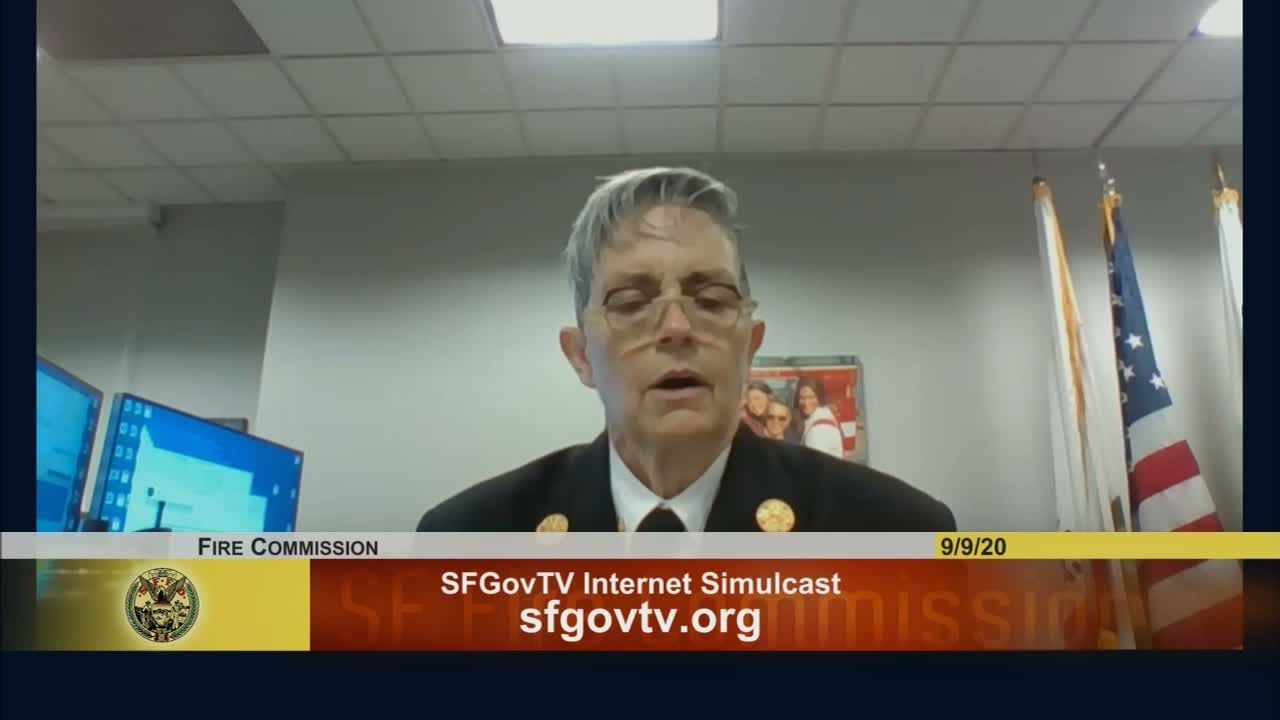
At the Sept. 9 meeting of the San Francisco Fire Commission, department leaders reported an uptick in COVID-19 cases among personnel, widespread wildland deployments and operational trends that are reshaping response priorities.
An unidentified department presenter told commissioners that the department had recorded 26 positive COVID-19 tests among personnel and had 15 members in quarantine; seven of those positives were among firefighters returning from wildland deployments. "So far, we have had 26 positive tests. We currently have 15 in quarantine," the presenter said, and described a protocol of testing returning crews and a five-day quarantine followed by repeat testing before release to the field.
Chief Victor Wersch delivered the operations report for August, detailing incident counts and mutual-aid activity. He said the department recorded one greater alarm and 22 working fires in August, along with 32 outside fires, 20 grass fires and 58 encampment fires. "We had 57 positions that were deployed and maintained for Wildland and Mutual Aid," Wersch said, and noted that 41 members remained deployed at the time of the meeting.
Commissioners and staff emphasized prevention and outreach. Wersch described distribution of coastal and cliff-safety brochures — roughly 1,500 handed out — and a multilingual handout campaign aimed at encampments after officials identified cooking and warming fires as common causes. "We are recording them, each and every one of them," Wersch said of encampment fires, cautioning that part of the apparent increase reflects a change in how those events are classified and documented and that the arson squad is now producing reports on many of those incidents.
On emergency medical services, the department said it was revising how it records housing status in patient-care reports, replacing older terminology with "people experiencing homelessness"; that change altered percentage calculations in the Narcan report and related EMS tables. According to the packet discussed at the meeting, about one-third of medical incidents involved people experiencing homelessness over the six-month window summarized.
Fire Marshal Daniel DeCocio and chiefs answered commissioner questions about alarms and alarm infrastructure. DeCocio distinguished false alarms from "unwanted" alarms triggered by legitimate smoke or other nonfire conditions. Wersch said alarms made up roughly 9% of calls in August and cited heat-related sensor activations and more sensitive detectors as reasons some alarms were later classified as false.
Commissioners also pressed the department on several operational issues: an increase in surf rescues (14 of 45 listed in the August report), a rise in vehicle/bicycle/pedestrian injuries since traffic patterns changed during the pandemic, and pending accessory dwelling unit (ADU) permit data. DeCocio said ADU neighborhood breakdowns are not tracked at the current level in this report but can be added on request.
On personnel matters related to training and promotions, the department confirmed a scheduled captain's test would go forward; arrangements will be made for quarantined or deployed members to take the test later. Officials also clarified that "decon events" listed in the medical report refer primarily to ambulance decontamination after suspected COVID-19 transports, distinct from decontamination following on-scene hazmat or trauma incidents.
The report prompted multiple commendations from commissioners for the department's work during a season of concurrent crises. Several commissioners asked for follow-up data and station-level breakdowns for specific incident categories to better understand trends and resource needs. The commission concluded the item by scheduling the previously postponed presentation from an employee affinity group for a future meeting.