Get Full Government Meeting Transcripts, Videos, & Alerts Forever!
Get email alerts on the Ems6 topic
No spam. Unsubscribe anytime.
SFFD highlights EMS 6 gains, outlines Street Crisis Response Team rollout
Summary
San Francisco Fire Department leaders told the Fire Commission that EMS 6 has cut frequent‑caller use, diverted hundreds of ER trips and led COVID response efforts; the department plans a CAHOOTS‑style Street Crisis Response Team, with one unit launching in November and six units targeted by March 2021.
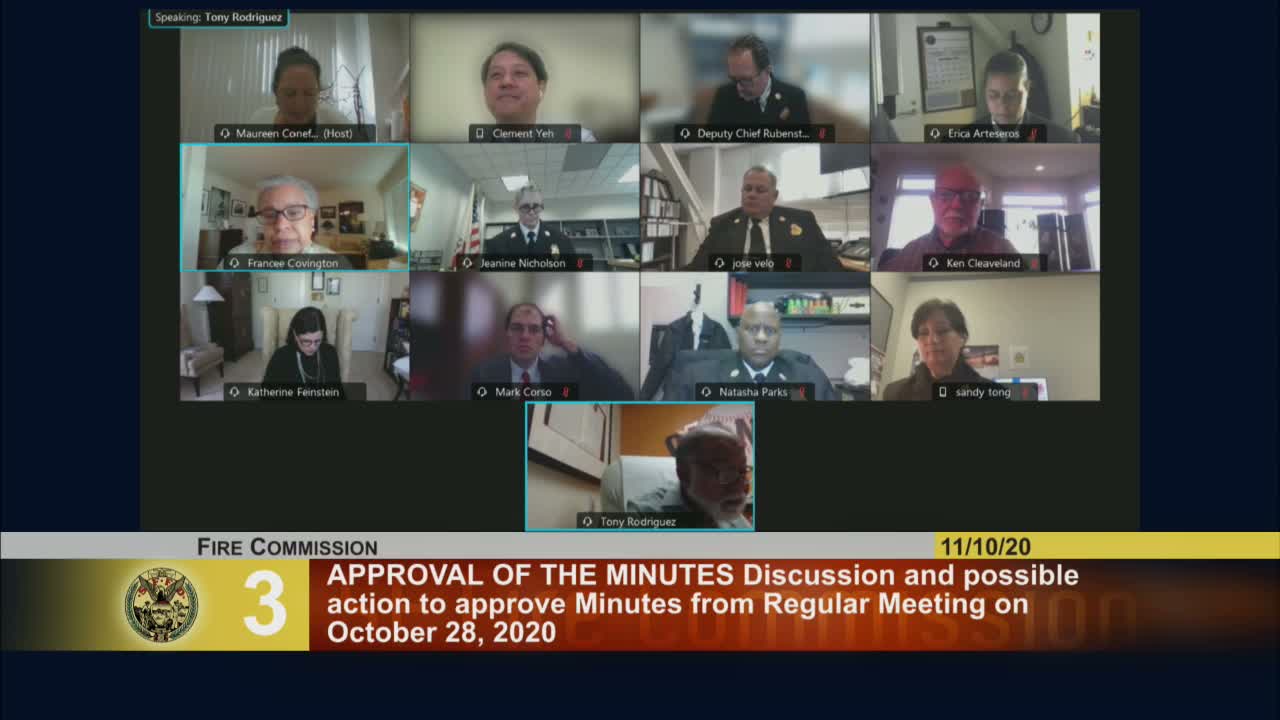
The San Francisco Fire Department on Nov. 10 told the Fire Commission that EMS 6 — a community paramedicine unit now approaching five years of operation — has produced measurable reductions in repeated 9‑1‑1 use and is central to the department’s pandemic and street‑outreach work.
"The secret to EMS 6 is a patient‑centered design," Dr. Clement Yeh said during the department presentation, describing a model that pairs paramedics with social‑service partners to find nonemergency referrals and follow clients after hospital visits. Chief Simon Pang said EMS 6 now has seven full‑time captain‑level positions and added staff activated through the COVID command center.
Presenters said frequent 9‑1‑1 users number roughly 545 per month and generate about 870 calls monthly — roughly 7% of users accounting for about 18% of EMS resources. For the first 10 months of 2020 the unit recorded 1,360 referrals and 691 successful connections to services, with 584 emergency‑room transports diverted. The department reported a 51% connection rate overall.
Captain April Sloan described the managed‑client program within the statewide Whole Person Care initiative. "We develop a prehospital action plan," she said, and store the plan in EPIC and ESO so field crews and hospitals can see it. Sloan said 32 active managed clients showed a 34% average decrease in emergency utilization after plans and wraparound services were implemented.
The commission also heard a detailed account of Site 42, an isolation/shelter‑in‑place location co‑staffed by EMS 6 and sobering‑center partners. Chief Pang said Site 42 used a supervised, medically informed managed‑alcohol protocol for a highly vulnerable cohort; during their stay the site cohort showed a 91% drop in 9‑1‑1 use. Pang said that cohort of 14 people would otherwise have generated an estimated 1,056 calls in a year and that the intervention avoided roughly 916 calls while improving clients’ stability.
Captain Michael Mason described the Healthy Streets Operations Center’s encampment resolutions and sheltering work. He said HSOC coordinated dozens of departments and community organizations to move people into shelter‑in‑place hotels and safe‑sleeping sites; between June and October 2020 HSOC resolved more than 60 encampments and offered shelter to over 1,100 people. Mason said an October tent count was about 700; as of Nov. 5 he reported 13 large encampments remained.
The presentation closed with a plan for a Street Crisis Response Team modeled on Eugene, Ore.’s CAHOOTS program: each unit will include an EMT/paramedic, a behavioral‑health clinician and a peer specialist. The department plans an initial unit in November, a second unit by January 2021 and six total units by March 2021. At full scale the SFFD anticipates handling an estimated 15,000–17,000 calls per year with the new units.
Commissioners praised the program but pressed presenters about a shortage of long‑term placement options, conservatorship barriers and the limits of current psychiatric‑bed capacity. Dr. Yeh and Chief Pang acknowledged those constraints and urged cross‑agency support. Commissioners requested follow‑up materials and agreed to recall the EMS 6 presentation for a deeper review at a future meeting.
The Fire Commission did not take new formal action on policy or funding at the meeting; it asked staff to provide written materials and periodic updates so commissioners could track performance and resource needs.