Get Full Government Meeting Transcripts, Videos, & Alerts Forever!
Get email alerts on the Operations topic
No spam. Unsubscribe anytime.
Chief details recent large fires, EMS trends and training; commissioners press for data on Narcan use
Summary
Chief Janine Nicholson and operations leaders reviewed major incidents in Nov.–Dec., training and outreach, and an EMS briefing that reported 16 newly pinned paramedics and a small decline in multiple-dose Narcan administrations from 230 to 184 over the period; commissioners asked for analysis of the trend.
At the Jan. 8 Fire Commission meeting Chief Janine Nicholson and Deputy Chief Victor Wirsh reviewed recent operations, staffing and outreach activities.
Nicholson highlighted community outreach (an SPCA therapy-dog visit to Station 49 and a memorandum of understanding for more visits), a demonstration of an electric fire engine (she said it was "interesting and, pretty cool" but added "we're not, we're not ready for it"), and the department—s career-track work group aimed at expanding in-house promotion and training. She also noted the department continues to search for a department physician to fill a vacancy.
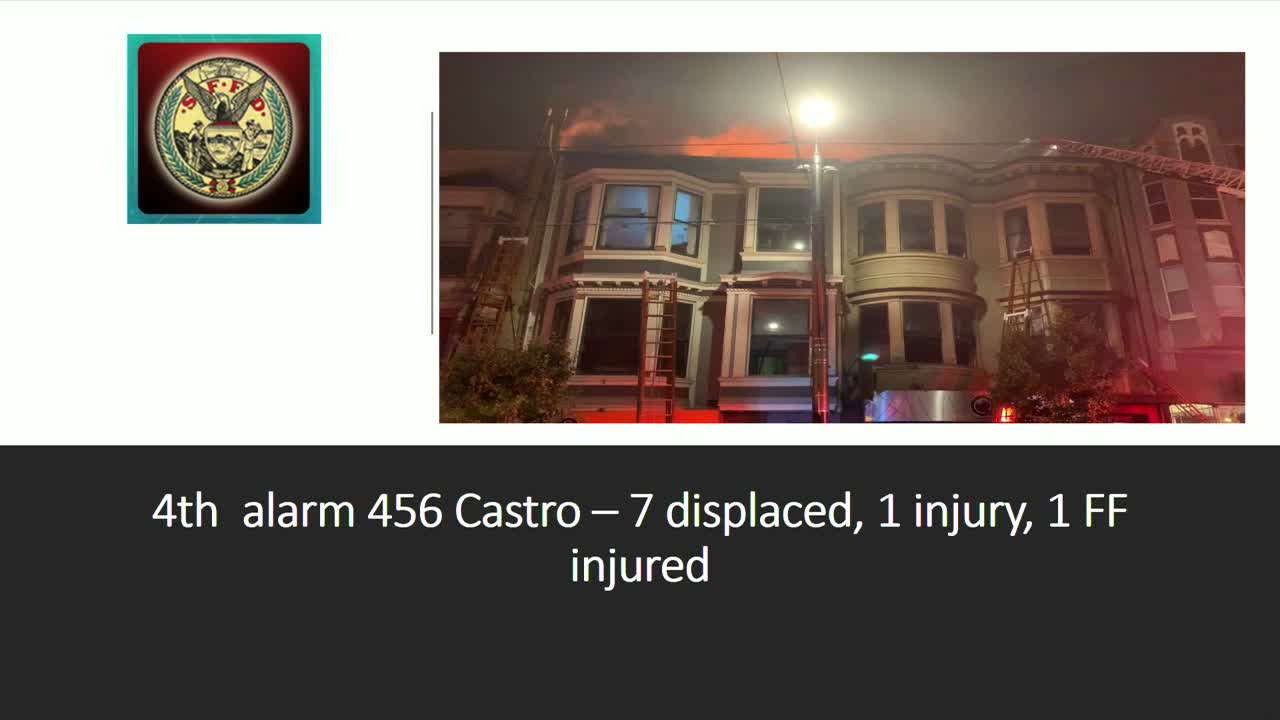
Deputy Chief Victor Wirsh gave the operations report for November and December, describing five greater alarms in the reporting period, including a Nov. 16 fourth-alarm fire at Castle Street that required four alarms and was contained early the next morning. He praised coordinated responses and said crews performed well.
Assistant Deputy Chief Sandra Tong reported EMS updates: a bump-up academy for EMT-to-paramedic training, 16 newly pinned paramedics, a planned community paramedic training course beginning Jan. 27 (projected to include about 10 participants), and a decline in multiple-dose Narcan administrations from 230 to 188 (Nov.) and then to 184 (Dec.).
Commissioners asked whether the Narcan decrease could reflect increased overdose deaths; Commissioner Alejandro Van Varanasi asked, "So are we seeing these numbers go down because people are dying?" Chief Nicholson said staff would research the trend and pointed to variability caused by different batches of fentanyl. She promised follow-up analysis for the commission.
The operations discussion also covered prevention, a recent hazmat at the airport on Dec. 6 (four patients treated), expanded canine capabilities for urban search and rescue, mobile command returning to service, and community distribution of smoke and carbon monoxide detectors (Jonathan Baxter secured 800 smoke detectors and 300 CO detectors for distribution).