Get Full Government Meeting Transcripts, Videos, & Alerts Forever!
Get email alerts on the Ems6 Program topic
No spam. Unsubscribe anytime.
San Francisco Fire Department outlines EMS‑6 impact, staffing and limits of involuntary holds
Summary
Medical director Dr. Clement Yeh and Section Chief Simon Pang told the Fire Commission EMS‑6 has reduced frequent 911 use among managed clients, outlined staffing and hours to expand coverage, and cautioned that involuntary psychiatric holds (Welfare & Institutions Code §5150) should remain a last resort performed with law enforcement and behavioral health partners.
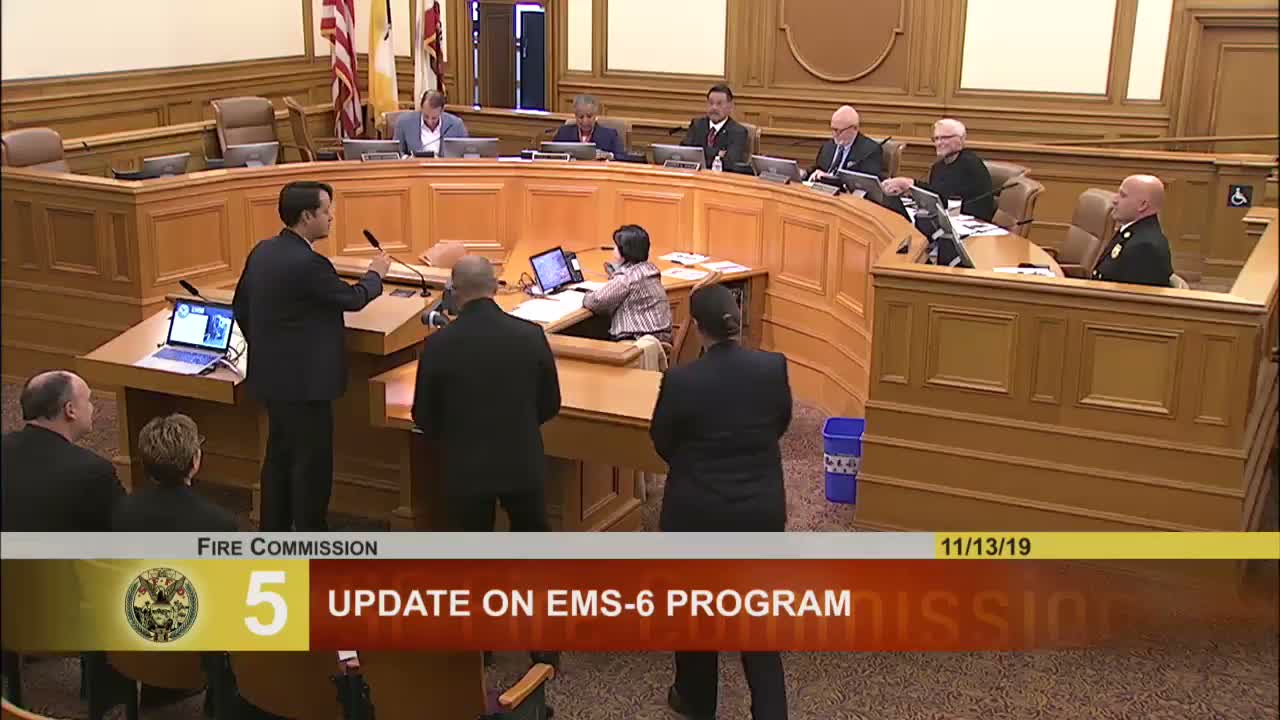
San Francisco’s EMS‑6 community paramedic team has helped reduce repeat 911 use among the city’s highest‑utilizing clients, department leaders told the Fire Commission on Nov. 13, while urging caution about expanding involuntary detention authority.
Dr. Clement Yeh, medical director for the Fire Department, said the program began in January 2016 as a multi‑agency pilot and focuses on "meeting people where they're at, figuring out where the gaps are, where the unmet needs are," and connecting them to housing, primary care, mental‑health services and other supports. He said EMS‑6 provides de‑identified data to the state EMS authority and OSHPD to support policy changes.
Section Chief Simon Pang presented case studies showing measurable declines in emergency use among managed clients. "On average, since our inception in 02/2016, we have affected a monthly decrease in utilization of 35.3%," he said, and reported that when EMS‑6 arrives on scene the team has produced a roughly 40% ER diversion rate.
Pang described operational goals and staffing: by March 2020 the team hopes to be "fully staffed at 7 EMS captains," operating roughly 6 a.m. to 2 a.m., seven days a week, and able to run up to four concurrent units at peak times. The department said existing funding backs the planned expansion.
Commissioners pressed the team on legal authority and patient rights after repeated calls. Commissioner Joe Alieto Veronese asked whether the commission could designate EMS‑6 captains to place 5150 (involuntary psychiatric) holds; he said such a change might be routed by resolution to the Board of Supervisors. Dr. Yeh and Chief Pang urged caution. "Paramedics are not authorized to place people on a 51 50 hold," Pang said, and both presenters stressed that involuntary detention is ethically and legally fraught and should be used as a last resort in collaboration with law enforcement and behavioral‑health professionals.
Pang and Sloan described the team’s multidisciplinary approach: EMS‑6 carries case management, psychiatric nurse practitioners and street‑medicine clinicians who ride with units to improve triage and to convene case conferences that create pre‑hospital action plans directing the appropriate resource for future activations.
The team also discussed possible funding from a federal ET3 Medicare pilot that could reimburse non‑transport care for Medicare beneficiaries. Dr. Yeh said the department has applied and expects an answer in the spring, but cautioned that ET3 would only cover a subset of the program’s clients and would not be a panacea for long‑term funding.
Commissioners and presenters also discussed the state housing conservatorship pilot authored by State Senator Scott Wiener and signed by former Governor Brown; Pang said the tool is narrowly targeted, has a multi‑step referral and judicial review process, and guarantees placement in permanent supportive housing at the end of conservatorship.
The commission requested ongoing EMS‑6 data and said it will consider coordination or policy steps if the department asks for expanded authority. The presentation included client testimony and multiple case studies described at length during the public session.