Get Full Government Meeting Transcripts, Videos, & Alerts Forever!
Get email alerts on the Administrative Bulletins topic
No spam. Unsubscribe anytime.
Fire Commission adopts updated 2019 administrative bulletins including new cannabis guidance
Summary
The San Francisco Fire Commission unanimously approved revised 2019 administrative bulletins that add guidance for cannabis cultivation/extraction, clarify residential sleeping-area alarm standards and address smoke-damper practices; one proposed bulletin on passive smoke-control methods was pulled for revision.
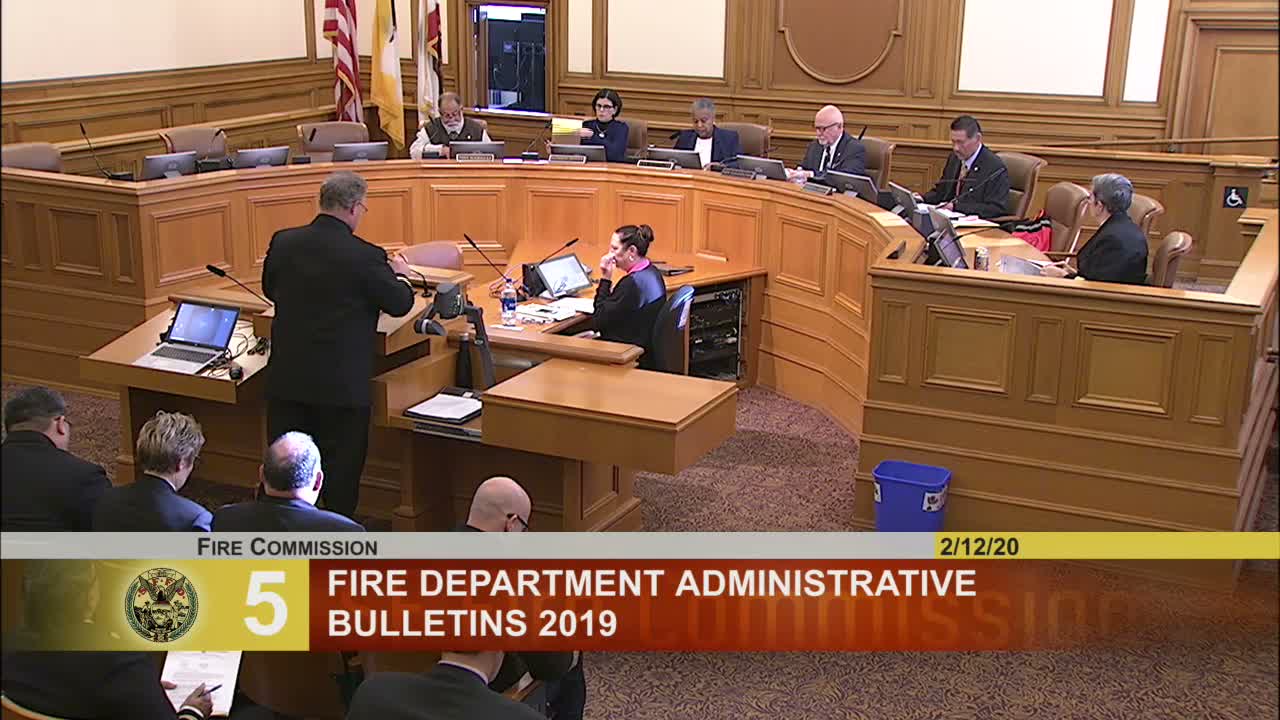
The San Francisco Fire Commission on Feb. 12 unanimously approved revised 2019 administrative bulletins that update the Bureau of Fire Prevention's interpretation of the fire code and add new guidance on several topics. Assistant Fire Marshal Rich Brown presented the package and the commission moved to adopt the documents after discussion.
The bulletins reflect the 2019 code cycle and include four new administrative bulletins now before the commission: AB 2.17 and AB 2.18, which provide permit and plan-submittal guidance for cannabis cultivation and extraction facilities; AB 3.08, which clarifies requirements for audible fire alarms in residential sleeping areas and references the department's "75-decibel pillow test" compliance timeline; and AB 5.14, which sets criteria relating to the removal or equivalencies for fire/smoke dampers where HVAC penetrations occur in fire-resistance-rated corridors. Brown said the ABs were posted for 30 days on Dec. 13, 2019 and that the draft was updated following a Jan. 28 public hearing.
Brown told commissioners the new cannabis guidance responds to "a volume of operations" in the city, with extraction and cultivation often housed in former industrial f-occupancy buildings, and noted the hazardous-materials issues those uses can create. He said the department estimated at least a dozen such facilities in operation, concentrated in the Bayview area.
Commissioners pressed for clarifications on several technical points. Commissioner Tony Rodriguez asked why AB 4.09 removing legacy hose cabinets was proposed; Brown explained that many older buildings are moving toward full sprinkler systems, making hallway hose cabinets obsolete. On flexible sprinkler heads (AB 4.27), Brown said the change signals that moving an existing flexible hose sprinkler in a ceiling generally requires a permit because those fixtures can be displaced. On fire service access elevators, Brown said a change in the International Building Code eliminated below-grade elevator lobbies: "we can't touch the building code in the normal fire code way," he said, and that the department had removed a sentence in the draft that would have required elevators to serve all floors after legal advice from the city attorney.
One bulletin, AB 5.15 addressing the use of passive methods for required smoke-control systems in high-rise buildings, was pulled from consideration after public comment. Brown said the department will continue work with concerned designers and stakeholders and return with revisions.
The motion to adopt the revised bulletins, with AB 5.15 withdrawn for further revision, carried unanimously.
The commission asked staff to ensure affected buildings are tracked so operational hazards can be logged in dispatch, and Brown said the department will continue outreach to designers and the public via its posted administrative bulletins.