Get Full Government Meeting Transcripts, Videos, & Alerts Forever!
Get email alerts on the Ems Operations topic
No spam. Unsubscribe anytime.
Fire Department outlines EMS strategy, seeks alternatives to hospital transports
Summary
Assistant Deputy Chief Sandra Tong presented a multi-part EMS strategy focused on alternative response models, community paramedicine and data-driven staffing to reduce ambulance wait times and hospital diversions. Commissioners pressed for diversion and 'frequent user' data and urged clearer partnership with the Department of Public Health.
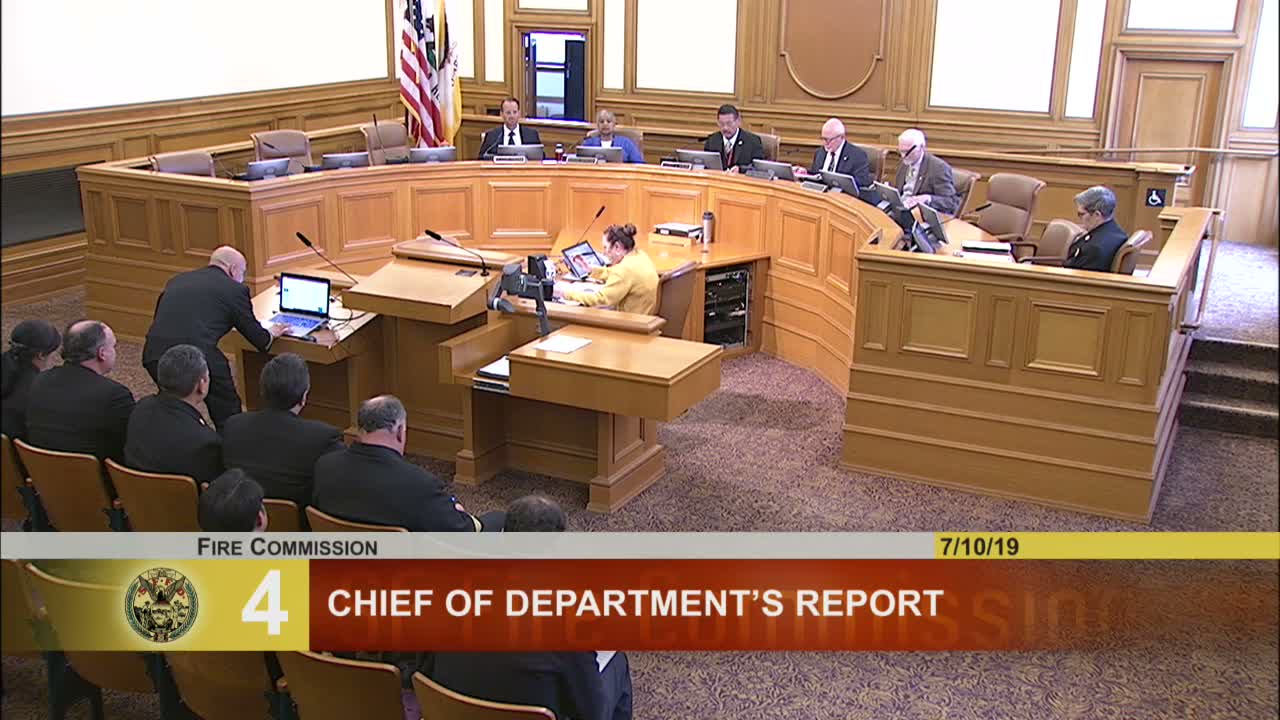
Assistant Deputy Chief Sandra Tong told the Fire Commission on July 10 that the San Francisco Fire Department is re-examining how it delivers pre-hospital care to reduce unnecessary hospital transports and strengthen surge capacity.
Tong said the EMS division is studying alternative response vehicles and staffing models, expanding hands-on training and clinical partnerships with hospitals, and developing a formal EMS strategic plan to prioritize staffing, funding requests and program implementation. She described pilots and programs—such as the QRVs (quick-response vehicles) and the EMS 6 outreach unit—that aim to divert low-acuity patients from emergency departments and to provide more patient-centered care in the field.
The presentation stressed community paramedicine and mobile integrated healthcare as mechanisms to lower repeated 9-1-1 use. Tong said community paramedics could work with hospitals and social-service providers to address underlying needs for frequent users and to conduct in-home follow-ups. She also described work groups addressing schedules, equipment and morale issues, especially at Station 49, and said the department obtained and permitted 15 new ambulances.
Commissioners sought specific data. Commissioner Ken Cleveland asked for a breakdown of “frequent flyers” and how many 9-1-1 calls they generate; Tong said staff would calculate and return with that figure. Commissioners noted an item in the packet that showed roughly 1,023 'frequent-user' cases in the reporting period and expressed concern that roughly 40 percent of calls are homeless-related—figures they said should be used to inform outreach and funding requests.
Dr. Clement Yeh, present in the chamber, described legal and statutory limits that have historically constrained diversion and community-paramedicine activities and noted that both statute changes and administrative re-interpretation at the state level are enabling broader pilots. He said San Francisco’s sobering center and EMS 6 have offered models the rest of the state is watching.
Tong also outlined technology and logistics the department is exploring, such as systems that show hospital capacity to crews in real time and checklists to help field crews in surge events. She said the new Station 49 facility should improve morale and operational capacity; the latest public schedule projection for Station 49 in the meeting packet was October 2020.
The commission asked the department to compile additional quantitative details—hospital diversion counts, the composition of paramedic versus EMT staffing, the dominant 9-1-1 call types, and the frequency and cost of repeated-user calls—for follow-up at a future meeting.
The department emphasized that expanding community paramedicine and alternative responses should be done in partnership with the Department of Public Health and other agencies and that some expansions may require state legislative or administrative change.