Get Full Government Meeting Transcripts, Videos, & Alerts Forever!
Get email alerts on the Station13 Development topic
No spam. Unsubscribe anytime.
City staff and Related outline plan to rebuild Station 13 at 530 Sansom, with off‑site affordable units funded by inclusionary fee
Summary
Real Estate staff recommended negotiating with a Related California‑led team to rebuild and relocate Fire Station 13 at 530 Sansom, pairing a replacement 4–5‑story station and 20‑story mixed‑use tower whose inclusionary fee revenue is estimated near $10 million to fund 50–70 affordable units at 772 Pacific. Commissioners pressed for contract guarantees, seismic and training access details, and clearer penalty provisions.
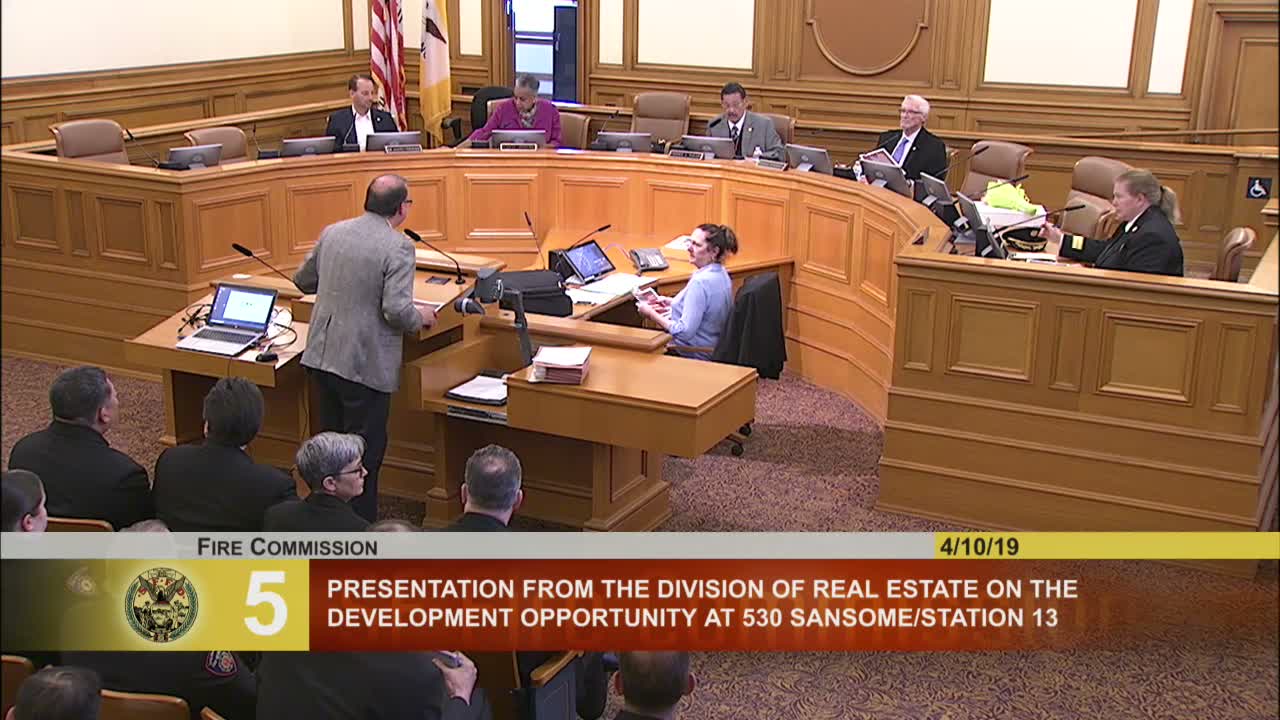
John Updike, senior project manager in the City’s Real Estate division, briefed the San Francisco Fire Commission on a proposal to replace and relocate Fire Station 13 at 530 Sansom as part of a Related California‑led mixed‑use development. Updike said the project grew out of the Public Lands for Housing initiative and a 2018 Board of Supervisors direction to solicit proposals for city‑owned sites.
"We received four proposals" by the March 1 deadline and "the first ranked bidder was far and away, by more than 20%" financially, Updike told commissioners, describing a package that pairs a new mid‑block fire station with a 20‑story hotel, fitness club and condominiums on the corner parcel. He said the station and shared garage would be designed to a Category 4 seismic standard and that the massing and program are still conceptual.
Why it matters: the developer team proposes using sale proceeds plus an inclusionary‑fee payment tied to the tower’s gross square footage to fund an off‑site affordable housing project at 772 Pacific (the New Asia site) that the Mayor’s Office of Housing preliminarily estimates could yield 50–70 units. Updike characterized the inclusionary fee figure as a modeled estimate: "The $10,000,000 figure I'm referencing ... we're rounding numbers here but that is based on the inclusionary fee schedule of the planning department." He cautioned the commissioners the number may fluctuate slightly during CEQA and final design.
Commissioners asked detailed operational questions. Assistant Deputy Chief Tony Rivera and Updike described programmatic elements intended for Station 13: space for turnout gear and apparatus, an on‑site workout area within the ~22,000 sq. ft. station program, rooftop access carved out specifically for fire training and two points of ingress/egress to preserve response times. Updike said the replacement station might be slightly smaller in gross square footage than the existing building due to modern design efficiencies but would "function much better."
Contentions and conditions: commissioners pressed for stronger contractual protections to ensure the city receives the projected funds even if construction costs rise. One commissioner asked whether the $10 million is guaranteed; Updike said the fee is formula‑driven and may vary: "As we go through CEQA, there might be slight adjustments ... I don't want to say to the penny what it is because I don't know, to be perfectly honest." Commissioners asked staff to explore contract language that would (a) keep the inclusionary proceeds dedicated to the housing site and (b) return delay or liquidated‑damages payments to the department if construction overruns harm operations or force extended relocations of crews.
Timing and delivery model: Updike said the City would negotiate a conditional exchange agreement with the developer, proceed through entitlement and CEQA (he estimated two years conservatively), and then return to the Board of Supervisors for ratification and permitting. He described the delivery as a private developer‑delivered project under a construction management agreement with contractual deadlines and penalties. Updike said the team believes construction could start in 2021 with station occupancy possible in late 2023 under an accelerated schedule; commissioners called for caution given local construction history.
Next steps: commissioners voiced conditional support but asked Real Estate and DPW for periodic design updates, traffic/response‑time analyses (SFMTA coordination), a clean draft of the conditional exchange for commission review prior to Board submission, and legal review of whether contract penalties or surplus funds could be directed to the Fire Department. Updike and the Related representative said they would provide materials and printouts and continue coordination with fire command staff.
Reporting note: Updike emphasized the recommendation is to move to negotiation and that final decisions require Board of Supervisors action and CEQA clearance.
Sources: Presentation and Q&A with John Updike (Real Estate) and representatives of Related California; Assistant Deputy Chief Tony Rivera; Chief Joanne Hayes White, as recorded in the commission meeting transcript.