Get Full Government Meeting Transcripts, Videos, & Alerts Forever!
Get email alerts on the Municipal Budget topic
No spam. Unsubscribe anytime.
Fire Commission endorses department—s budget priorities, declines to submit requested target reductions
Summary
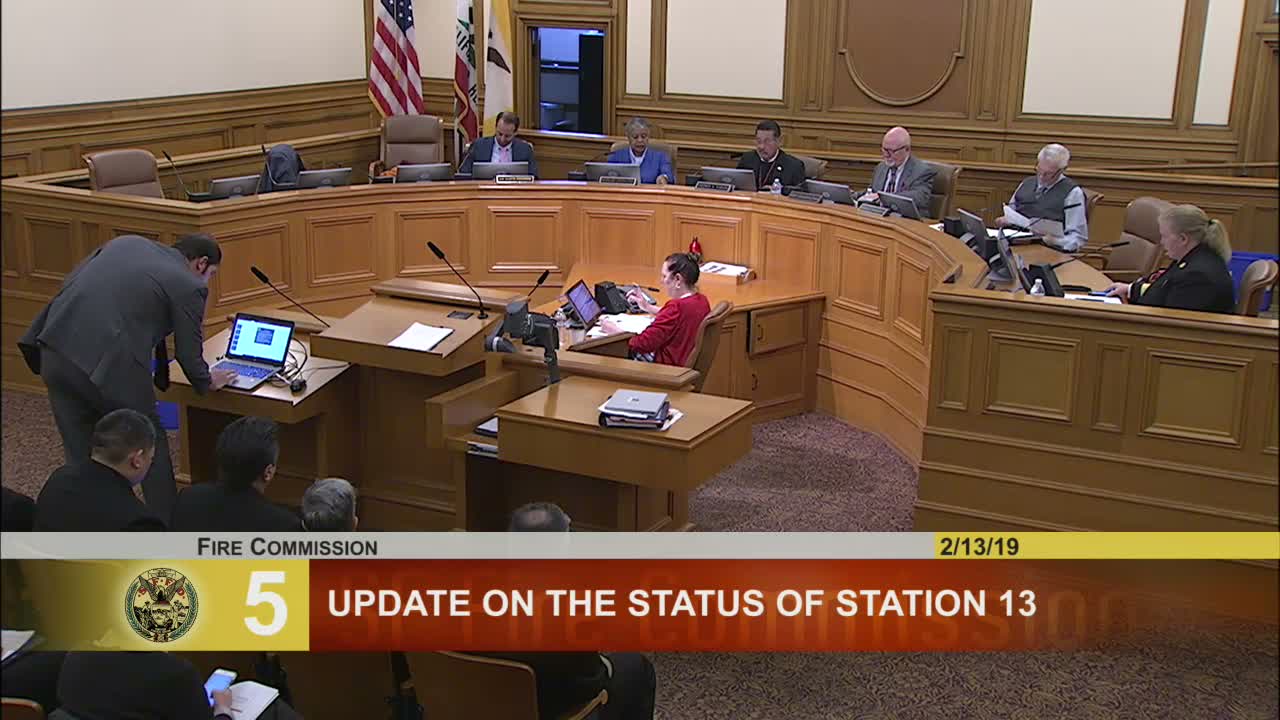
Commissioners voted unanimously Feb. 13 to endorse the San Francisco Fire Department—s draft operating budget position: the department will not submit the mayor—s requested 2% target reductions and instead prioritize EMS staffing, restoration of incident support specialists and equipment/fleet replacement.
The Fire Commission on Feb. 13 unanimously adopted a motion endorsing the San Francisco Fire Department—s recommendation not to submit the citywide 2% target reductions requested under the mayor—s budget instructions. Mark Corso, the department—s finance and planning director, presented the draft operating budget for FY2019–21 and said departments were asked to propose 2% reductions per year plus a 1% contingency in each year to address a projected city structural shortfall.
Corso told commissioners that the department—s budget is largely dedicated to frontline emergency operations and that consensus from internal Budget Committee discussions was that requested reductions would harm service delivery. He identified three top priorities the department seeks to protect in budget negotiations with the mayor—s office and Board of Supervisors: restoring EMS staffing (ambulance and EMS units), restoring incident support specialists (an estimated 7 daily positions requiring roughly 26 personnel and an estimated $6.5 million total cost to restore daily coverage), and funding fleet and disaster‑response equipment (engines, trucks, ambulances, AWSS/PWSS items and other mission‑critical gear).
Corso also provided an EMS billing analysis for FY2018: about 70,000 accounts with ~66,000 transports; total ambulance charges around $143.6 million; statutory adjustments (primarily Medicare and Medi‑Cal contractual reimbursements) of roughly $75 million; write‑offs ~ $24 million for bad debt; payments received roughly $26 million; and open accounts roughly $17 million still in collections. Corso explained that Medicare and Medi‑Cal reimbursement rules leave limited flexibility—for example, a hypothetical $2,000 ambulance charge might generate a Medicare reimbursement of about $450 or a Medi‑Cal reimbursement of about $125—so the department faces structural reimbursement shortfalls.
Commissioners asked detailed questions about fee increases (Corso said proposed fire prevention fee increases would be about 4%), recruiting and academy cadence (one H2 and one H3 class per year in the draft), anticipated retirements (Corso estimated roughly 50–60 separations over the coming period), and potential supplemental reimbursement opportunities such as GEMT (Ground Emergency Medical Transport), which generated roughly $2 million last year under existing program rules. Commissioners also discussed creative revenue options—such as hospital drop‑off fees for delayed ambulance turnover and shared funding for homeless‑related EMS demands—and asked staff to pursue options with the mayor—s office and other city departments.
Vice President Francie Covington moved that the commission adopt the department—s budget position (not to submit the target reductions and to prioritize EMS staffing, incident support specialists and equipment); Commissioner Ken Cleveland seconded the motion. The commission voted "aye" with no opposed votes and the motion carried.
The motion included a direction for continued collaboration with the mayor—s office and Board of Supervisors as the mayor prepares a budget proposal, and commissioners asked staff to return with further details on staffing projections, restoration costs and collections outcomes as the budget process advances.