Get Full Government Meeting Transcripts, Videos, & Alerts Forever!
Get email alerts on the Airport Operations topic
No spam. Unsubscribe anytime.
Fire Department outlines airport rescue capabilities, plans to expand bike medics
Summary
Assistant Deputy Chief Kai Ali told the Fire Commission that San Francisco International Airport operates four ARFF vehicles (exceeding FAA Index E requirements), maintains a Marine Emergency Response Facility and recently launched a bike-medic pilot; the department plans to add two bike medics and is installing runway hydrants to speed apparatus refills.
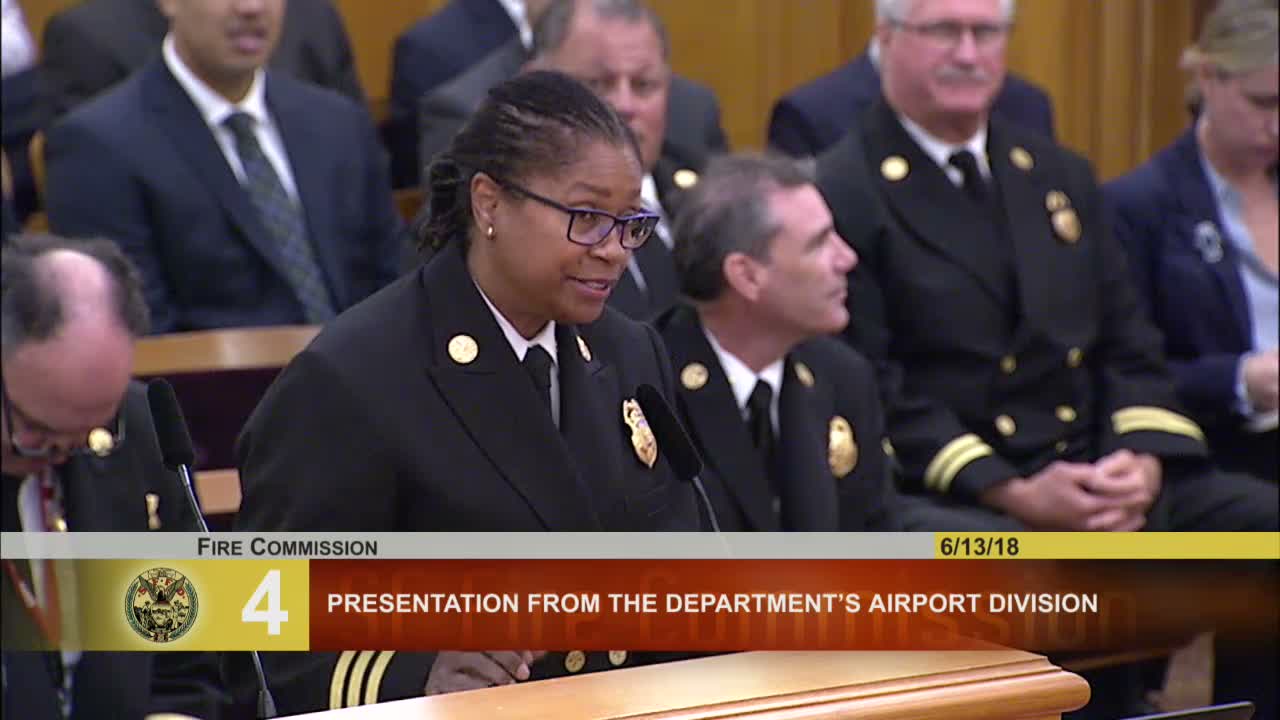
Assistant Deputy Chief Kai Ali told the Fire Commission on Wednesday that the department’s Airport Division operates above minimum federal rescue standards and is preparing to expand on recent safety gains.
“The San Francisco International Airport began in 1927 as Mills Field … Index E requires that we have 3 ARFF vehicles, and San Francisco Airport currently has 4 ARFF vehicles—exceeding the FAA requirement,” Ali said, describing the airport’s Oshkosh Stryker apparatus and other rescue assets.
Ali said the ARFF vehicles at the airport can discharge large volumes of extinguishing agents—he described 4,500-gallon Oshkosh Strykers and auxiliary systems for foam and dry chemical—and noted the department also staffs type-3 structure engines, aerial platform trucks and mass-casualty units. He said the airport maintains a 767 training aircraft for realistic exercises and requires a 40-hour ARFF course plus an annual live-burn for airport rescue firefighters.
On marine response, Ali detailed the department’s Marine Emergency Response Facility (MRF), which includes a Moose Boat Rescue 55, a Boston Whaler (the Vigilant), two jet skis and smaller craft such as an airboat and a zodiac. She said the primary boat operator is staged at Station 2 (the airport crash house) and that mutual-aid partners are available when needed.
Ali also summarized recent program additions at the airfield. The department launched a bike‑medic pilot in April; Ali said the two bike medics handled 145 calls in April and 169 in May. “Currently we have 1 bike medic daily … we have in the budget for next year additional bike medics,” Ali said, adding the department is seeking two additional bike medics to extend coverage.
Commissioners asked about staffing limits for marine craft and jet skis, and Ali said recruitment and water‑recertification courses are under way because some previously trained personnel have retired or transferred. On runway infrastructure, she said the airport is installing an underground hydrant system to reduce the time apparatus spend returning to stations to refill, a change prompted in part by lessons learned from prior incidents.
Several commissioners praised the airport’s material support for the department and asked for the presentation in print. Assistant Deputy Chief Ali said she would supply the report and supporting graphics to the commission for the next packet.
The airport briefing concluded with no public comment; the Commission moved on to budget and other items.