Get Full Government Meeting Transcripts, Videos, & Alerts Forever!
Get email alerts on the Alert Warning System topic
No spam. Unsubscribe anytime.
San Francisco reviews AlertSF, sirens and WEA after recent gas leak and tsunami watch
Summary
The Department of Emergency Management briefed the Fire Commission on AlertSF (opt-in, ~90,000 users), the outdoor siren network (about 120 units), and use of wireless emergency alerts; staff defended their choices during a Jan. 23 tsunami watch and said they've applied for a $2.5M FEMA mitigation grant to expand earthquake early-warning capabilities.
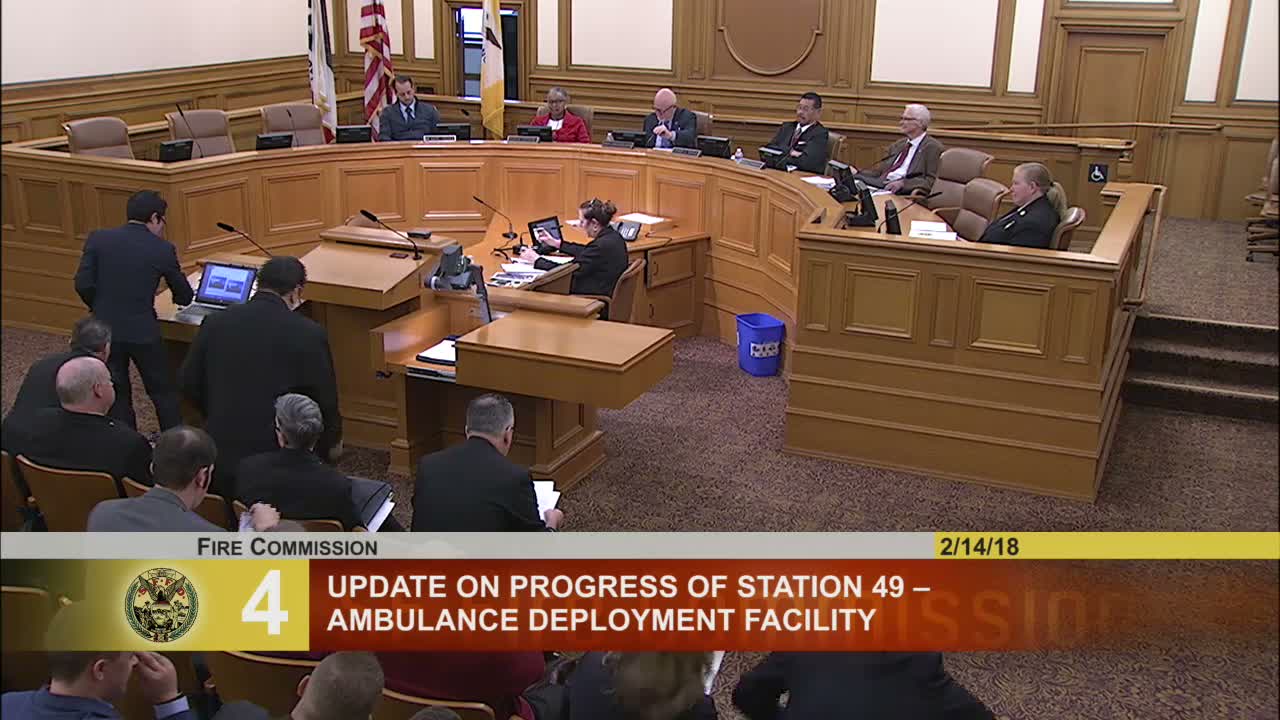
The San Francisco Department of Emergency Management (DEM) told the Fire Commission on Feb. 14 that the city operates multiple alert-and-warning systems and is working to sharpen messaging after recent incidents.
"Our primary one is AlertSF," Deputy Director Mike Dayton said. "The biggest thing I think to know about AlertSF is it's completely opt in." Dayton said AlertSF reaches roughly 90,000 users in the city and is used by duty officers and incident commanders to send geographically targeted messages.
DEM explained the difference between opt-in channels and the federal Integrated Public Alert and Warning System. "Wireless emergency alerts ... we would actually target an area of the city and say, regardless if you've registered or not, we're gonna pull the trigger and we're gonna alert you via your cell phone," Dayton said. The department also operates about 120 outdoor sirens and maintains social-media and Nextdoor presences.
Dayton reviewed three recent incidents to illustrate choices the department makes: a Feb. 6 high-pressure gas leak that prompted evacuation of about 10 buildings and rapid coordination with Salvation Army and the American Red Cross; a Jan. 23 Alaska earthquake that briefly put California under a tsunami watch and triggered city alerts that were later canceled when sensors showed no inundation risk; and a local magnitude-4.4 East Bay quake on Jan. 4 that highlighted a need for embedded early-warning systems at critical sites.
Commissioners and staff focused on message clarity during the tsunami watch. Commissioner Veronese said the initial AlertSF text left recipients unsure what to do and asked whether follow-up cancelation messages were sent. Dayton and DEM duty officers said pre-crafted, instructional text exists for imminent threats and that follow-up messages and multi-channel outreach (sirens, WEA, field units) are used for an imminent evacuation; DEM said it would investigate why some recipients reported not receiving follow-ups.
Dayton said DEM has applied for a $2,500,000 Hazard Mitigation Grant to pilot technology that would automatically open fire-station doors after a large earthquake and enable school drop/cover actions. "One of the things we're hoping to do is we've applied for a $2,500,000 hazardous mitigation grant program and that would ... allow the fire department ... to open up the fire department doors as soon as you have a severe enough magnitude earthquake," he said.
Officials emphasized the role of preparedness and public education. "AlertSF is completely opt in," Dayton said. "So this relies upon our preparedness campaign, SF72, to encourage people to sign up."