Get Full Government Meeting Transcripts, Videos, & Alerts Forever!
Get email alerts on the Occupational Health Safety topic
No spam. Unsubscribe anytime.
New safety director outlines plan to reduce firefighter injuries, bring tanks and training into compliance
Summary
Anthony Boone, the San Francisco Fire Department—s director of occupational environmental health and safety, told commissioners he will focus on Cal/OSHA compliance, training, respiratory protection and tracking injury data, and said he brought the department—s underground fuel tanks into compliance with state reporting systems.
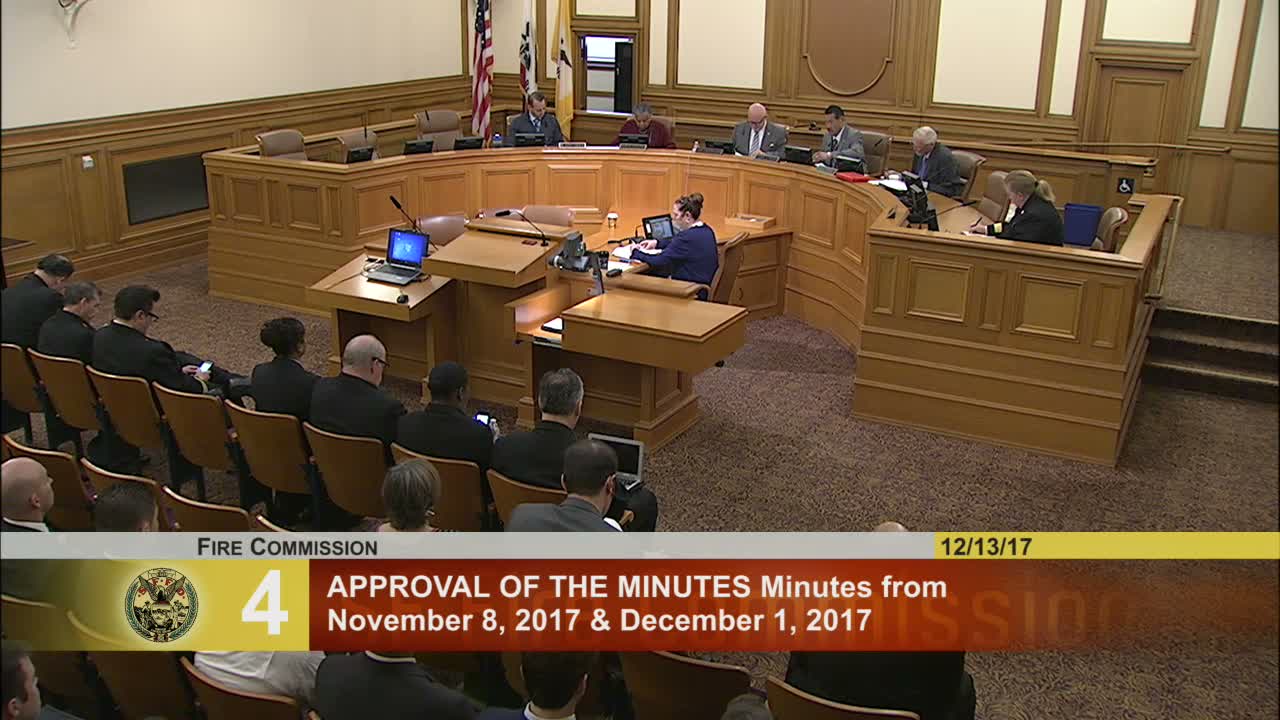
Anthony Boone, the San Francisco Fire Department—s new director of occupational environmental health and safety, told the Fire Commission on Dec. 13 that his first six months on the job have focused on bringing department environmental programs into regulatory compliance and building a "culture of safety." Boone said he has already brought the department's underground fuel storage tanks into compliance with state reporting and that his priorities for 2018 include policy reviews, enhanced training and improved respiratory protection.
"Safety is a 24/7 job," Boone said in his opening remarks, adding that his role is to "anticipate, recognize, evaluate and control workplace hazards." Boone said his early metrics will rely on Cal/OSHA injury logs and OSHA-recordable injury rates and that he is compiling the data to run Pareto analyses to identify the most frequent causes of injury.
Commissioners immediately pressed him on two topics that have drawn attention nationally: cancer among firefighters and stress/PTSD. Boone said he has reviewed external studies on firefighter cancer and will bring his findings to the department—s health and safety committee, which he said already works with the San Francisco Firefighters Cancer Foundation. "I don't have that information in my hands" regarding department-specific cancer rates, he said, and deferred requests for internal and retiree statistics to the committee chair and the department physician.
Boone also described his inspection and follow-up process for station safety issues, explaining he conducts inspections, documents findings, makes recommendations up the chain of command and follows up by phone or re-inspection if needed. He told commissioners that the EPA and state reporting system (CERS) require monitoring and response plans for underground storage tanks exceeding certain capacities, and that the department has roughly 16 stations with such tanks.
Vice President Steven Acasio and other commissioners asked Boone to provide written training materials and a short description of the station-level training he brings to crews; Boone said his immediate training focus is on ergonomics, hazard communication and respiratory protection, plus injury and illness prevention. Several commissioners suggested returning with a fuller presentation once training materials and metrics are in place.
Boone, who described prior work at Laguna Honda Hospital, Materion Corporation and United Airlines, said his overarching goal is to make an "inherently dangerous job" safer by improving policies and practical measures within the firehouses and across department operations. He invited further questions and promised to provide the commission with additional detail as his assessments progress.