Get Full Government Meeting Transcripts, Videos, & Alerts Forever!
Get email alerts on the North Bay Wildfires topic
No spam. Unsubscribe anytime.
SFFD deploys engines, ambulances and strike teams to North Bay fires; commissioners press for early-warning review
Summary
The San Francisco Fire Department reported multiple strike-team and ambulance deployments to the North Bay wildfires, with roughly 48 SFFD members deployed and at least 11 engines attached to mutual-aid efforts. Commissioners asked for a report on early-warning systems and resource-readiness.
The San Francisco Fire Department told the Fire Commission on Oct. 11 that it had sent significant mutual-aid resources to the North Bay wildfires while keeping minimum staffing in the city.
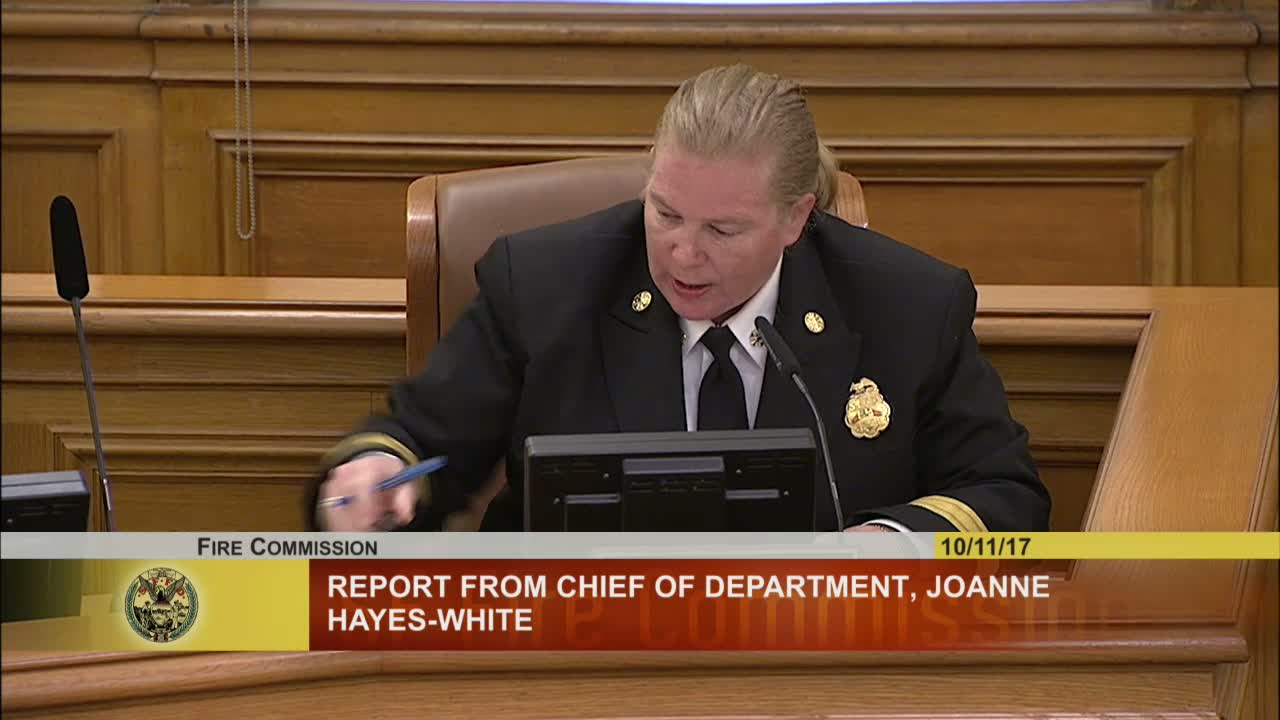
Chief of Department Joanne Hayes White said the department had about 48 members deployed to the North Bay and that "we run 44 engines here per day. We have 11 engines up in the North Bay," describing strike-team and ambulance support the city provided. She also noted the department expected delivery of eight new fire engines later in the fiscal year.
Deputy Chief Gonzales, in an operations update, described the scale and urgency of the fires and provided preliminary incident tallies reported to the department: "The latest I'm getting 2,000 structures now, 17 unfortunately deceased and over 200 people missing," he said. Gonzales detailed strike-team assignments and rotation plans and said SFFD crews performed structure protection and evacuations under fast-moving, high-wind conditions.
Tom Fogel of San Francisco Firefighters Local 798 told commissioners the union had canvassed members in evacuated areas and identified members who lost homes, and he urged firefighters experiencing losses to use the IAFF relief fund the union had established.
Chief Zanoff, who led ambulance operations, described the strike-team ambulance deployment: three ambulances were sent to assist evacuations at Sutter Santa Rosa and a convalescent facility and subsequently dispersed patients to receiving hospitals in Vacaville and Vallejo. The department prepared a mass-casualty bus with Muni support and offered it to Region 2; "Santa Rosa didn't ask for it," Zanoff said, and the resource was stood down after Region 2 declined immediate use.
Commissioners pressed for clearer public-notification tools. Commissioner Joe Alioto Veronese told the commission that some residents in affected areas reported receiving little or no warning before fire impacts and asked the department to present options for early-warning systems. Veronese said in part that "the only way [my mother] knew about it was because she went outside to check on her horses and found herself surrounded by fire," underscoring the request for a formal briefing on alerting technologies and outreach strategies.
The commission agreed to add an item on early-warning systems to a future agenda and also requested follow-up briefings on drone policy and the department's training-facility plans. Commissioners and department leaders repeatedly emphasized balancing mutual-aid commitments with the need to keep San Francisco staffed at required minimums.
The meeting record shows commissioners thanked department personnel for rapid deployments and coordination, and the commission remained engaged in oversight while the incident evolved.