Get Full Government Meeting Transcripts, Videos, & Alerts Forever!
Get email alerts on the Ems And Operations topic
No spam. Unsubscribe anytime.
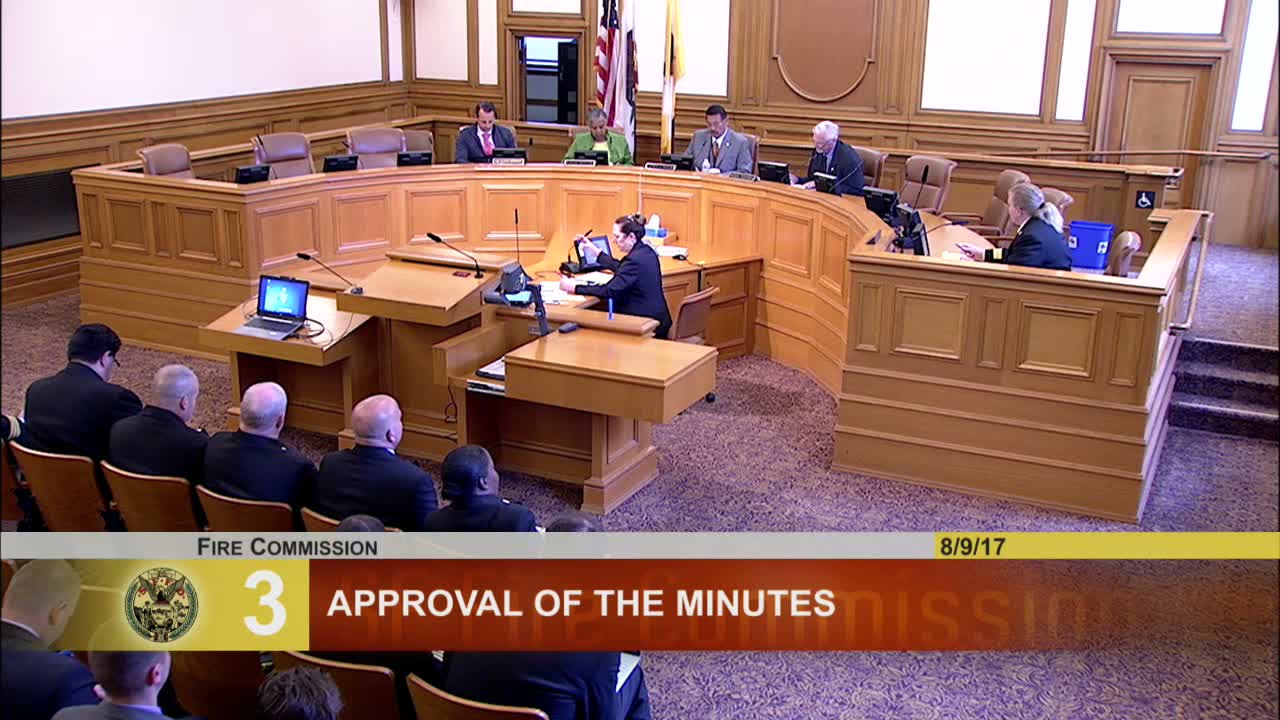
Fire commission hears operations report and debates role of EMS 6 for frequent 911 callers
Summary
The San Francisco Fire Commission reviewed an operations report that detailed training, incident response and EMS metrics; commissioners questioned EMS 6'a team focused on repeated 911 callers'about whether the unit's preventive work falls within the fire department's core mission.
The San Francisco Fire Commission on Aug. 9 received an operations report from Chief Joanne Hayes White and deputy staff that highlighted academy classes, recent incidents and metrics for ambulance and outreach teams, and prompted detailed questioning about EMS 6'a unit that seeks to reduce repeat 911 calls by linking frequent callers to services.
Chief Joanne Hayes White opened the report and asked Deputy Chief Ramona Williams to present operations on behalf of Deputy Chief Mark Gonzales. Williams said the department had just closed fiscal year 2016'17 and is beginning purchases under the 2017'18 budget for fleet and equipment. "Our 122nd class is in their 16th week and we look forward to graduating 43 members next month, Sept. 8 at our Treasure Island Training Facility," Williams said. She added the 123rd class will welcome 54 members, with 42 scheduled to start Sept. 25 and 12 joining two weeks later.
The operations portion listed two "greater alarm" responses: a July 7 wildland fire at McLaren Park that burned about 23 acres with no structures affected, and a July 14 second'alarm fire at 1831 Polk Street that involved heavy attic fire but no contents loss. Williams also summarized mutual'aid deployments and rescues, including bay rescues and a July 31 barricaded'subject incident at 15th and Beaver in which the department assisted.
Assistant Deputy Chief Andy Zanoff (AMS Division) presented emergency medical services statistics. He reported EMS 6 recorded 222 encounters during the reporting period, "about 7.4 encounters per shift," and said the unit focuses on contacting and connecting people who repeatedly call 911 to health and social services. Zanoff said staff track individuals and cited cases where intervening services reduced repeat calls: "There was one person who called 26 times in the month of June. Through the efforts of EMS 6 and the Department of Public Health that person called 0 times in the month of July." The report also listed 241 permits issued (May 2017) and gave response'time metrics, with an average reported response time of 8.58 minutes and a high percentage of on'scene arrivals under 10 minutes.
Commissioners pressed for clarity about EMS 6's scope and measurement. Commissioner Joe Alioto Veronese asked whether "encounters" means the same 86 individuals are being seen repeatedly and whether the city is essentially funding non'emergency health care. "When you dial 911, we're going to show up if it's a health related issue; that's always going to happen," Veronese said, but he asked where the line should be drawn when other agencies might be better placed to prevent nonacute problems.
Dr. Yeh, identified in the report as someone who administratively oversees EMS 6, responded that preventing emergencies is part of the broader safety'net: "Although we are a service that responds to all citizens for emergency needs, many people depend on us as a safety net. One of our big goals is to connect them with services so they can improve their health and don't require emergency services as often." He offered to provide additional detail to commissioners offline and to arrange follow'up briefings.
Other commissioners agreed to pursue ride'alongs to observe EMS 6 operations and requested more granular tracking data about who is proactively contacted by EMS 6 versus who is referred by other units. Commissioner Michael Hardiman and Commissioner Francie Covington both praised the report's organization and asked for continued updates.
The department also outlined internal policy work: evaluating oxygen'delivery devices to reduce the need for intubation, improving inventory control for medical supplies and ongoing facility planning for ambulance deployment. Assistant Deputy Chief Tony Rivera told the commission that the central shops relocation is underway and that the ladder shop will be incorporated into a new facility; staff acknowledged some initial "hiccups" are likely during the move.
The commission asked for the department strategic plan to be distributed to stakeholders by the end of the month with a mechanism for submitting written feedback through the chain of command, and several commissioners signaled interest in deeper briefings on EMS 6 outcomes and metrics.
The commission will review those follow'ups in subsequent meetings; Williams also invited commissioners to the Sept. 8 Treasure Island graduation for the academy class.