Get Full Government Meeting Transcripts, Videos, & Alerts Forever!
Get email alerts on the Wildfire Response topic
No spam. Unsubscribe anytime.
San Francisco Fire Department says strike teams deployed to California wildfires have mostly returned
Summary
The San Francisco Fire Department told the Fire Commission that strike teams sent to Butte County and Southern California returned safely and that about 200 city firefighters hold wildfire qualifications; commissioners pressed staff on equipment readiness and contingency staffing.
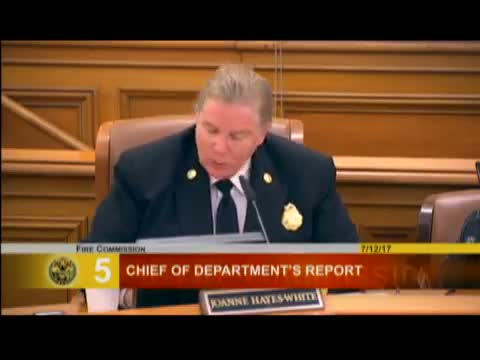
The San Francisco Fire Department reported to the Fire Commission on July 12 that strike teams it deployed to recent California wildfires have largely returned and that the department maintains contingency plans for the remainder of the summer fire season.
Chief Joanne Hayes White said the department deployed a strike team led by Captain Pablo Seguenza with Assistant Battalion Chief Brooke Baker and 20 members (five engines) to the Butte County area and also sent a state‑quartered rig from Station 43 with four engines to Southern California’s Alamo Fire. "I'm glad that 22 of our 26 members have returned home safely," Hayes White said.
The report said the rigs deployed included apparatus the department purchased used from the state; those engines are described internally as mid‑1990s vintage but are routinely maintained. Commissioners asked whether soft equipment (hoses and other consumables) was depleted when strike teams deploy. The chief replied that the department’s Bureau of Equipment and Support Services and Division III monitor readiness and that the deployed apparatus were fully stocked and ready to roll.
Deputy Chief Mark Gonzales told commissioners the department fields roughly 200 personnel trained for wildland deployments, with about 200 having completed annual wildland certification training required for mutual‑aid assignments. Gonzales described staffing lists prepared daily during wildland season to identify available, certified personnel for deployment.
Commissioners pressed for contingency planning for peaks in wildfire activity. The chief reiterated the department’s duty to balance mutual‑aid support with maintaining adequate local coverage under the state master mutual aid agreement: "It's always a judgment call," she said, noting the department must retain resources for San Francisco while assisting other jurisdictions.
The commission’s discussion also touched on operational lessons: the department credited rapid mobilization (teams deployed within hours of a call), mutual‑aid coordination, and training for strike team leaders as key factors in successful deployments. No formal policy changes or additional authorizations were announced at the meeting; commissioners requested continued briefings on readiness and equipment inventories as the dry season progresses.