Get Full Government Meeting Transcripts, Videos, & Alerts Forever!
Get email alerts on the 911 Dispatch topic
No spam. Unsubscribe anytime.
San Francisco officials outline staffing, technology push to speed 911 response
Summary
City officials told the Fire Commission on May 24 that 911 call volume has risen roughly 36% in recent years and that a mix of hires, training changes and new dispatch technology should restore targeted service levels by late 2018 or earlier.
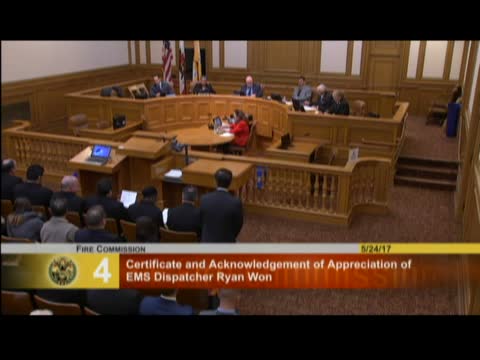
San Francisco officials told the Fire Commission on May 24 that a sustained rise in 911 calls and an unusual spike in staff separations have driven down call-answer performance and forced heavy reliance on overtime, and outlined a plan using additional hires, revised training and new computer-aided dispatch tools to restore service standards.
Rob Smuts, deputy director at the Department of Emergency Management, said the center has seen a roughly 362037 percent increase in overall call volume over the last five to six years, from about 2,400252,500 calls per day to roughly 3,400233,600. He said slightly more than half of those calls are true 911 emergencies and the rest are nonemergency police or service calls.
"We have seen about a 36, 37 percent increase in call volume in the last five or six years," Smuts said during a presentation to the commission. He added that the center also experienced a spike in separations, noting 17 non-probationary departures last year versus an expected 7 to 8.
Smuts described the center27s two primary service benchmarks: answering 90% of emergency calls within 10 seconds (a police-origin standard) and answering 95% of emergency calls within 15 seconds (an NFPA standard). Recent measurements placed the center near 752580% for the 10-second benchmark, with an average answer delay in recent weeks of roughly eight seconds and a worst-month average close to 11 seconds.
To address the gap, Smuts said the administration secured funding last year for 40 dispatcher hires and plans to request roughly 45 hires in the current budget cycle. He detailed a training pipeline that takes about a year from classroom start to fully qualified dispatcher (seven weeks of classroom training, followed by multi-month phone and radio training and one-on-one time with certified trainers), and warned of lag time between hiring and operational benefit.
"We already have hired the staff that will get us back to standard," Smuts said, "We already have them in the building. We already are training them. It's a question of how long that training will take and what we do in the meantime."
Smuts also described workforce retention challenges: roughly one-third of recruits do not finish training, most washouts are due to attendance or failure to meet phone or radio training standards, and some candidates withdraw because they find the job27s intensity greater than expected. To reduce burnout among incumbents he said he has negotiated scheduling flexibilities with the union (Local 1021), increased opportunities to trade shifts, and pursued other wellness measures.
On the technology side, Smuts said the department is rolling out improvements to its computer-aided dispatch (CAD) system, moving toward automatic vehicle location (AVL)/GPS-informed recommendations and a system that lists the closest ambulances and travel-time-informed routing. He said the new tool will show the six closest ambulances for any incident and will help with both dispatch decisions and post-dispatch repositioning.
Smuts said some of those technology upgrades will be implemented in the coming weeks and that wider modernizations (including the state-led NextGen 911 migration and text-to-911 capability) will arrive as infrastructure and interoperability allow. He told the commission the combination of hires, training cadence and technical upgrades should restore service levels and allow overtime spending to fall to sustainable levels by around the end of 2018.
Commissioners pressed Smuts on abandoned calls, non-emergency traffic and public education. Smuts said dispatchers call back every abandoned 911 and that many abandoned calls are accidental dials; he and commissioners discussed publicizing the city27s non-emergency number (415-553-0123) and using 311 for certain nonurgent police reports to reduce pressure on 911 lines.
The commission did not vote on policy changes at the meeting; Smuts asked the commission to support continued budgetary authority to hire dispatchers and to help publicize non-emergency alternatives while technical upgrades and training pipelines mature.