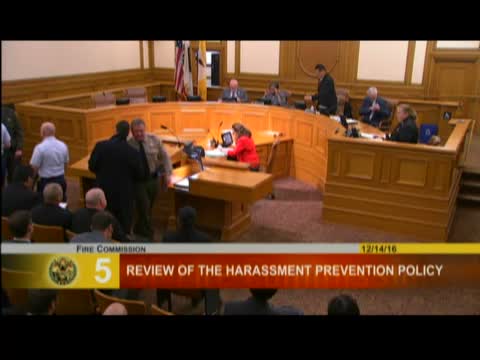
Fire Commission reviews harassment-prevention training, considers annual and implicit-bias modules
Loading...
Summary
The San Francisco Fire Commission heard a detailed briefing on the department's harassment-prevention policy and training requirements tied to state Assembly Bill 1825 and discussed expanding training department-wide and adding implicit-bias material.
Heizuso Bouchong, who oversees the department's human-resources training, told the Fire Commission on Dec. 14 that the department's EEO and harassment policies trace to a series of general orders and local rules and are aligned with state law under Assembly Bill 1825 (2007), which requires supervisors to take harassment-prevention training. Bouchong said the department has updated its general order (General Order 15A43) and, for 2016, required the entire force of more than 1,600 uniformed and civilian members to complete the same online module used for supervisors, with certificates collected by HR.
Commissioners asked whether rank-and-file members and all officers should take the supervisor-level training more frequently. Commissioner Nakaju pressed for clarity on officer responsibilities and whether all members should take the module; Bouchong said newly promoted lieutenants and battalion chiefs receive additional officer-focused modules and that for 2016 the department extended the supervisor module to its entire workforce to increase awareness. "We are requiring the whole department, both uniformed and civilian," Bouchong said.
The presentation distinguished the two legal theories of harassment: quid pro quo (between supervisor and subordinate) and hostile work environment, and Bouchong explained reporting and investigative procedures. She said employees are encouraged to report directly to Human Resources rather than follow the chain of command if that is uncomfortable; HR then determines whether DHR will open a formal investigation and notifies the chief's office when interviews or implementation steps are needed.
Several commissioners urged adding implicit-bias training. Chief Joanne Hayes White and Bouchong said the department has explored an eight-hour implicit-bias pilot and seeks to work with the city's Department of Human Resources to include implicit-bias material in future modules. "We will keep DHR posted," Chief Hayes White said, adding she supports an annual requirement if scheduling and vendor licensing allow. Commissioners asked for an action item to return to the commission with a timeline and potential general-order language to make annual or refreshed training standard.
Next steps: the commission supported agendizing harassment-training requirements as an action item at a future meeting and asked staff to consult with DHR about vendor licensing and the possible inclusion of implicit-bias content.