Get Full Government Meeting Transcripts, Videos, & Alerts Forever!
Get email alerts on the Mutual Aid topic
No spam. Unsubscribe anytime.
SFFD mutual-aid brief: department has trained personnel but needs more rigs and equipment
Summary
A department briefing outlined recent strike-team deployments, the mutual-aid framework and training requirements, and identified fleet and equipment gaps -- including a desire for more state rigs and caches of SCBAs and ladders.
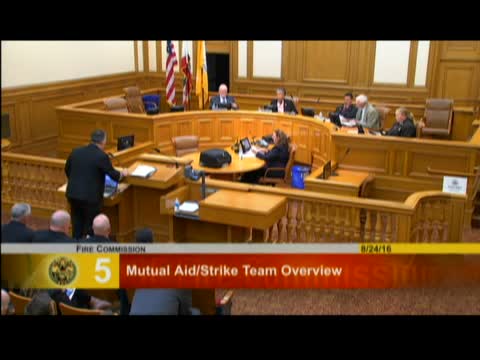
Chief Gonzales told the Fire Commission that San Francisco continues to meet mutual-aid obligations but faces limits in fleet capacity even as it fields trained personnel. "We have 158 personnel that are trained to go out," Gonzales said during a slide-driven overview of strike-team organization and recent deployments.
The presentation explained the California Master Mutual Aid Agreement and FireScope origins and described a typical strike team as five engines with a strike-team leader and assistant. Gonzales said SFFD currently has three qualified strike-team leaders and a fourth nearing qualification, and that recent deployments included teams responding to wildland-urban interface fires east of Bakersfield.
Commissioners focused questions on authority and capacity: who can deploy strike teams other than the chief, whether strike teams assist with non-fire disasters and how the mutual-aid obligations interact with local staffing commitments. Gonzales said the department follows the general orders governing mutual aid and that, in immediate-need calls within the Bay Area, predesignated engines are dispatched automatically.
Panel members repeatedly returned to fleet shortages. Gonzales and other staff explained that the department purchased five surplus "yellow" state rigs years earlier at reduced cost and that while SFFD has the personnel to form more strike teams, it lacks additional rigs to send. "We have the personnel. The challenge right now is the fleet," Gonzales said. Commissioners asked staff to pursue additional state rigs and for the chief to continue negotiations with state coordinators.
On equipment, the department said it is procuring caches so empty engines can be outfitted for deployments and planning purchases of fiberglass ladders, pyrolyte components and additional SCBAs. Staff said they will present a more detailed equipment and budget plan by January.
Next steps: commissioners asked for documentation on the mutual-aid regions, clarification of command roles for incident management teams, and a follow-up plan on fleet and equipment acquisition.