Get Full Government Meeting Transcripts, Videos, & Alerts Forever!
Get email alerts on the Fire Code Legislation topic
No spam. Unsubscribe anytime.
Fire Department flags staffing, IT needs after presentation on Campos fire-code proposal
Summary
Fire Marshal Dan DeCocio told the Fire Commission the Supervisor Campos proposal would require annual tenant notices about smoke alarms, biennial fire-alarm compliance filings and a 2021 sound-level upgrade deadline; the department said it lacks a complete building alarm inventory and requested funding for additional inspectors, IT and a database before implementation.
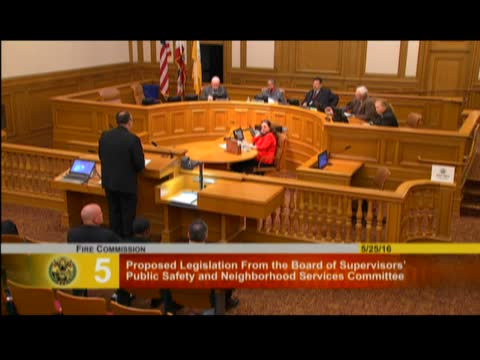
Fire Marshal Dan DeCocio told the San Francisco Fire Commission on May 25 that proposed amendments introduced by Supervisor David Campos would alter three parts of the fire code: smoke-alarm notices to tenants, biennial filing of fire-alarm maintenance test results, and an upgrade deadline for existing building fire-alarm systems.
DeCocio said the smoke-alarm portion would require building owners to distribute a fire-safety informational sheet annually to each tenant and post the notice in common areas; the department would publish the informational sheet on its website in English, Spanish and Chinese. The reporting requirement would compel owners of buildings with fire-alarm systems to file a statement of compliance every two years certifying that annual NFPA 72 testing occurred. The upgrade provision would require existing building alarm systems to meet sleeping-area audibility standards by July 1, 2021, or upon permitted construction with a value of $50,000 or greater.
The fire marshal warned commissioners the department does not have a complete inventory of which buildings have fire-alarm systems. "We don't know which buildings have fire alarms, which buildings don't," DeCocio said, citing an existing list of roughly 25,000 R2 properties and an estimate of about 5,000 buildings with nine or more units. He gave an "educated guess" that 7,000—7,000 buildings have fire alarms and estimated roughly 3,000—4,000 systems might need upgrades to meet the proposed sleeping-area sound-level requirement.
Those figures carry operational consequences. DeCocio estimated the department would receive more than 5,000 compliance forms annually and said the department would need additional clerical staff, an MIS/IT resource to build and maintain a searchable database, and extra inspectors and plan reviewers to process peak workloads. He recommended adding three field inspectors and two plan reviewers to handle plan checks and roughly three to four field inspectors to address inspection volume during a peak upgrade period; he also asked for managerial and clerical support to intake and post compliance records.
Commissioners pressed for hard cost estimates and a written response for the Board of Supervisors. Vice President Ken Cleveland said the department must make a concrete budget ask if the supervisor expects the ordinance to take effect on the proposed schedule. Chief Joanne Hayes White and DeCocio agreed to provide cost and staffing estimates at the commission's next meeting and to work with the Department of Building Inspection on data sharing; the DBI has committed funding to help start the project, discussed in the meeting as roughly $1,000,000 per year for two years, though commissioners noted ambiguity in the precise figure.
Commissioners also sought technical clarifications. DeCocio explained the difference between in-unit "smoke alarms" (stand-alone devices inside tenant units) and base-building "fire alarm" systems (central panels and building-wide notification). He described how compliance testing would be measured: contractors performing annual tests would take decibel readings in sleeping areas ("lay a meter on the pillow") to verify audibility standards. He said partial repairs that use compatible replacement parts may not trigger full building upgrades unless the work meets the $50,000 threshold for a full-scope upgrade.
The commission did not take action on the legislation at the meeting. The item will return to the commission with written cost estimates and with Supervisor Campos expected to attend the next meeting so commissioners can ask additional questions and the department can deliver a formal response to the Board of Supervisors.