Get Full Government Meeting Transcripts, Videos, & Alerts Forever!
Get email alerts on the Fire Safety Task Force topic
No spam. Unsubscribe anytime.
Fire Marshal outlines task force recommendations including annual alarm testing, tenant transparency and possible retrofit requirements
Summary
Fire Marshal DeCazio presented the Interagency Fire Safety Task Force final report and recommended measures including annual fire alarm and smoke alarm testing, posting building fire plans for tenants, improved complaint tracking, and consideration of retroactive fire blocking and sprinkler requirements while noting cost and displacement concerns.
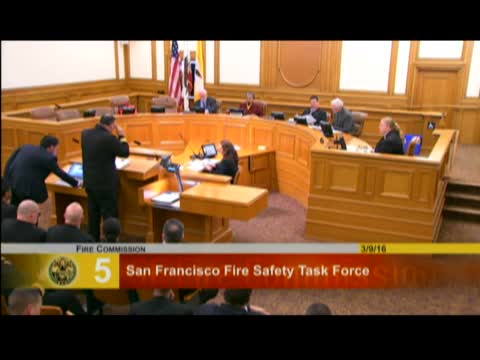
Fire Marshal DeCazio summarized the Interagency Fire Safety Task Force final report for the Commission on March 9, saying the ordinance that created the task force (Ordinance 90‑15) led to recommendations intended to reduce deaths and displacement from fires in multi‑unit residences.
Among the recommendations DeCazio highlighted were posting building‑specific fire safety information (similar to hotel exit maps) in multi‑unit residential lobbies and providing new tenants with layouts; requiring annual testing and documentation of fire alarm systems and adding annual smoke‑alarm verification by building owners; and strengthening public access to inspection, complaint and NOV (Notice of Violation) records via SF Data.
DeCazio said the task force recommended clarifying the NOV hearing process so that administrative hearings are required rather than discretionary, and proposed creating an online database that documents how fire protection systems functioned in buildings that experienced fires. He described a technical retrofit recommendation to install fire blocking in attics for older balloon‑frame construction where, when opened up for work, a $20,000 threshold could be used to identify projects where fire blocking would be required upon permit work.
On sprinkler retrofits, DeCazio acknowledged serious cost and displacement concerns: he noted a PUC flat hookup example of roughly $28,000 and warned owners and tenants about the possibility of asbestos abatement, tenant relocation and other expenses. He also pointed to data showing that sprinkler systems substantially improve survival in fires, saying that having a sprinkler “increases your chances of surviving a fire 80 percent.”
The Bureau of Fire Prevention has already created a dedicated R2 complaint section, reassigned staff and signed a captain to head that unit; DeCazio said the department would partner with the Department of Building Inspection and the Department of Public Health to refine referral and hearing processes and was working with Supervisors Campos and Wiener on legislative proposals for annual alarm reporting and streamlined NOV procedures.
Commissioners pressed staff on budget impacts and asked for follow‑up reporting. Vice President Ken Cleveland and others suggested exploring fee reductions or other incentives to reduce retrofit costs for owners. DeCazio said the department advocates starting with low‑cost, high‑impact steps (such as posting building layouts and requiring annual alarm testing) while continuing to study cost‑intensive measures. He and commissioners agreed that a one‑year follow‑up report on implementation progress would be useful.