Get Full Government Meeting Transcripts, Videos, & Alerts Forever!
Get email alerts on the Ems Reconfiguration topic
No spam. Unsubscribe anytime.
San Francisco fire officials say EMS reconfiguration two-thirds complete; aim to finish hiring and deployment by March 2008
Summary
San Francisco Fire Department officials told the commission they are about two-thirds through an EMS reconfiguration that shifts from fixed 24-hour ambulances to a dynamic, data-driven deployment. Officials said the change has increased peak-period ambulance availability, set performance benchmarks (4.5-minute defibrillator target) and plans to complete hiring and training in early 2008, contingent on the city budget.
The San Francisco Fire Department told the Fire Commission on Monday that its multi-year reconfiguration of fire-based emergency medical services is roughly two-thirds finished and on track to be completed with additional hiring and training in early 2008, pending budget approvals.
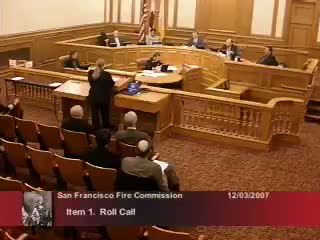
"We are currently approximately 2 thirds of the way through what we're calling our EMS reconfiguration," Fire Chief Joanne Hayes White told commissioners during a special briefing. The department has moved from a system with mostly fixed, 24-hour ambulances to a mix of remaining 24-hour units and dynamically deployed ambulances that staff peak periods, Hayes White said.
The reconfiguration, the department said, has allowed it to put far more units on the street at busy times than before: where pre-merger days typically saw about 12 to 14 ambulances available, the peak-period model can put "as many as 25 ambulances" in service, officials said. Assistant Deputy Chief Pete Howes described the new approach as "system status management," using GIS posting locations and a peak-period staffing model to match resources to demand.
Officials emphasized performance goals tied to patient outcomes. Dr. John Brown, director of the Emergency Medical Services Agency, said benchmarks include getting a defibrillator to a patient within "4 and a half minutes" (measured at the 90th percentile), an ALS (paramedic) response within seven minutes and an ambulance arrival within 10 minutes on high-acuity (code 3) calls. Dr. Carl Spohr, the agency—s medical director, recounted a recent successful cardiac arrest response in which crews arrived in "2 and a half minutes," used a defibrillator and the patient ultimately survived.
The department also outlined quality-improvement and data efforts to sustain those goals. Dr. Brown reviewed the Local EMS Information System (LEMSIS) and a First Watch real-time monitoring tool as central to oversight, and said the city is piloting an electronic patient care record for field medics. Brown said Phase I of LEMSIS was funded by an Urban Area Security Initiative grant and that Phase II would expand administrative access for faster analysis.
Operational details and system limits were a focus in commissioner questions. Howes described dispatch and triage using the Clawson system and explained that code 2 calls (non-life-threatening) are dispatched promptly but do not receive lights-and-sirens response. Commissioners raised concerns about outlying neighborhoods—Battalions 8, 9 and 10 (including Richmond, Sunset, Visitacion Valley and Bayview Hunters Point)—where posting locations and hospital access historically create response challenges; Hayes White said those areas remain a priority for additional posting locations.
Budget uncertainties were flagged as a potential risk to the remaining phase. When Commissioner Clark asked whether the recent budget pressures would slow hiring, Hayes White said she was "hopeful that it will not" but acknowledged the department must work with the mayor—s budget office and the Board of Supervisors to preserve recruitment needed to finish the reconfiguration. The department expects to hire a new class in January and to have trainees on the street by March 2008, she said.
Officials also addressed system-wide issues: private ambulance providers operate as backup and for transfers but must integrate with the city—s dispatch system to answer 911 calls; San Francisco General Hospital was reported as on diversion about 19% of the time in a one-year cut cited by presenters, creating transport and placement challenges; and incident-report and sentinel-event processes were explained, with sentinel events handled with a 72-hour investigative target.
The presenters named several community programs that aim to reduce demand on 911 and improve outcomes: an asthma outreach program to reduce breathing-related 911 calls, a HOME team (homeless high-user outreach) to help frequent callers, a public-access defibrillator program covering over 170 sites and a disaster registry for seniors and disabled residents. The department also highlighted a $37,000 donation of a training mannequin from the Fireman's Fund Heritage Program/Wells Fargo Insurance Services used in paramedic training.
Commissioners thanked department staff and urged continued reporting on posting locations, performance management plans and the hiring timeline. No formal votes were taken at the special meeting; presenters said materials and monthly operations reports are available on the EMS agency website.
The commission opened public comment near the end of the session; one commenter thanked firefighters and supervisors for increased public information and for stabilizing EMT staffing. The commission adjourned after closing remarks and directions on how the public may submit written comments or attend regular meetings.