Get Full Government Meeting Transcripts, Videos, & Alerts Forever!
Get email alerts on the Amplified Sound topic
No spam. Unsubscribe anytime.
Entertainment Commission reviews draft to reorganize amplified-sound rules, add street‑performer permit
Summary
Staff presented a draft ordinance to move commercial amplified-sound rules out of Police Code Article 1 into Article 15.1, create fixed-place outdoor permits and a two‑year amplified‑sound street‑performer permit, and add enforcement tools and modest fees; commissioners asked for time to review.
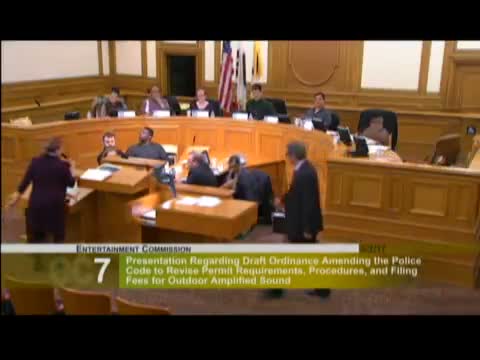
San Francisco — Executive Director Kane presented the Entertainment Commission on Feb. 7 with an early draft ordinance to reorganize how the city regulates amplified sound, proposing new permit types for ongoing outdoor amplification and a two‑year street‑performer permit that would be visible while a performer is active.
Kane told the commission the current structure “puts amplified sound activities in boxes that no longer fit,” and proposed moving sections 43–48 related to loudspeaker permits out of Police Code Article 1 (titled “Nuisances”) into Article 15.1 where the city has a fuller permitting and enforcement framework. “I don’t think that amplified sound is a nuisance necessarily,” Kane said, arguing the change would give staff and police clearer tools to manage time, place and manner of outdoor amplification.
Under the draft, businesses or organizations that regularly use outdoor amplification could apply for a fixed‑place outdoor amplified‑sound permit (an “F‑pass”). One‑time outdoor amplified events would remain an option but would be capped at 12 per year before staff would encourage a fixed‑place permit.
The draft also proposes a two‑year, portable permit for amplified‑sound street performers, with modest rules — for example, a suggested 50‑foot buffer from another performer and limits on locations near schools and hospitals — and a visible permit badge. Kane said the fee structure under consideration would be cost‑recovery‑based and mentioned a working proposal of $100 for two years (about $50 per year), with fee waivers available for applicants who can demonstrate inability to pay.
Kane emphasized enforcement changes in the draft: relocating these commercial amplified‑sound rules into Article 15.1 would allow administrative citations, notices of violation, and in some cases upgraded misdemeanor language that the police department requested in order to strengthen compliance tools. He said the city attorney and SFPD had reviewed draft language and that Chief Redmond had been supportive of adding enforcement options.
Commissioners raised multiple practical questions: how parade sound trucks would be handled, whether place‑of‑entertainment permits would automatically include outdoor rights in future applications, how to assess sound‑system size and wattage, and how to price inspections when staff or inspectors are required to attend events. Kane said many of those operational details will be set during drafting and rulemaking, noting the draft intentionally focuses on tools rather than broad policy judgments.
Several commissioners urged caution and requested time to review the proposal in detail before the commission takes an action vote. President Bridal Tan asked staff to place the item on the next agenda so commissioners could deliver written feedback; Kane said staff would continue refining the draft and search for a Board sponsor to introduce it to the full Board of Supervisors.
What’s next: Staff will refine the draft based on commissioner feedback, identify a sponsor for introduction to the Board of Supervisors, and return to the Entertainment Commission for a possible action vote at a future meeting.