Get Full Government Meeting Transcripts, Videos, & Alerts Forever!
Get email alerts on the Accessibility Policy topic
No spam. Unsubscribe anytime.
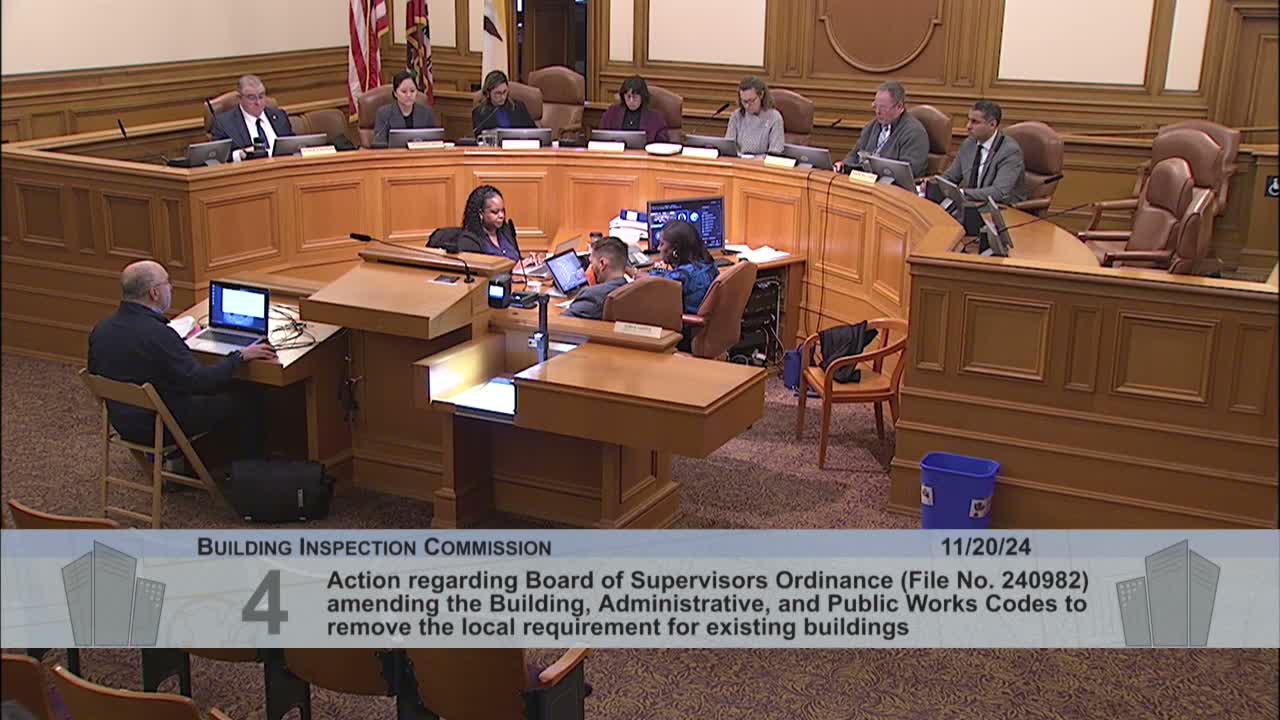
Building Inspection Commission recommends repeal of proactive ABE enforcement, 4–2
Summary
The San Francisco Building Inspection Commission voted 4–2 to recommend that the Board of Supervisors repeal the local proactive enforcement provisions of the Accessible Business Entrance (ABE) program, citing budget and staffing constraints and advocating a shift toward grants, outreach and case‑by‑case appeals. Disability advocates warned the change could lower local standards.
The San Francisco Building Inspection Commission voted 4–2 on Nov. 20 to recommend that the Board of Supervisors adopt an ordinance (File No. 240982) that would remove the local proactive enforcement requirement of the Accessible Business Entrance program.
Supervisor Rafael Mandelman, sponsor of the ordinance, told the commission the proposal would "sunset enforcement of the Accessible Business Entrance program," require reporting by the Office of Small Business and the Mayor's Office on Disability, and launch a collaborative initiative called "beyond the front door" to support accessibility. "Sunsetting enforcement of the ABE does not relieve property owners and businesses of their obligation to comply with federal and state accessibility laws," Mandelman said, adding that the change would remove a local requirement that goes beyond state and federal law.
Supporters told the commission the program has produced substantial compliance but has become costly and administratively difficult for small owners. Architect Serena Calhoun, who has processed hundreds of ABE permits, said the program is "broken," describing missing addresses in city records, civil‑engineering costs that can run into the tens of thousands of dollars, and expensive permit and vendor registration steps that small merchants struggle to meet. Katie Tang of the Office of Small Business described a barrier‑removal grant that reimburses up to $10,000 for physical improvements, and Tate Hannah of the Department of Building Inspection (DBI) said DBI will hire a certified access specialist (CASP) inspector to provide higher‑level accessibility guidance to field staff.
Disability advocates and access specialists urged caution. William Raela of Accessible San Francisco said the ABE was designed to address gaps in state law and warned that removing proactive local enforcement risks reducing local accessibility standards. Arnie Lerner, a member of the code advisory committee and the Access Appeals Commission, urged modifying and simplifying the program and using the appeals process to find affordable, "readily achievable" fixes rather than scrapping the program.
Commissioners split along pragmatic and principled lines. Supporters of repeal cited a DBI workload and budget crunch that would make issuing thousands of notices of violation (NOVs) unrealistic and argued that targeted incentives, grants and an expanded TI/hardship process could raise compliance without overwhelming enforcement capacity. Opponents said the program's enforcement tool had never been fully tested and warned that repealing it would cede local leadership on accessibility to litigation and state law.
Commissioner Newman moved to recommend approval of the ordinance; Vice President Shattuck seconded. The roll call vote was: Toot — yes; Shattuck — yes; Chavez — no; Ming — yes; Newman — yes; Williams — no. The motion carried 4–2.
The commission asked staff for follow‑up information, including more precise counts of technical‑infeasibility and hardship filings, data on appeals referred to the Access Appeals Commission, and a written policy describing how DBI will use CASP staff and funnel accessibility complaints and education if the ordinance becomes law. The commission’s recommendation will go to the Board of Supervisors for final action.