Get Full Government Meeting Transcripts, Videos, & Alerts Forever!
Get email alerts on the Enforcement Ecc topic
No spam. Unsubscribe anytime.
Building Inspection Commission upholds placement of contractor on Expanded Compliance Control list
Summary
The commission voted unanimously on Oct. 16 to reject an appeal and uphold DBI—s determination to place a contractor on the Expanded Compliance Control list after DBI presented four notice-of-violation cases it said involved structural demolition, excavation undermining neighbor footings and framing that lacked required fire-rated assemblies.
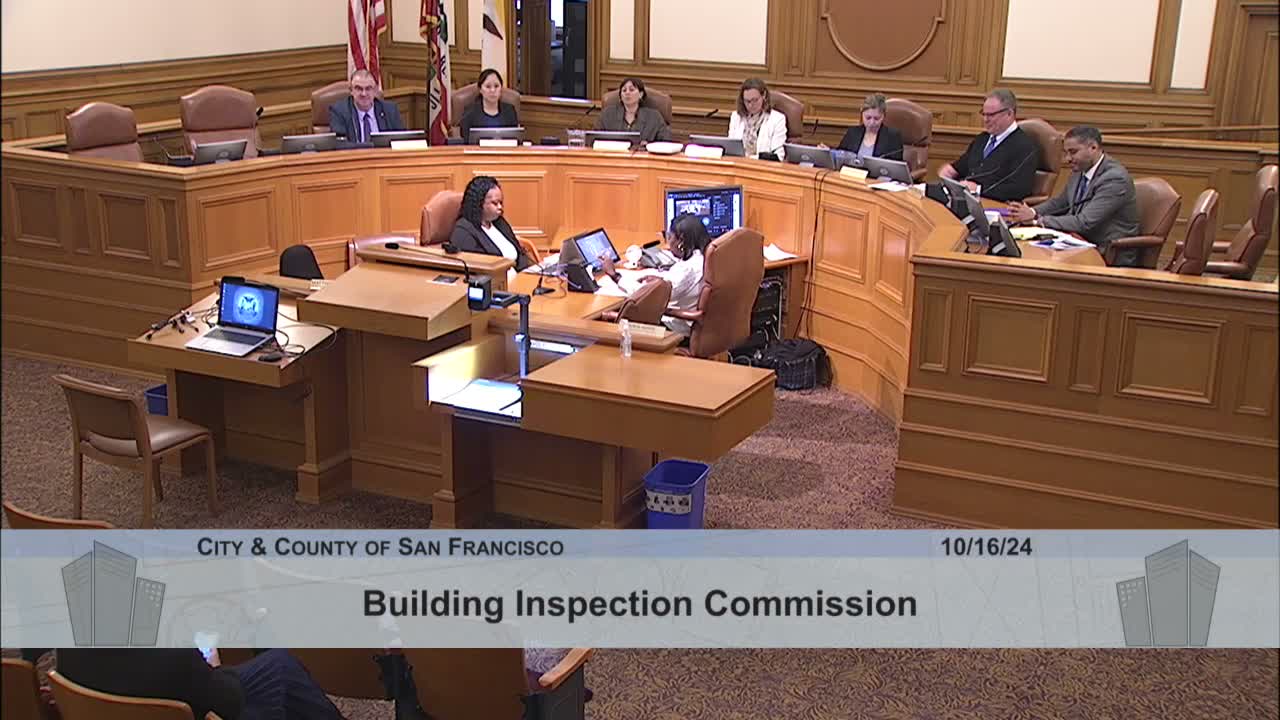
The San Francisco Building Inspection Commission on Oct. 16 unanimously rejected an appeal and upheld the Department of Building Inspection—s determination to place a contractor on the department—s Expanded Compliance Control (ECC) list, after commissioners concluded the file showed repeated, serious violations that posed public-safety risks.
DBI compliance manager Chris Vergara told the commission the appellant met the ECC statutory trigger by incurring three or more qualifying violations within an 18-month period or, alternatively, by committing conduct the department deems egregious and that creates a significant health, safety or property risk. Vergara reviewed four notices of violation (NOVs) tied to work at addresses cited in DBI—s files and said the violations fell under structural demolition and substantial noncompliance categories.
"So we believe it's a violation and respectfully request that the commission uphold the notice of determination because there's three or more violations within an 18-month period," Vergara said.
The appellant, Tad Nguyen, disputed parts of DBI—s account, arguing some work predated his engagement and that inspectors issued NOVs in ways he described as procedurally unfair. "This is my livelihood," Nguyen said during his remarks, adding that the listing on the ECC could severely harm his ability to get future work.
DBI's chief building inspector, Kevin Birmingham, countered with technical details. Birmingham said approved plans required certain foundations or shoring and that, in multiple instances, work observed in the field exceeded approved plans, left neighboring foundations undermined or produced exterior walls that did not meet the required 1-hour type X assembly. "It left both properties and the middle property very vulnerable," Birmingham said of one excavation he described.
Commissioners questioned both parties about evidence, timing of NOVs and whether multiple NOVs should be consolidated if they relate to the same project. Several commissioners emphasized the seriousness of excavations under neighbor footings and of uninspected framing that later required retroactive corrections. Commissioners also discussed statutory constraints—DBI said the ordinance defines eligibility as three qualifying NOVs in an 18-month rolling window and that the department reviewed files monthly and solicited any mitigating evidence from the respondent.
President Alexander Tutt moved to reject the appeal and uphold the director's determination; Commissioner Newman seconded. The clerk conducted a roll-call vote in which President Alexander Tutt, Vice President Shattuck, Commissioner Ming, Commissioner Newman and Commissioner Williams each voted yes. The motion carried unanimously.
Under the ECC process as described by DBI, a listed contractor's name and details are maintained in a department list for public viewing and a series of heightened oversight measures apply to permit applications for five years, including referrals to licensing agencies, additional plan-review scrutiny and extra site inspections. DBI staff said the listing is intended to protect the public by flagging repeat or severe noncompliance and does not, by itself, suspend a contractor's license.
The commission directed staff to prepare the required written determination within 90 days and to provide notice consistent with the ordinance. The meeting record shows commissioners also requested follow-up clarifications about how the ECC log cross-references related entities, engineers or firms when names or license numbers appear under different business entities.
The commission's action leaves in place DBI's notice of determination to place the contractor on the ECC list; the department will publish its written findings and follow the posting and referral steps described in the ordinance.