Get Full Government Meeting Transcripts, Videos, & Alerts Forever!
Get email alerts on the Vacant Storefront Exemption topic
No spam. Unsubscribe anytime.
Building Inspection Commission backs temporary exemption for storefronts blocked by public construction
Summary
The commission unanimously recommended Board of Supervisors File 240499 to allow a 180-day exemption from vacant-storefront registration and fees when public infrastructure construction blocks access, with recommended amendments to clarify geographic scope and require evidence for extensions.
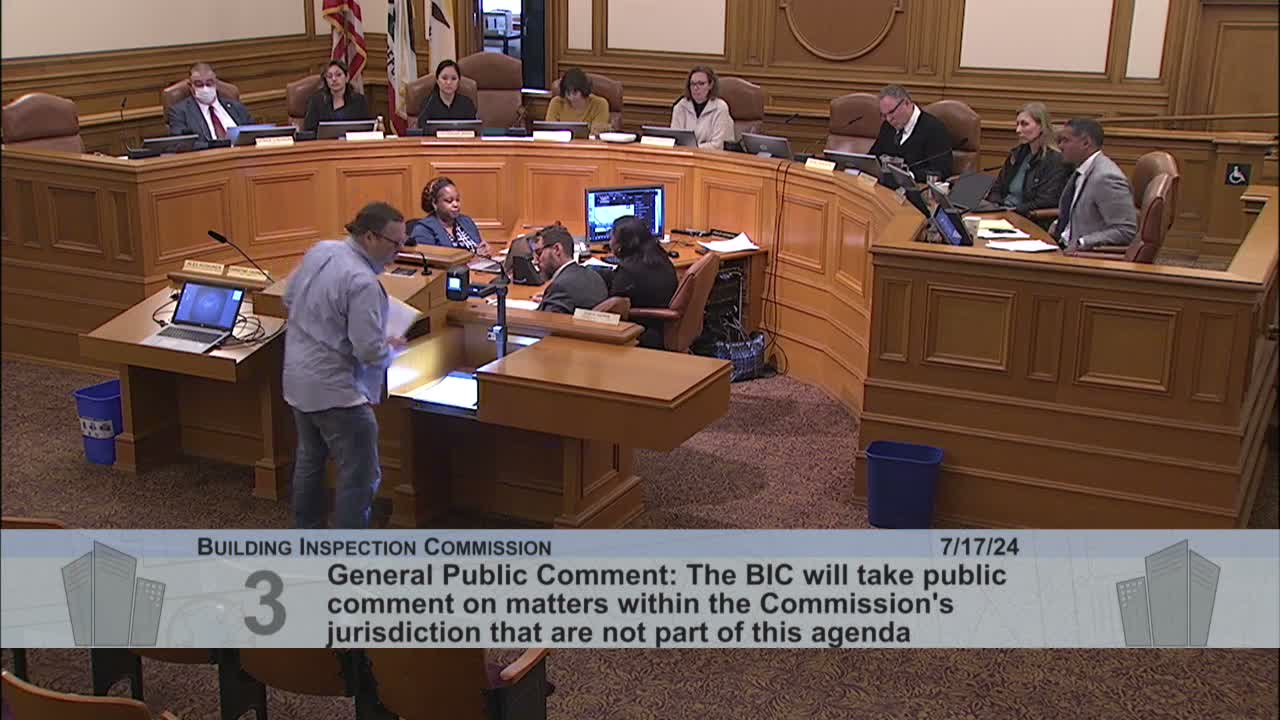
The San Francisco Building Inspection Commission voted unanimously July 17 to recommend Board of Supervisors File 240499, an ordinance that would exempt commercial storefronts from the city’s vacant-storefront registration and the associated annual fee when public infrastructure construction or maintenance prevents access to the storefront.
Angelina Yu, representing Supervisor Chan’s office, told the commission the amendment would “add a third exemption to make it simpler so that, if a public infrastructure project… they would have, an exemption,” arguing the change would give relief to leaseholders and owners affected by multi-month construction on commercial corridors.
DBI staff urged changes to the ordinance’s original language. Staff said the department is not positioned to determine legal causality between construction and vacancy and recommended removing a requirement that DBI verify causality. DBI instead recommended that property owners submit evidence and that the ordinance require construction or maintenance be ongoing for at least 30 days to qualify, plus additional evidence for extensions past 180 days.
Deputy City Attorney Rob Capo said the ordinance “is specific to the storefront's access to the public right of way,” meaning an exemption would apply when a person cannot reach a storefront’s entry or exit from the public right of way. Capo cautioned that DBI would still need to review submissions and that some discretion and judgment calls could be involved in borderline cases.
Commissioners debated how narrowly to define access and whether to set a geographic boundary. Some commissioners favored a clear geographic rule (for example, impact on the same block) to reduce discretionary determinations and burdens on DBI; others favored allowing DBI discretion to handle San Francisco’s varied conditions and suggested implementation details should be handled by form and procedure rather than statute.
President Alexander Toots moved, with a second from Vice President Shattuck, that the commission recommend the ordinance with an amendment asking the Board of Supervisors to adopt a clearly defined geographic boundary for access. The motion passed on a roll-call vote with all commissioners voting yes.
What happens next: the commission’s recommendation and suggested clarifications will be forwarded to the supervisor’s office and the ordinance will proceed through the Board of Supervisors’ committee process. The ordinance as presented would give a 180-day exemption that may be extended by submitting additional evidence if construction remains ongoing.