Get Full Government Meeting Transcripts, Videos, & Alerts Forever!
Get email alerts on the School Impact Fees topic
No spam. Unsubscribe anytime.
SFUSD will count all assessable interior space when calculating school-impact fees starting Feb. 1
Summary
San Francisco Unified School District told the Building Inspection Commission it will change how it calculates school-impact fees—adding interior non-habitable common square footage to the chargeable area for new residential development and charging additions above 500 sq ft on the entire addition—effective Feb. 1; commissioners raised concerns about outreach and timing.
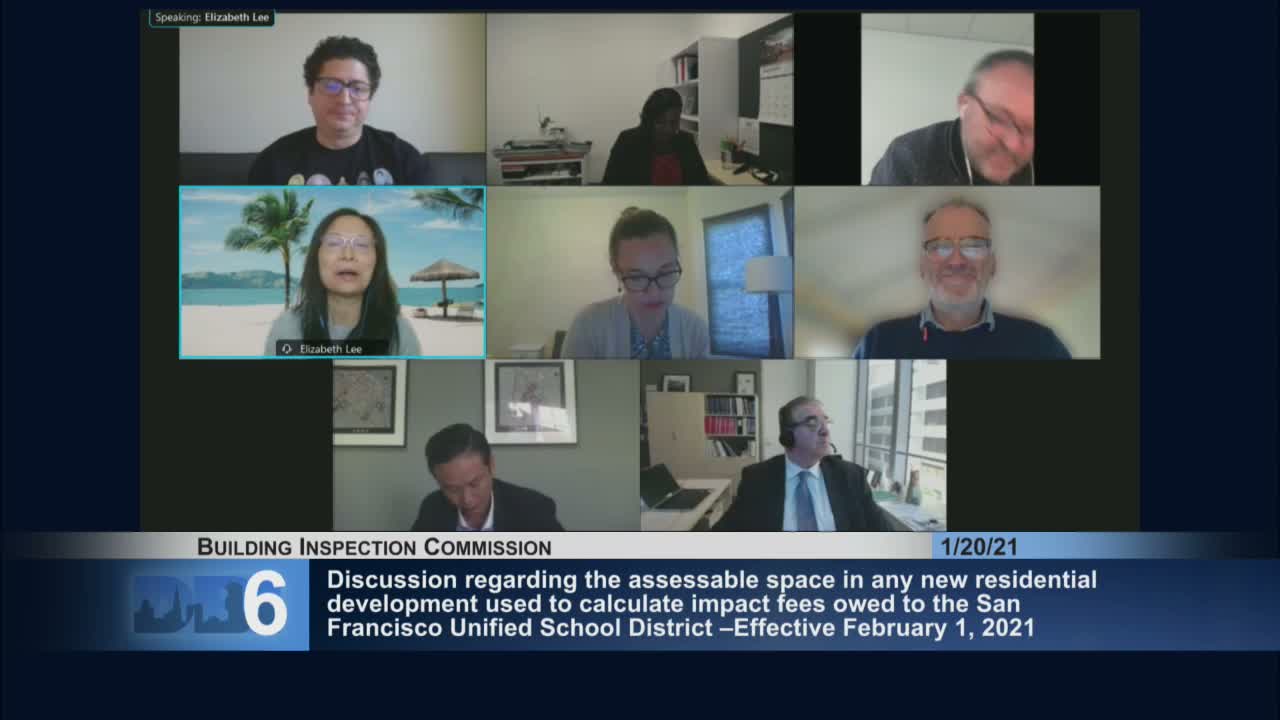
The San Francisco Unified School District notified the Building Inspection Commission on Jan. 20 that, effective Feb. 1, 2021, it will change how it calculates school-impact fees for new residential development.
Elizabeth Lee, manager of SFUSD's Real Estate and Employment Office, said the district will now include all assessable square footage within residential structures when calculating charges authorized by the Government Code. That broadens the definition of "chargeable spaces" beyond habitable rooms to include interior common areas such as hallways, stairs, storage rooms, fitness centers and lounges. The district said typical exemptions remain: uncovered walkways, detached accessory structures, patios, and residential garages are not chargeable under the new calculation when they are accessory to residential units. Garages within commercial structures remain chargeable.
Under the change, additions to existing residential properties greater than 500 square feet will be charged for the entire added area once that threshold is exceeded. SFUSD staff said they have updated forms and coordinated with DBI but do not plan additional board hearings because the code authorizes the method change; the district said it has worked with DBI staff for nearly two years to implement the update.
Commissioners expressed concern about stakeholder outreach and the timing of the change during an economic downturn. Vice President Moss and others said a higher fee burden could make some projects less feasible and asked who had been informed; SFUSD staff said notices were posted on DBI and the district published a release, and committed to follow up with the mayor's office liaison if needed.
The commission did not act on the fee change (the district presented it as informational). DBI clarified it will be the collecting agency for the fee and will use the assessor's method for calculating assessable square footage.
The district contact said it will assist DBI with outreach and can provide additional detail if commissioners want more analysis of fiscal impact or examples of how fees would change for common project types.