Get Full Government Meeting Transcripts, Videos, & Alerts Forever!
Get email alerts on the Compliance Control topic
No spam. Unsubscribe anytime.
San Francisco commission weighs ordinance to publicly flag repeat code violators; staff to refine language
Summary
Commissioners reviewed Supervisor Ronan's ordinance (Board File No. 210015) to formalize DBI's process for tracking repeat and egregious building-code violators, requiring senior plan review, pre-issue site inspections, posting a public compliance list, and reporting licensed professionals to state boards; commissioners and industry asked staff to narrow scope and return on Feb. 17.
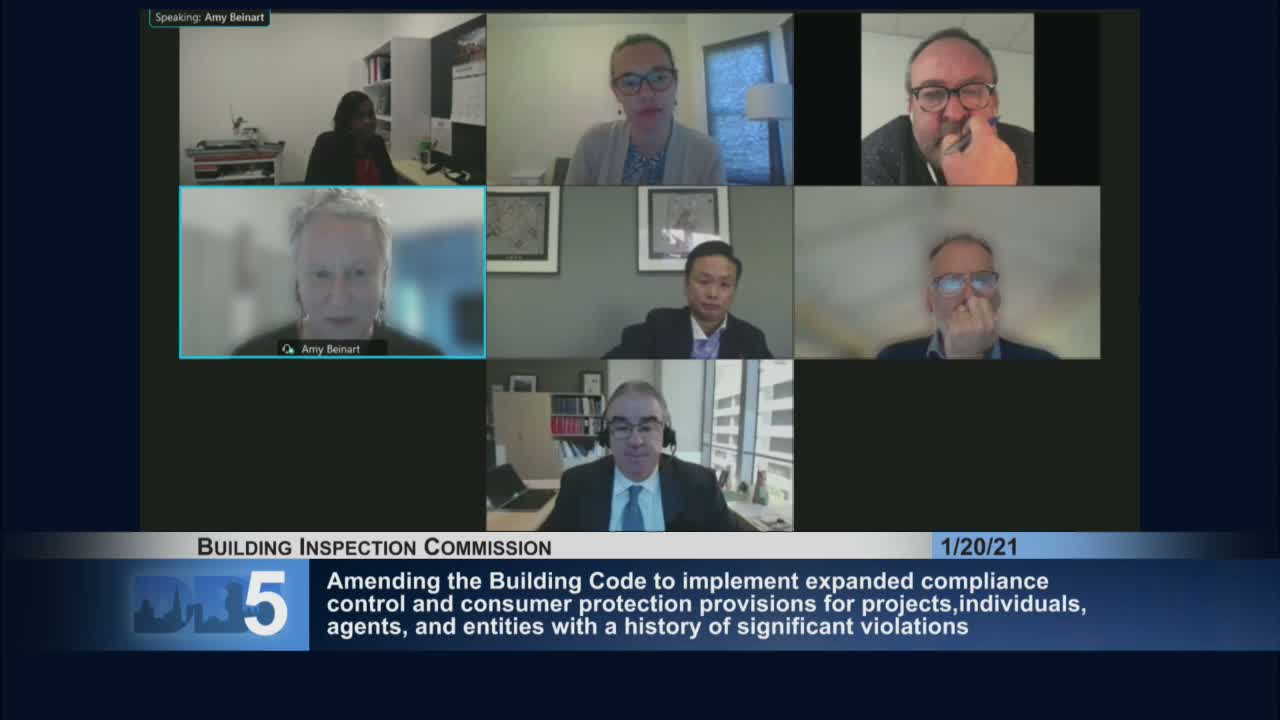
San Francisco's Building Inspection Commission spent the bulk of its Jan. 20 meeting examining an ordinance (Board of Supervisors file no. 210015) that would codify and expand the Department of Building Inspection's practice of subjecting serial violators to heightened review.
Assistant Director Christine described a DBI policy that flags individuals with repeated serious notices of violation (NOVs) for second-level plan review, mandatory site inspections before permit issuance and a senior inspector assigned to respond to complaints. The proposed ordinance would require DBI to post an expanded compliance-control list on its website, provide quarterly reports to the commission and, in some cases, notify state licensing boards or the City Attorney for further action.
Amy Beinart, legislative aide for Supervisor Hillary Ronan, told the commission the measure was prompted by a string of high-profile cases, including a 2020 federal arrest and a civil suit involving structural engineer Rodrigo Santos and projects in District 9 where unpermitted work allegedly created life-safety hazards. "Having serial offenders violate our laws again and again with no measures in place to stop them is unacceptable," Beinart said.
Industry speakers and neighbors generally supported stronger enforcement but urged narrowing the bill's scope. Sean Kiglin of the Residential Builders Association told the commission the draft is "way too broad" and warned that architects, engineers or owners could be swept onto the list for incidents that do not reflect intentional or dangerous wrongdoing. Jerry Drattler urged DBI to benchmark the program against similar programs in San Jose, Los Angeles and Sacramento and to require quarterly public reporting on the number of individuals tracked and enforcement actions taken.
Commissioners probed multiple technical points: what qualifies as a "serious" NOV, whether NOVs are typically issued to owners or to professionals, how a three-strikes-in-18-months trigger will be counted when multiple violations can be on a single NOV, who may appeal and when, and whether the director may immediately place an individual on the list for a single egregious action.
Deputy City Attorney Rob Capela said the ordinance envisions a two-stage approach: a nonpublic tracking list and a separate public compliance list. Under the draft, a party must generally have three qualifying NOVs within an 18-month period to be placed on the public list, but the director would have discretion to list someone immediately in truly egregious cases; that decision would be appealable to the commission within the administrative code timeline.
Commissioners repeatedly emphasized avoiding unintended consequences that would place owners, tenants or peripheral contractors on a public blacklist. President Inge McCarthy and Commissioner Jacobo proposed a small subcommittee (McCarthy, Jacobo and Clinch, with staff) to fine-tune language. Staff agreed to meet with the committee and accept written suggestions. The commission voted to continue the ordinance to its Feb. 17 meeting to allow edits and further vetting.
The next steps: DBI staff will assemble suggested amendments and operational definitions of "serious" NOVs; the subcommittee will meet with the supervisor's office; and the revised ordinance will be returned to the Building Inspection Commission before being taken to the Land Use Committee.