Get Full Government Meeting Transcripts, Videos, & Alerts Forever!
Get email alerts on the Candlestick Redevelopment topic
No spam. Unsubscribe anytime.
OCII workshop advances Candlestick Point amendments after heated public comment on outreach and housing
Summary
OCII staff proposed amendments to restart Candlestick Point development including a 2,000,000 sq ft transfer from Hunters Point Shipyard, extended financing time limits, a rise in indebtedness cap, higher height limits and revised R&D parking ratios; public speakers pressed for clearer outreach, enforceable affordable‑housing benchmarks and stronger local contractor commitments.
Office of Community Investment and Infrastructure staff on July 2 presented a package of proposed amendments meant to "restart Candlestick" and accelerate infrastructure and housing at the Candlestick Point and Hunters Point Shipyard redevelopment sites, triggering a long public comment period centered on outreach, displacement fears and enforcement of community benefits.
At a workshop before the OCII commission, staff and the 5Point development team asked commissioners for feedback on six main changes: extend the redevelopment plan time limits for public financing, transfer 2,000,000 square feet of commercial capacity from the Hunters Point Shipyard to Candlestick Center, allow more flexible commercial and mixed uses at the stadium‑site “pie,” adopt a phased parking approach for research-and-development space (initially 2 spaces per 1,000 square feet for the first 1,700,000 sq ft, with a study to consider reductions to about 1.3 later), increase Candlestick Center height limits (from about 120 feet to as much as 180 feet in parts of the center), and streamline some design‑review steps while preserving public and commission review of major phases.
Katarina Kidd, 5Point’s director of planning, and Lila Hussain, senior project manager for Candlestick, described the history of the long‑delayed redevelopment, noting that the project was first approved in 2010 and that a series of setbacks (Navy land‑transfer delays and other issues) prompted staff to propose the amendments. Kidd said the changes are intended to make the site more competitive in the regional market while preserving the plan’s core commitments: an overall housing program that includes a 32% BMR requirement and park/open‑space pledges. Staff told commissioners the plan has attracted roughly $136,000,000 in community‑benefit contributions to date and that about $7,700,000 is being stewarded through the San Francisco Foundation for local housing and workforce programs.
The presentation also described programmatic commitments: a community benefits scholarship program administered with Scholarship America, roughly $2,250,000 committed to the Southeast Health Center rebuild, a community revolving loan fund and a community‑builder program to construct 500 units with local builders. Staff said the next phase aims to activate parcels and build infrastructure with a goal of site activation beginning in 2025, and that major phase applications for Blocks 6 and 7 and Aurelius Walker parcels would follow.
Speakers from across the Bayview Hunters Point community offered sharply divided perspectives. Several longtime residents and community leaders urged rapid approvals to deliver jobs, housing and community benefits. ‘‘This project plan is the best plan we’ve ever put forward,’’ said Roberta Achtenberg, a longtime resident and consultant who has worked on the project for years. Local contractors and housing organizations, including the San Francisco Housing Development Corporation, said they are ready to build and support affordable units and workforce programs.
But many nearby homeowners and community advocates said outreach had been insufficient and asked for stronger, enforceable benchmarks before the commission approved amendments. "I learned about this project on accident," said Brian Robinson of the Candlestick Heights Community Alliance, summarizing a common complaint that presentations varied across meetings and that immediate neighbors had not been directly engaged. Shirley Moore, a homeowner who said her property lies about 100 feet from the site, said homeowners had been excluded from outreach and asked for direct engagement.
Housing advocates pressed for clearer accountability. John Abalos for the Council of Community Housing Organizations asked what benchmarks would ensure the amended timeline produced affordable housing sooner rather than later. Several labor and contractor commenters urged firm commitments to small‑business and local contractor participation; LaShawn Walker of 5Point reiterated that a 50% SBE contracting goal remains in place and that staff would continue to work on micro‑LBE inclusion and outreach.
Commissioners used the workshop to press staff on several topics: how the plan addresses sea‑level rise (staff said mitigation measures and updated datum guidance will be applied and that the city coordinates through a multi‑department sea‑level‑rise committee); the sequencing and phasing of Alice Griffith replacement and next‑phase housing (staff said phasing was renumbered but that timing for Alice Griffith units remains comparable and that some parcels adjacent to Alice Griffith were moved up to an earlier launch); and parking and equity (staff defended a phased R&D parking approach and said an empirical parking utilization study would guide any future reductions).
Staff also reported a proposed increase in the redevelopment plan indebtedness cap (public financing capacity) from $1.7 billion to $5.9 billion combined for the project areas, said they were implementing SB 143 changes to time limits, and proposed allowing tax‑increment revenues at Candlestick to help fund future Shipyard infrastructure.
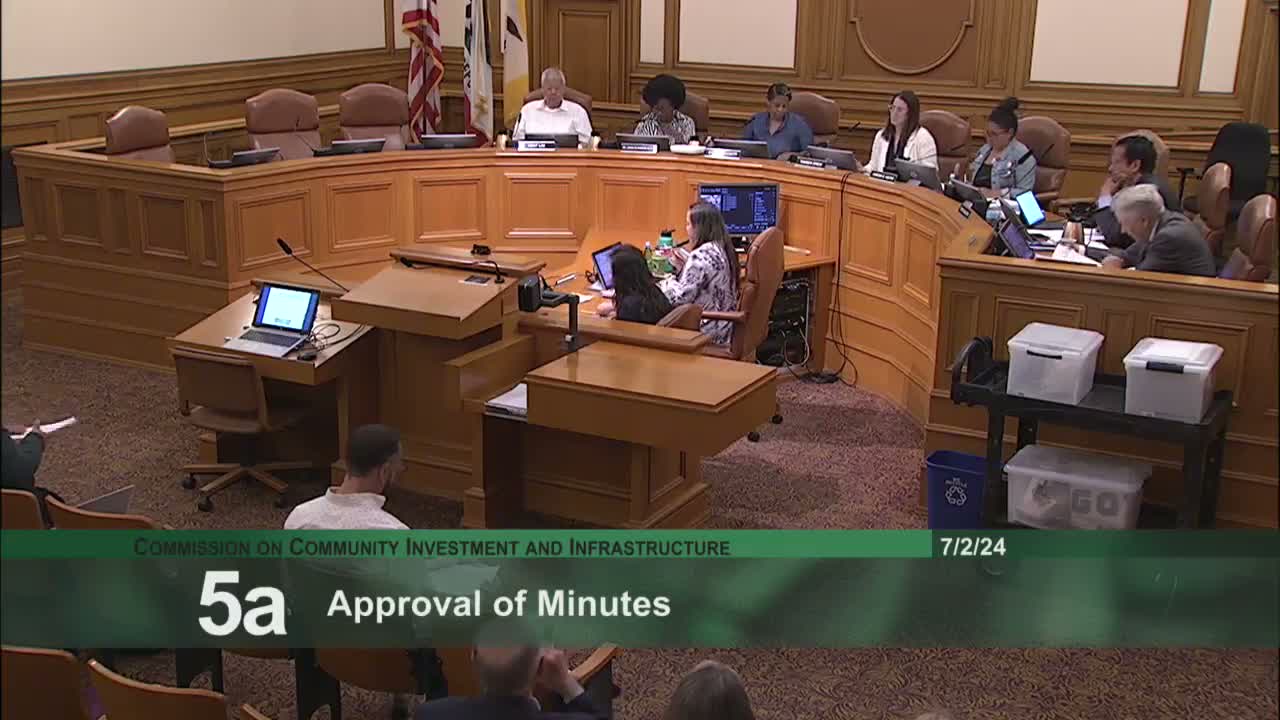
No formal vote on the plan amendments occurred at the workshop. Commissioners were told staff will return July 16 with formal amendment documents for action; design‑for‑development amendments and general‑plan consistency findings are scheduled to go before the Planning Commission on July 18. The commission approved an unrelated procedural motion earlier in the meeting to adopt the minutes from June 18 (5‑0).
Next steps: staff committed to additional targeted outreach to adjacent homeowners and Alice Griffith residents, to provide detailed housing‑by‑phase tables and to commission the parking/utilization study and other technical analyses before amendments come back for formal action.