Get Full Government Meeting Transcripts, Videos, & Alerts Forever!
Get email alerts on the Certificate Of Preference topic
No spam. Unsubscribe anytime.
OCII and MOHCD describe COP outreach gains and bottlenecks; DAHLIA, Links Investigations cited as tools
Summary
OCII and the mayor’s housing office reviewed certificate-of-preference outreach and DAHLIA platform uptake, reporting high application volume but large attrition (staff cited ~85% of certain applications did not move forward) and staffing constraints for certificate processing.
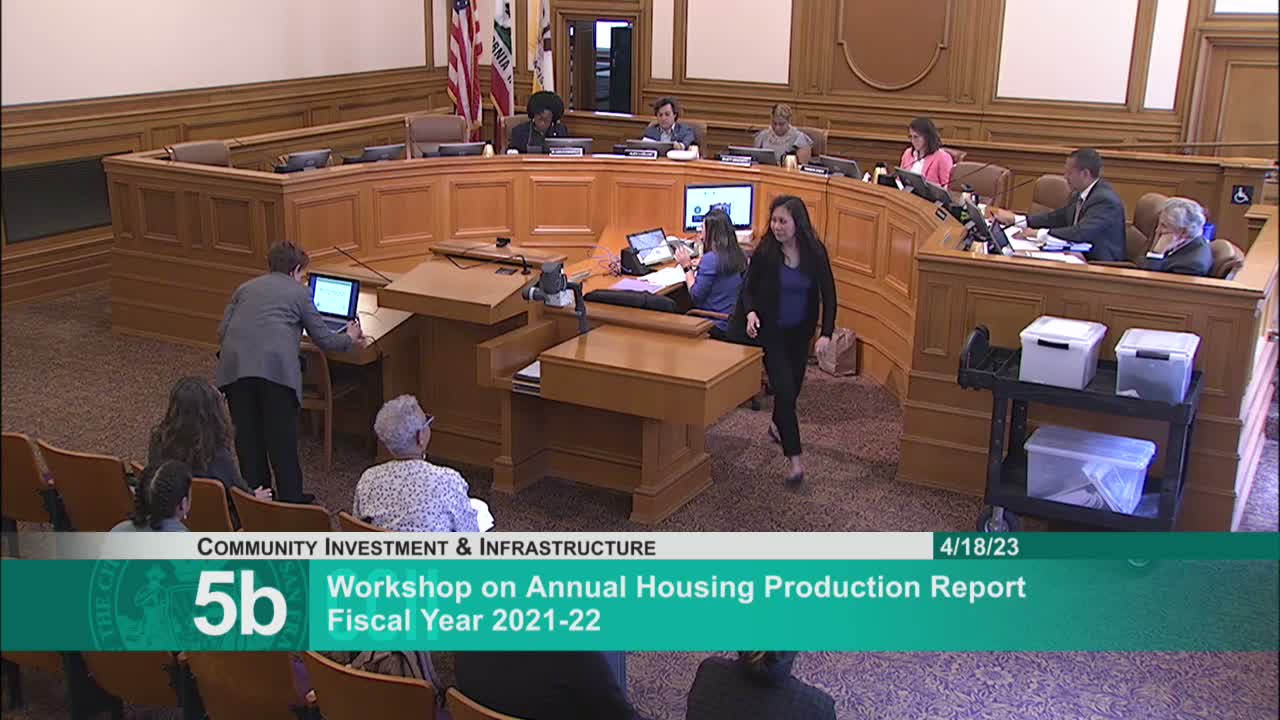
OCII and the Mayor’s Office of Housing and Community Development presented an update on certificate-of-preference (COP) marketing and outreach on April 18, focusing on tools and barriers to moving eligible holders into available affordable units.
"Per state law, the certificate of preference or COP program was created to provide an affordable housing preference for low and moderate income households that were displaced due to redevelopment agency action," Pam Sims, senior development specialist at OCII, told the commission. She summarized outreach coordination with MOHCD and developer reporting requirements.
Maria Benjamin of MOHCD said the DAHLIA web application has been central to keeping application volume flowing during the pandemic and beyond. "We received over 150,000 applications, electronic applications, during this reporting period, with almost 150,000 of them being for rental housing," she said, and added that DAHLIA Partners helps OCII and developers track applicants.
Benjamin highlighted attrition in the intake-to-lease process: "Eighty-five percent of the 192 applications that COP holders submitted during this period... didn't move forward," she said, citing reasons including failure to respond to leasing agents (about 52% of non-moves), choice to be placed on a wait list (16%), or withdrawal after the lottery (18%). She said less than 2% were denied for credit, eviction or criminal background reasons.
Staff described other outreach efforts: a Links Investigations contract (started Nov. 2022) tasked with locating originally displaced individuals and identifying descendants; expanded MOHCD processing of descendant certificates under Assembly Bill 1584 (effective 01/01/2022); and efforts to coordinate subsidies with Catholic Charities and other nonprofits.
Commissioners pressed staff on several operational issues: how long leasing agents attempt callbacks (staff said at least five attempts across contact modes over a two-week period), whether parking or unit size drove withdrawals (staff said MOHCD projects can have limited or no parking and that unit size/eligibility mismatches are a common reason), and the availability and timing of rental subsidies (staff said subsidies exist but can run out during the fiscal year and that COP holders are prioritized when subsidies are available).
Staff also noted processing capacity constraints: Sonya McDaniel is the primary staffer processing descendant certificates; MOHCD reported 273 certificate requests since July and was still processing several dozen pending submissions. OCII and MOHCD said they are hiring additional staff and planning expanded outreach, including community fairs and targeted outreach via community partners.
The item was a workshop and required no commission action; staff said a LINCS/Links Investigations report on outreach outcomes will be presented in June.