Get Full Government Meeting Transcripts, Videos, & Alerts Forever!
Get email alerts on the Housing Adu Fees topic
No spam. Unsubscribe anytime.
Board of Supervisors Approves Temporary ADU Fee Waiver, Backed by $165,000 Appropriation
Summary
The San Francisco Board of Supervisors unanimously approved an ordinance (File 210030) waiving specified building fees on new accessory dwelling unit (ADU) permits retroactive to Jan. 1; companion ordinance (File 210031) appropriates $165,000 to cover labor costs. DBI will report annually on use of the waiver.
San Francisco’s Board of Supervisors unanimously approved a temporary ordinance waiving certain building-related fees for specified accessory dwelling unit projects and accepted a companion appropriation to cover implementation costs.
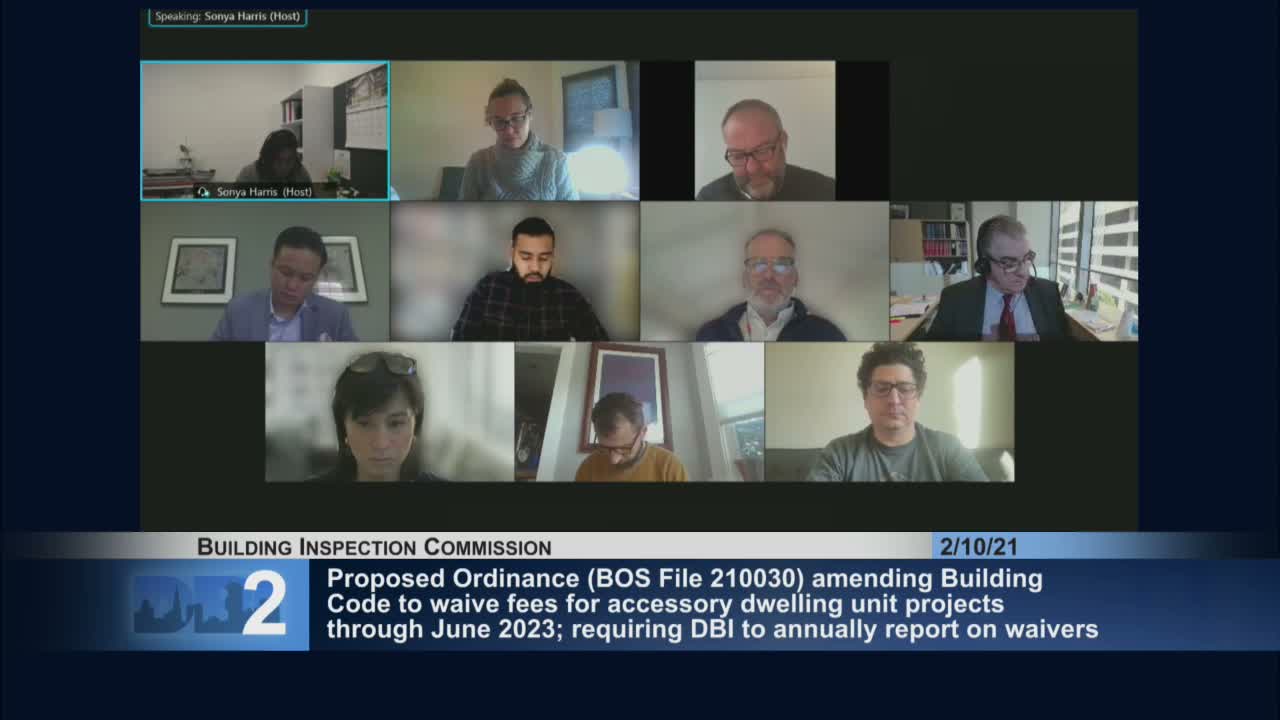
The ordinance (Board of Supervisors File 210030) waives fees including building inspection, plan review, protection fees and site surcharge fees for ADU projects on lots containing single‑family homes. DBI Legislative Affairs official John Murray told the commission the measure would be retroactive to Jan. 1 and would expire on June 30, 2023. He said applicants who filed after Jan. 1 would be eligible for refunds.
Lee Lovett of Supervisor Marr’s office said the ordinance is intended to support new ADU construction, add to the city’s housing stock and contribute toward the city’s RHNA allocation. Lovett said the proposal adds language to section 107A0.15 of the building code and includes reporting requirements for the Department of Building Inspection to submit annual information on the number of projects taking advantage of the waivers, their type and location, total fees waived and any administrative impacts.
DBI staff said the change is narrowly targeted to new construction and does not apply to legalization of existing, unpermitted spaces. DBI also noted that under a prior pilot program the average fee waived per ADU permit was about $1,700, though staff emphasized the prior pilot included ADUs within multi‑unit buildings and is not a perfect apples‑to‑apples comparison.
The ordinance is accompanied by File 210031, which appropriates $165,000 from the general fund to cover the cost of labor related to administering the waiver during the current fiscal year. Commissioners asked about the fiscal effect and procedural details; DBI staff said the appropriation estimate was based on prior pilot experience limited to single‑family ADU permits.
There was no public comment on the item. A motion to support the ordinance was made and seconded and the board approved it on a unanimous roll‑call vote.
The ordinance requires DBI to report annually to the board on the waivers’ use and impact. The department will remove the code section once the ordinance reaches its expiration date, as described in the measure.