Get Full Government Meeting Transcripts, Videos, & Alerts Forever!
Get email alerts on the Housing Abatement topic
No spam. Unsubscribe anytime.
Appeals board upholds abatement for 109 Pierce St., holds order in abeyance for six months
Summary
The San Francisco Abatement Appeals Board unanimously upheld an order of abatement for 109 Pierce St. but voted to hold the order in abeyance for six months so life-safety issues can be remedied while mediation between owner and tenant continues.
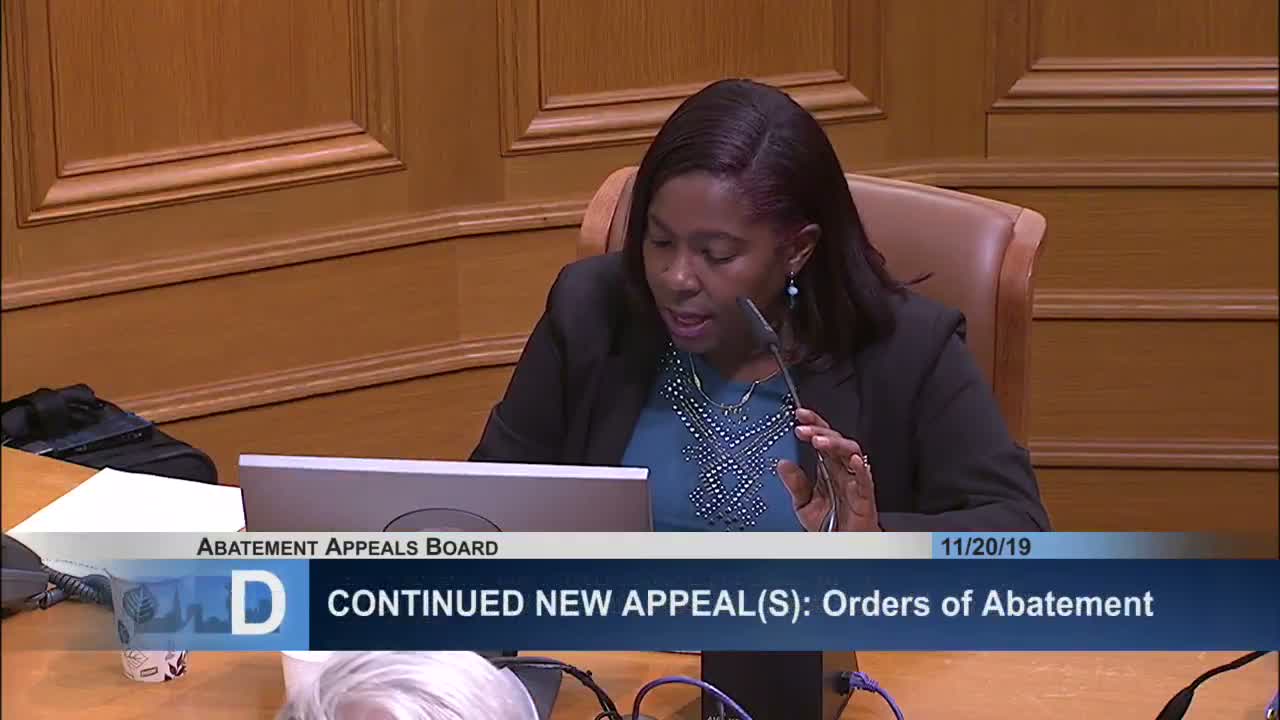
The San Francisco Abatement Appeals Board on Nov. 20 upheld an order of abatement for 109 Pierce Street but voted to hold the order in abeyance for six months while inspectors verify that life-safety issues are addressed and mediation proceeds.
The case stems from Notice of Violation No. 201889001, issued after an Aug. 2018 inspection that found leaking, mold and a deteriorated rear stairway. James Sambon Matsu, chief housing inspector, told the board the department’s deadline for completing repairs was last September and that the city has seen no sufficient progress. "All we ask for is the order of abatement," he said.
The building’s owner, represented by attorney Ryan Patterson, said the owner purchased the property and obtained permits to perform extensive rehabilitation work but that contractors will not do some work while a unit remains occupied. Patterson described an offer to the tenant to occupy a condo and said the owner would provide up to $100,000 in rent assistance to help the household secure long-term subsidies. "We request that you, don't issue this order of abatement," Patterson told the board.
Tenant Jackie Long, who said she has lived at 109 Pierce Street for 40 years, opposed relocation. "It is my home. I would like to stay there," she said, describing a household that includes a disabled daughter, a physically disabled son-in-law and a 9-year-old grandchild. Tom Drowen of Legal Assistance to the Elderly, representing Long, said an earlier unlawful-detainer action has been dismissed and urged the board to consider the possibility that owners may pursue substantial rehabilitation to remove the building from rent control.
Inspectors showed photos taken Nov. 18, including peeling paint and mold in a bedroom and kitchen and wood rot near a temporarily repaired stair. Inspector Christina Moy told the board the mold is a health concern for the child living in the unit and that a blue tarp placed on the roof was inadequately secured and had partially blown off. Moy said the stair remains temporarily fixed but not fully abated.
City attorney Brad Russi told the board it may hold an order of abatement "in abeyance" for up to 18 months if the board finds no serious and imminent hazard that would require evacuation. Commissioners and staff clarified the distinction between a "life-safety hazard" (for example, a deficient second means of egress) and a "serious and imminent hazard." The department’s assessment was that the stair and environmental issues are violations that pose health or life-safety concerns but, as inspected, did not meet the code threshold for immediate evacuation.
After extended questioning about whether the outstanding work could be done while the tenant remained in place, and whether the owner’s broader rehabilitation plan aimed to produce a certificated rebuilt building that would not be rent-controlled, Commissioner Walker moved to uphold the order of abatement but hold it in abeyance for six months while life-safety issues are corrected and mediation continues. The motion also directed staff to suspend accrual of fees during the abeyance; the board carried the motion unanimously.
What the board decided and what happens next: the order of abatement remains the board’s remedy but is not immediately recorded or pursued for collection while the six-month abeyance is in effect. Staff said current assessed costs total roughly $3,000. The department and tenant counsel said they would continue negotiations and provide updates to the board. The board asked for follow-up reports on compliance and safety verification before the abeyance expires.