Get Full Government Meeting Transcripts, Videos, & Alerts Forever!
Get email alerts on the Capital Plan topic
No spam. Unsubscribe anytime.
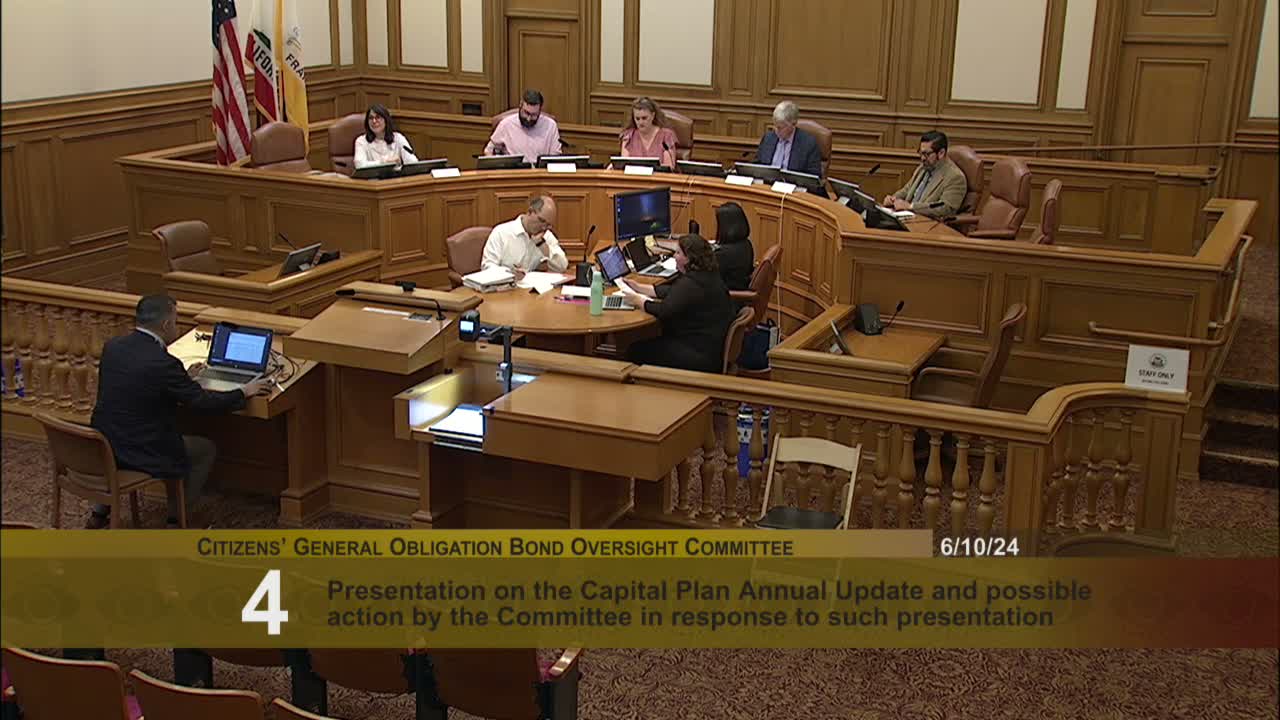
City staff outline $3 billion uptick in San Franciscos 10-year capital plan, preview November bond changes
Summary
City capital planning staff told the oversight committee the 10-year plan rose about $3 billion (to roughly $44.5 billion), driven by SFPUC capital increases; the March G.O. bond was trimmed to focus on $300 million for affordable housing and the mayor added $70 million for complete-streets and public places to a planned November bond.
San Francisco capital planning staff told the General Obligation Bond Oversight Committee that the city's 10-year capital plan increased by roughly $3,000,000,000 this year, from about $41.5 billion to $44.5 billion, primarily because the San Francisco Public Utilities Commission raised its departmental capital program. Kate Faust, capital planning manager in the Office of Resilience and Capital Planning, said the capital plan is a fiscally constrained roadmap that identifies needs and then indicates what the city expects to fund.
Faust said two changes to the citys general obligation (G.O.) bond program were notable: the capital planning committee removed the shelter program from the March bond so that the March measure focused exclusively on affordable housing ($300,000,000, which the committee reported passed in March), and the mayors office revised a planned November bond to add about $70,000,000 for complete-streets projects and public spaces. Faust said smaller amendments to the approved capital plan add about $30,000,000 to programed amounts.
Nishad Joshi, capital budget manager, briefed the committee on the cash (pay-as-you-go) program and the citys pavement condition index (PCI) target. He said the capital plan aims to maintain a PCI of about 75 (a commonly used regional benchmark described to the committee as "good"); 85 is described as "optimal," and scores below the low 70s typically require more-intensive reconstruction. Joshi said recent adopted capital budgets have trended below the plans recommended funding levels, prompting use of financing tools such as certificates of participation (COPs) to backfill general fund shortfalls.
Committee members asked staff to clarify the jargon and metrics. Staff explained COPs are general-fund-backed debt that do not require voter approval, and said PCI results come from annual public-works inspections combining visual assessment and recent work history.
The update was presented as an off-year briefing; staff said they will return this fall with a full update when the capital plan is formally revised.