Get Full Government Meeting Transcripts, Videos, & Alerts Forever!
Get email alerts on the Shelter Crisis topic
No spam. Unsubscribe anytime.
Mayor's office briefs Building Inspection Commission on emergency shelter ordinance to speed openings under AB 932
Summary
The mayor's office briefed the commission Jan. 30 on two companion ordinances intended to accelerate the opening of shelters during a declared shelter crisis by activating AB 932 and adopting Appendix N standards, using an MOU-based review in lieu of discretionary building permits; the item was for discussion only and no vote was taken.
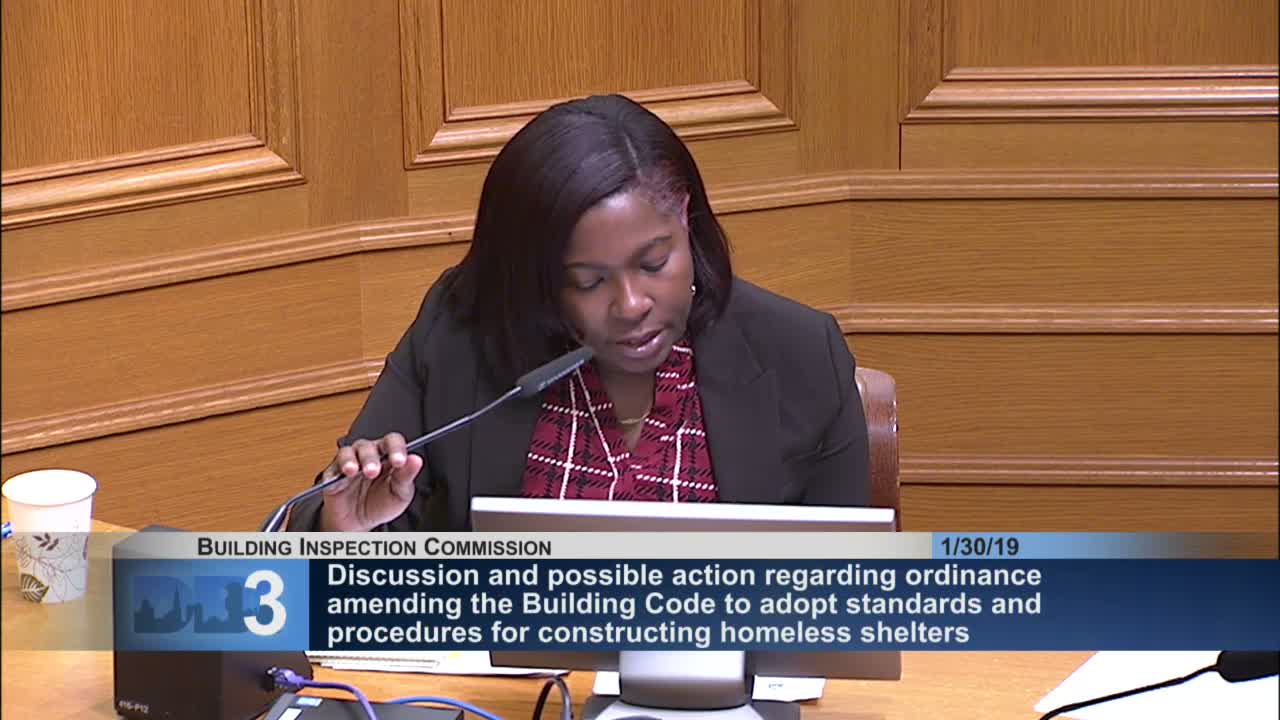
Emily Cohen of the Mayor's Office told the Building Inspection Commission on Jan. 30 that the city is facing a "dire crisis" of homelessness and presented two companion ordinances intended to speed shelter openings under state law.
Cohen said the city's recent count estimates about 7,500 San Franciscans experience homelessness on any given night, roughly 4,300 of whom are unsheltered, and that more than 1,100 people are on the nightly shelter waiting list. "This is an ambitious goal and one that we have every intention of achieving," Cohen said as she described a mayoral target to open 1,000 new shelter beds over two years.
The mayor's package includes a contracting ordinance to allow the Department of Homelessness and Supportive Housing and Public Works to execute contracts more quickly, and a separate ordinance (the item before the commission) that would activate AB 932 at the local level and adopt alternative design and siting standards for shelters during the declared crisis. Cohen said the ordinance would formalize an interdepartmental memorandum of understanding (MOU) among DBI, Fire, Public Works, Planning and the Department of Homelessness and Supportive Housing to guide review and sign-off on shelters opened under the expedited rules.
Cohen and Deputy City Attorney Rob Capela emphasized that the expedited process would not waive life-safety requirements. Capela explained that the ordinance references Appendix N, a state-adopted set of emergency housing standards developed after AB 932, and that the city will need to formally adopt Appendix N (with any necessary local amendments) and obtain sign-off from the Department of Housing and Community Development before the expedited rules take effect.
Commissioners asked whether the expedited procedure applies to new construction as well as retrofits of existing buildings; Cohen said it applies to both and that DBI would still inspect and sign off, typically through a letter certifying the structure meets the adopted standards. Commissioners also questioned the expected life span of temporary/tensile structures and whether DBI should anticipate additional services; presenters said shelters will be site-specific and may range from interim tensile structures to longer-term modular units and that DBI's ongoing inspections and plan checks remain part of the process.
Speakers and several commissioners expressed support for moving quickly; a public commenter and a statement read into the record on behalf of Vice President Walker conveyed strong support for the mayor's approach. The item was placed on the agenda for discussion only and no formal action or recommendation was taken by the commission at this meeting.