Get Full Government Meeting Transcripts, Videos, & Alerts Forever!
Get email alerts on the Homelessness topic
No spam. Unsubscribe anytime.
Building Inspection Commission backs temporary shelter standards tied to state law
Summary
The Building Inspection Commission unanimously approved an ordinance to activate state AB 932 and adopt Appendix N as temporary building standards for homeless shelters during a declared shelter crisis; the measure requires interdepartmental MOUs and state HCD sign-off and will sunset with the state law.
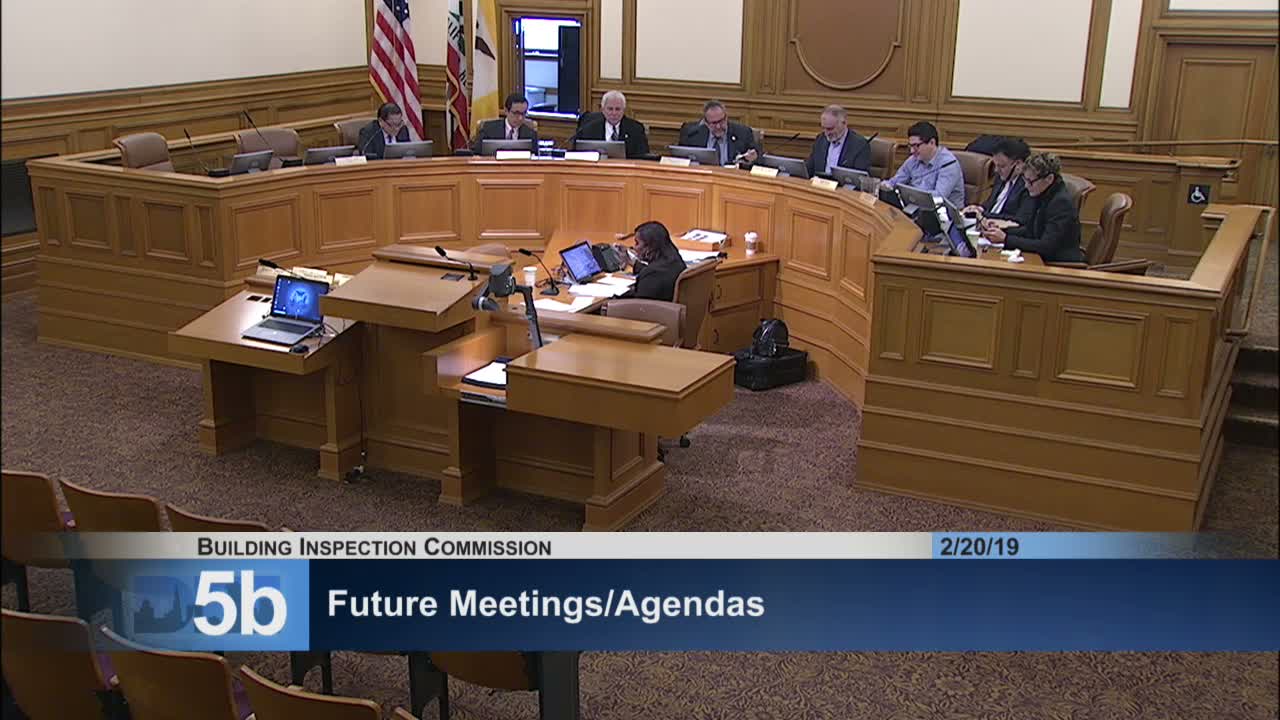
The Building Inspection Commission unanimously approved on Feb. 20 an ordinance that allows San Francisco to use streamlined building standards for homeless shelters during a declared shelter crisis.
Emily Cohen of the Mayor’s Office told commissioners the ordinance (Board of Supervisors file no. 190,045) would activate state AB 932 and explicitly adopt Appendix N as a set of emergency standards for temporary shelter housing. Cohen said the city’s 2017 point‑in‑time count recorded about 7,500 people experiencing homelessness, roughly 4,300 of whom were unsheltered, and that more than 1,100 people remained on the shelter waiting list.
The ordinance packages two related approaches: one streamlines contracting and removes some planning-code barriers to open shelters more quickly; the other amends DBI procedures so shelters can be approved through a memorandum‑of‑understanding process and a letter confirming life‑safety compliance rather than the usual discretionary building permit during the crisis. Cohen said the city is working with DBI, the Fire Department, Public Works, Planning and the Department of Homelessness to define the MOU process and reporting requirements.
Deputy City Attorney Rob Capla told the commission that Appendix N is intended for emergency housing of a temporary nature and applies only for the duration of a declared crisis. He said modular units would be built to state code, but permanent connections or changes that remain after the crisis could require compliance with local standards.
Commissioner Warshall pressed the panel on whether emergency standards would remain if a structure continued to be used after the crisis; Capla said the emergency standard does not permit permanent occupancy under those temporary rules once the state statute or the local authorization expires. Cohen noted the ordinance must be submitted to the state Department of Housing and Community Development for final sign‑off and that the local authorization would sunset with AB 932, currently scheduled to expire on Jan. 1, 2021.
A motion to approve the ordinance was moved and seconded and carried unanimously in a roll‑call vote.
The commission’s approval sends the ordinance forward to the Board of Supervisors and, if enacted locally, to HCD for state review. The ordinance’s authorizing provisions will remain tied to the duration of AB 932 unless the Legislature or the state agency takes further action.