Get Full Government Meeting Transcripts, Videos, & Alerts Forever!
Get email alerts on the Capital Plan topic
No spam. Unsubscribe anytime.
City outlines $38 billion 10‑year capital plan, adds affordable‑housing chapter and prioritizes equity and resilience
Summary
The Office of Resilience and Capital Planning presented the newly adopted 10‑year capital plan, which includes a new affordable‑housing chapter, a $1.2B constrained geobond program over 10 years and a $125M recovery stimulus proposal; members discussed tradeoffs among geobonds, debt capacity and ballot timing.
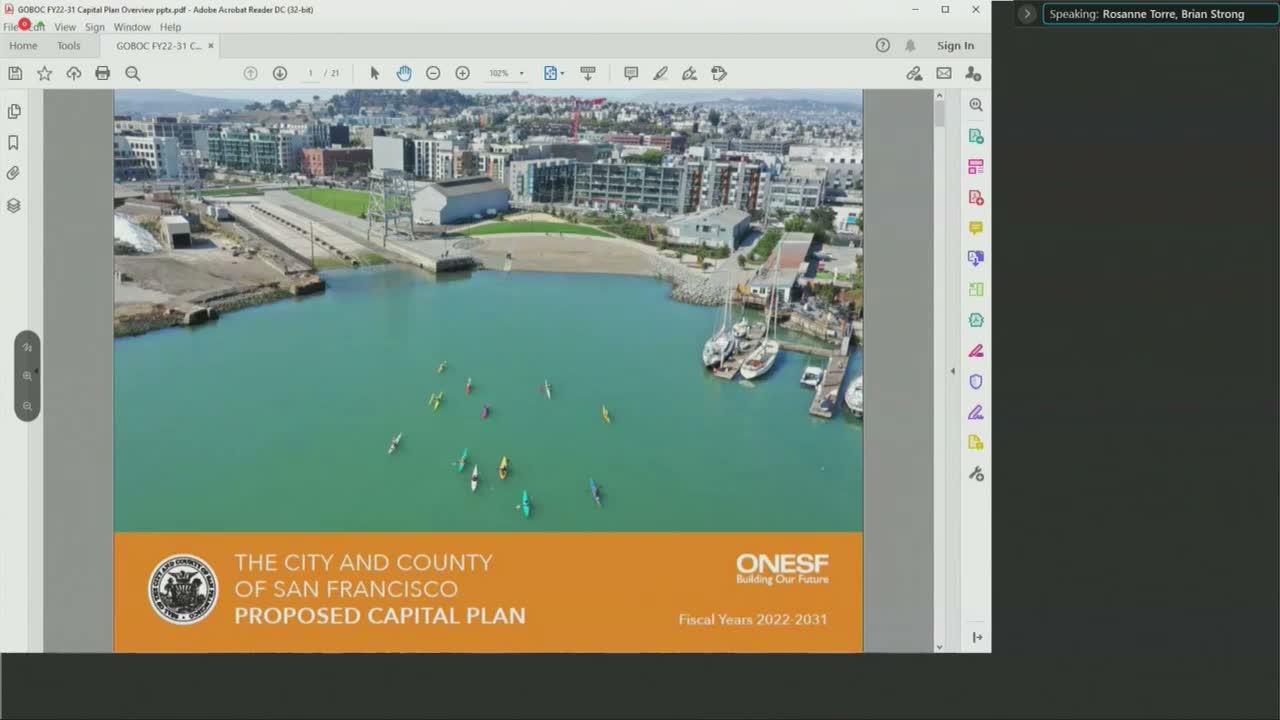
Brian Strong, Chief Resilience Officer and Director of the Office of Resilience and Capital Planning, briefed the Citizens G.O. Bond Oversight Committee on the city’s 10‑year capital plan. Strong said the plan totals roughly $38 billion and for the first time formally includes an affordable‑housing chapter, estimating $2.6 billion of spending over the next decade (much of it from private development).
Strong emphasized new capital planning principles that explicitly include racial equity and resilience and noted the plan’s focus areas: sea‑level rise and climate resilience, seismic upgrades for high‑risk buildings, digital connectivity, community health centers and permanent supportive housing. He identified capacity constraints after $1.7 billion of geo bonds were approved since 2019 and said the recommended 10‑year geobond program is about $1.2 billion to remain within debt capacity limits.
Nishad Joshi outlined the debt and issuance schedule embedded in the plan: a proposed $400 million transportation geobond (June 2022), a public health bond ($187.5 million, Nov 2023), an affordable housing bond ($160 million, Nov 2024) and future waterfront and other bonds. Staff said some planned closings may slip into July and noted that issuance timing will be balanced against retiring old bonds to preserve capacity.
Committee members raised concerns about whether a smaller affordable‑housing bond would affect voter support. Strong replied that increasing the housing bond would require reductions elsewhere in the geobond program and that tradeoffs will continue to be explored before the bond goes to voters. He said the capital plan also includes a $125 million recovery stimulus package targeted at projects that can start within 18 months and advance racial equity, climate resilience, housing preservation and small‑business recovery.
Staff described continuing efforts to track maintenance and renewals and to grow pay‑as‑you‑go allocations where possible. Members asked staff to keep the committee apprised of capacity changes and any changes in the sequencing or sizing of bond authorizations that could affect ballot measures.