Get Full Government Meeting Transcripts, Videos, & Alerts Forever!
Get email alerts on the Parks And Recreation topic
No spam. Unsubscribe anytime.
Rec and Park says 2008 bond closed out; 2012 projects largely complete as staff updates committee on pools and playgrounds
Summary
San Francisco Recreation and Parks told the Citizens G.O. Bond Oversight Committee that all 2008 bond projects are complete and 88% of 2012 bond project funding is spent; staff highlighted 63 completed projects, pool renovations (8 of 9 complete) and funding augmentations from city sources.
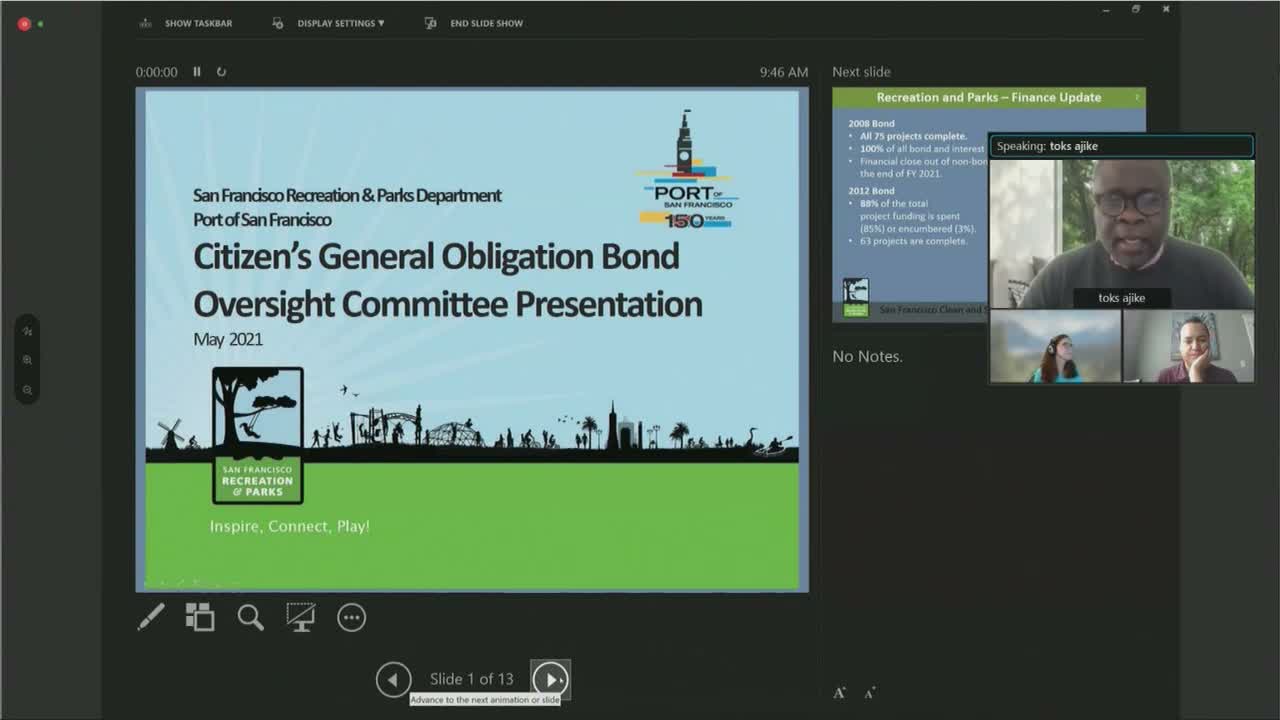
The Citizens General Obligation Bond Oversight Committee heard an update from the San Francisco Recreation and Parks Department on the status of projects funded by the 2008 and 2012 parks bonds. Tuxi Gekay said all projects financed by the 2008 bond are complete and that the bond and interest have been fully spent and await financial closeout. For the 2012 bond, Gekay said about 88% of project funding has been spent and that staff has completed roughly 63 named projects.
The presentation summarized neighborhood park openings, the Let's Play playground program, and the community opportunity fund. Gekay said 14 named neighborhood park projects are open and that only Rossi Pool remains under construction with delays linked to the COVID‑19 pandemic; pool work is expected to finish in mid‑summer. Under the Let's Play program, seven playground projects are open and six are in construction or design.
Staff described how some original bond baselines did not show ‘other funding’ but that projects were later augmented with additional city funds — for example the Downtown Park Fund and Open Space Fund — to address cost escalation and added scope. Antonio, the department capital finance manager, told the committee that the ‘other funding’ column often read zero because the 2012 bond baseline reflected the original scope; later project updates added supplemental funding as delivery needs evolved.
Committee members pressed staff about contracts, delay claims and contractor notices tied to the pandemic. Gekay said the department has received notices of potential delay (Garfield pool was cited as an example) and that the city’s position coordinated with the City Attorney is to grant non‑compensable time extensions, not additional compensation, absent contract terms that would require it.
On pools and programming, staff said the bond program renovated eight of nine pools and that design choices (for example creating a 25‑meter lap area plus a shallow recreation side) enabled programs for children, seniors and lap swimmers to run concurrently, increasing usage. Gekay cited internal pre/post opening studies and said some facilities showed usage increases as high as about 230% after renovations. Staff also said lifeguards and site security are provided during programmed hours and that community celebrations and social and web outreach are used to publicize new and renovated facilities.
The committee discussed maintenance and long‑term upkeep. Several members suggested the committee consider a follow‑up audit or review of maintenance and condition five to 10 years after projects are completed. Gekay pointed to a recent condition assessment and a database used to inform maintenance schedules and work orders; she noted Prop B funds are being used to support lifecycle maintenance.
The presentation closed with a preview of work tied to the 2020 health and recovery bond, and staff said many projects expected under that bond are already well into design.