Get Full Government Meeting Transcripts, Videos, & Alerts Forever!
Get email alerts on the Public Integrity topic
No spam. Unsubscribe anytime.
Controller's reviews find contracting and gifts weaknesses tied to DPW amid Nuru probe; committee forms subcommittee
Summary
Controller's office auditors presented preliminary internal‑control findings tied to the Mohammed Nuru investigation, identifying contracting, gifts and third‑party account weaknesses at DPW and recommending code changes. Committee voted to form a special subcommittee to track audit follow‑up and bond program intersections.
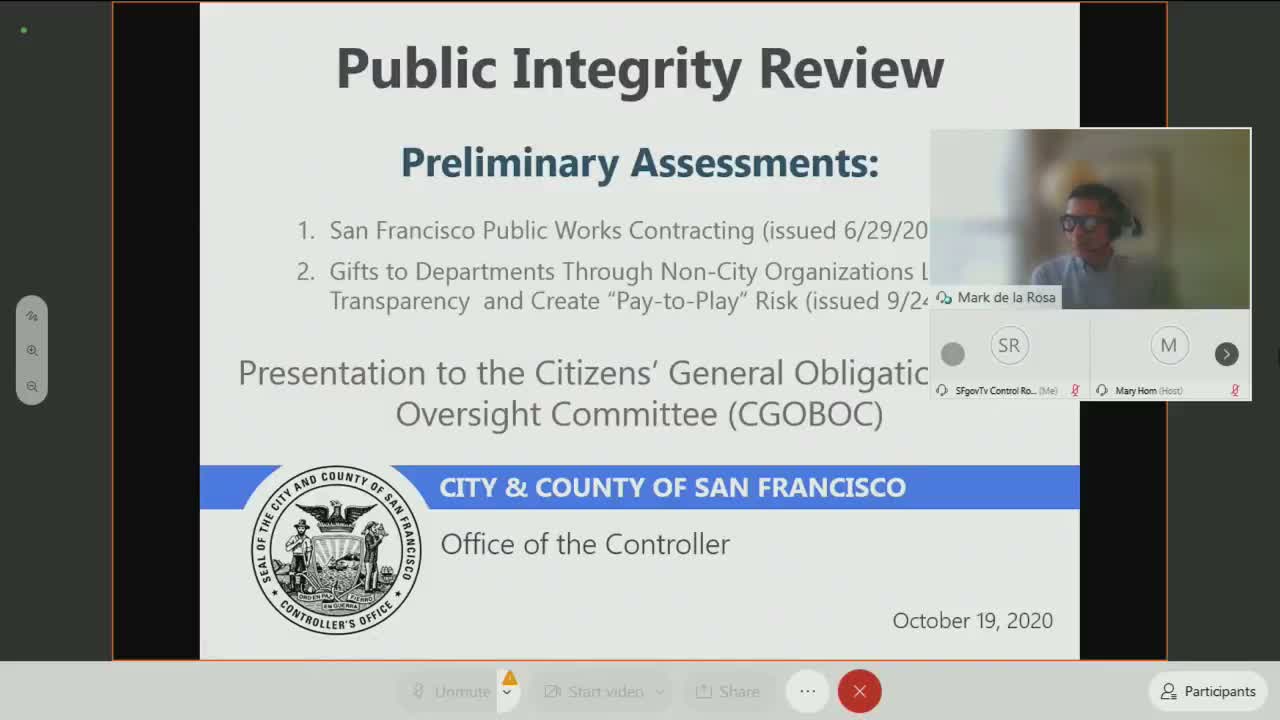
The acting director of audits in the Controller’s Office, Mark Dela Rosa, told the Citizens General Obligation Bond Oversight Committee that preliminary reviews tied to the Mohammed Nuru federal investigation reveal systemic internal‑control weaknesses in Department of Public Works contracting and in the oversight of donations routed through nonprofit partners.
Dela Rosa said the Controller’s Office examined public‑works contracting methods and non‑city accounts and found gaps in competitive solicitation practices, inconsistent use of pre‑qualified contracting pools, insufficient documentation for grants to nonprofits, and a lack of centralized monitoring of city contracting. He said the office also identified problematic “tone at the top” that prioritized expediency over transparency and cited the department’s historical delegation of contract approval authority as a risk factor.
The audits described several concrete examples: the City Attorney’s Office has issued subpoenas in the broader investigation; a $171,000 contract tied to a pit‑stop program was canceled; and the city initiated debarment proceedings against Azul Works Inc. Dela Rosa also detailed how some contractors that receive city contracts donated to Department of Public Works subaccounts held at the nonprofit Parks Alliance, and he recommended formal memoranda of understanding and clearer reporting requirements for those relationships.
Why it matters: committee members said the findings go to the heart of bond oversight because public‑works projects account for large portions of the city’s capital program and because contractor selection and contract administration affect budgets, schedules and public confidence. Several members described the reports as actionable and urged follow‑up with the City Attorney’s Office, the Ethics Commission and Board of Supervisors staff.
Questions and next steps: committee members asked whether the Controller’s Office planned legislative recommendations; Dela Rosa said some recommendations would require amendments to administrative code (cited Chapter 6 and Chapter 21), and that the office has been coordinating with supervisors and the Ethics Commission. The Controller’s Office also reported it has routed more than 60 public integrity tips to relevant offices since February and is finalizing a compendium of recommendations.
Committee action: after discussing options for staff support and timing, the committee voted to create a special subcommittee to examine intersections between the public‑integrity findings and bond programs and to report back at a future meeting. Staff warned the subcommittee will require additional administrative support; members asked for a focused December update on how audit recommendations would affect bond governance.
The Controller’s Office presentation did not assign criminal guilt to any entity; it described control gaps and proposed administrative and legislative remedies. The committee requested follow‑up memos on contractor lists, debarment status, and any direct connection between contractors named in subpoenas and specific bond projects. The committee adjourned after setting that follow‑up.