Get Full Government Meeting Transcripts, Videos, & Alerts Forever!
Get email alerts on the Capital Plan topic
No spam. Unsubscribe anytime.
Controller and capital planning office present 10-year capital plan and 18-month bond report; committee urges stronger pre-bond planning
Summary
Controller's office and the city's capital planning team presented an 18-month bond program review and an updated 10-year capital plan, urging standardized reporting and pre-bond planning to reduce delays caused by permitting, interdepartmental coordination and high construction costs.
Marnie Purcell Hill of the Controller's Office presented an 18-month analysis (Jan. 2017'June 2018) of scope, schedule and budget for the city's active general-obligation bond programs. The analysis found that earlier bond programs have spent most of their proceeds while later programs retain larger remaining balances; it credited large completed projects (Zuckerberg San Francisco General/Hospital rebuild) with producing savings that can fund follow-on work.
The report cataloged recurring delay drivers: regulatory permitting across multiple agencies (the Crane Cove Park schedule was extended by about 21 months for additional permits), interdepartmental coordination, extended community engagement, and rising construction costs that in some cases resulted in lower bids coming in far above original estimates. Marnie Purcell Hill summarized lessons learned and recommended standardized reporting templates and stronger pre-bond planning.
Heather Green, director of the Office of Resilience and Capital Planning, presented the updated constrained 10-year capital plan (capturing roughly $35 billion in needs). She described plan funding principles that prioritize mandated work, life-safety and resilience, and noted the city aims to hold general-obligation bond programming to a planning constraint tied to a 0.12% property-tax share established in 2006. The presentation identified several upcoming bond programs and draft programming: an affordable housing bond programmed at $300,000,000, an earthquake safety and emergency response component with large facilities items, and a waterfront/Seawall financing program whose first series was expected to close in June.
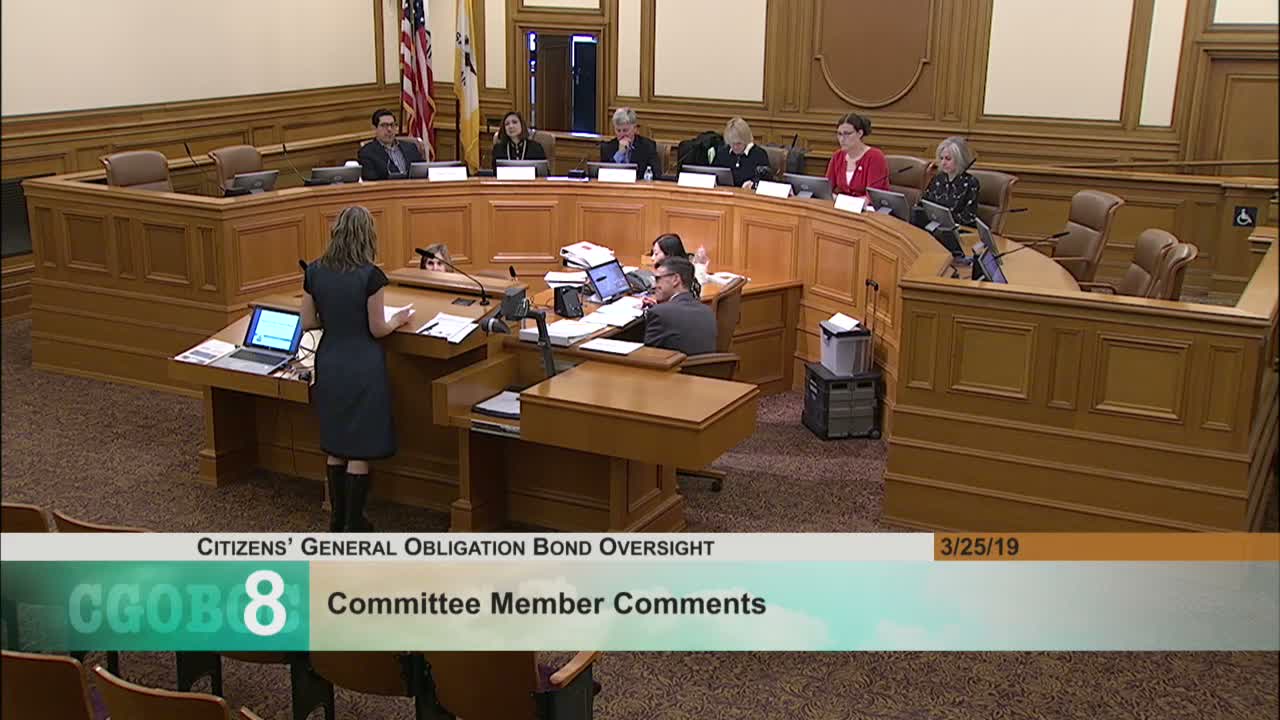
Committee members asked staff to present lessons learned directly to the Board of Supervisors'Budget and Finance Committee, requested more consistent project-level scope/timing/cost indicators, and offered to work with staff on standard templates and bond-report content prior to future issuances. Controller and planning staff agreed to follow up and to provide additional materials, including the public-perception study and standardized reporting templates in advance of the next fiscal year.