Get Full Government Meeting Transcripts, Videos, & Alerts Forever!
Get email alerts on the Transportation Bond topic
No spam. Unsubscribe anytime.
SFMTA updates GO-bond oversight committee on slow spending, Muni Forward gains and Van Ness disputes
Summary
SFMTA told the committee it has issued roughly $244 million of a $500 million Transportation bond, spent most of the first issuance and is targeting projects that can be delivered quickly; members pressed staff on Van Ness BRT dispute-review and permit coordination.
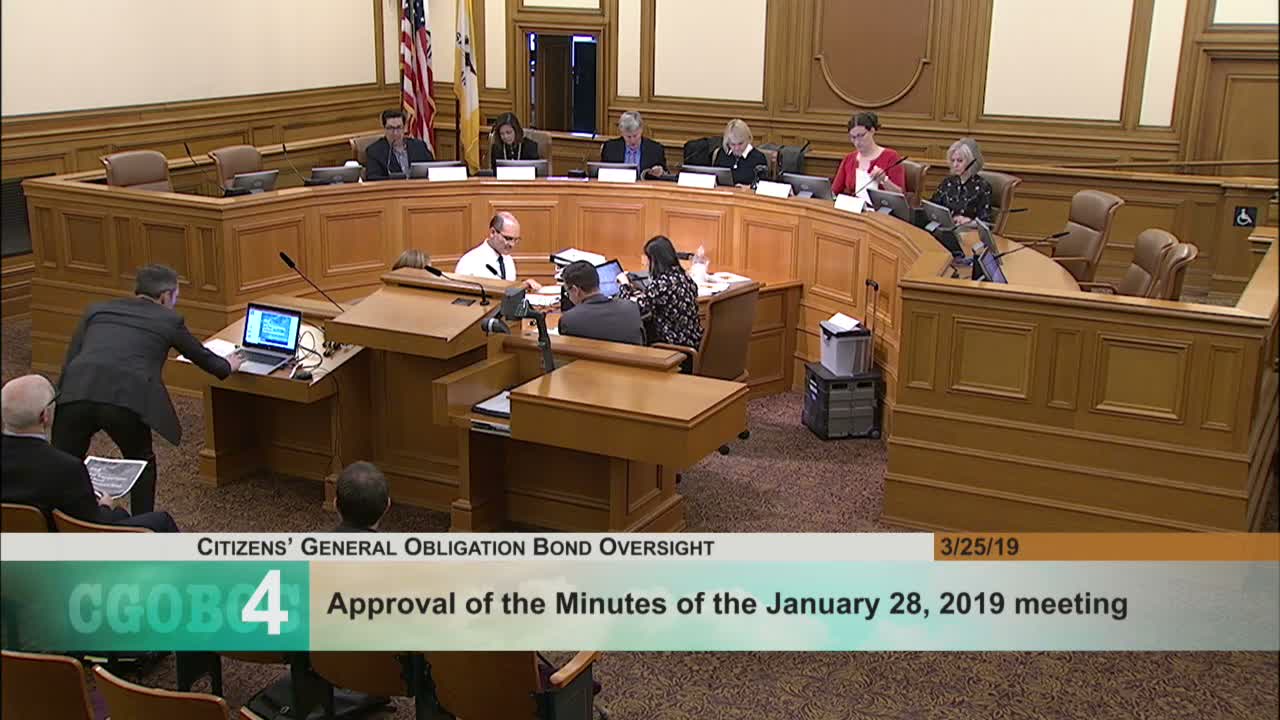
Chair Chu convened the GO Bond Oversight Committee for a quarterly briefing in which SFMTA Chief Financial Officer Leo Levinson outlined progress on the 2014 Transportation and Road Improvement general obligation bond. Levinson said the bond was authorized at $500 million, "we have had 2 issuances, totaling about 244,000,000," and staff has expended roughly 93% of the first issuance and about 22% of the second issuance.
The agency highlighted improvements completed under the Muni Forward program and other bond-funded work. Steve Boland, describing corridor improvements, said the 5 Fulton corridor'projects helped boost daily boardings "from about 14,000 riders before we started the improvements, up to about 23,000 today," and delivered roughly "a 9 to 12% improvement in speed in this corridor." Boland said similar capital work on the 9 San Bruno corridor and local investments such as transit bulbs and signal upgrades produced measurable ridership and travel-time gains.
SFMTA staff also reported facility investments funded or accelerated with bond proceeds. Jonathan Ruiz cited Islais Creek Phase 2 as a new bus facility storing 60-foot coaches, a five-track addition at Muni Metro East to accept new LRVs, and a roughly $40 million Burke warehouse retrofit that will create a new overhead-lines facility with improved seismic performance.
Committee members used the presentation to press staff on project-delivery risks. Members asked how encroachment permits and utility relocations are handled; Bruce Robertson of San Francisco Public Works said that when Public Works is the lead construction agency it "would handle that with the contractor" and will work with contractors to obtain necessary permits. Members also raised the status of claims and contract disputes; SFMTA staff said they currently see limited claims on most projects but acknowledged ongoing claims on some segments and committed to reporting claims status in future updates.
Van Ness Bus Rapid Transit drew sustained questioning. Members asked what "the referral process with Public Works" means for the Van Ness CMGC contract and about the three-member Dispute Review Board that both contractor and city selected. SFMTA explained the typical escalation path for contract concerns in construction management general-contractor projects and noted that Van Ness is a joint project involving sewer and water work for the PUC and Caltrans-related resurfacing under Public Works, which requires interagency coordination. SFMTA staff said the BRT will provide dedicated center-lane service and improved reliability once construction is complete, while acknowledging construction has been disruptive.
Several committee members asked for more standardized reporting on schedule, scope and cost risks in upcoming quarterly updates. The committee did not take formal action on bond reprogramming at the meeting; members instead requested follow-up information on dispute-review board selection, claims exposure, and the agency's process for shifting funds to projects that can move quickly.
The committee closed SFMTA'questions with staff agreement to provide additional written clarifications and to include claims status and clearer scope/timing/cost impact notes in the next report.