Get Full Government Meeting Transcripts, Videos, & Alerts Forever!
Get email alerts on the Candlestick Major Phase Amendment topic
No spam. Unsubscribe anytime.
OCII workshop previews amendments to Candlestick Point plan with more housing, more office and fewer large-format retail spaces
Summary
At an Oct. 1 workshop, OCII staff and developer 5Point presented amendments that would add housing (including senior and affordable units), convert some retail to office (including a proposed 118,500 sq ft office transfer from Hunters Point), raise certain building heights, update infrastructure for sea-level-rise standards, and seek three resolutions after CAC review in October.
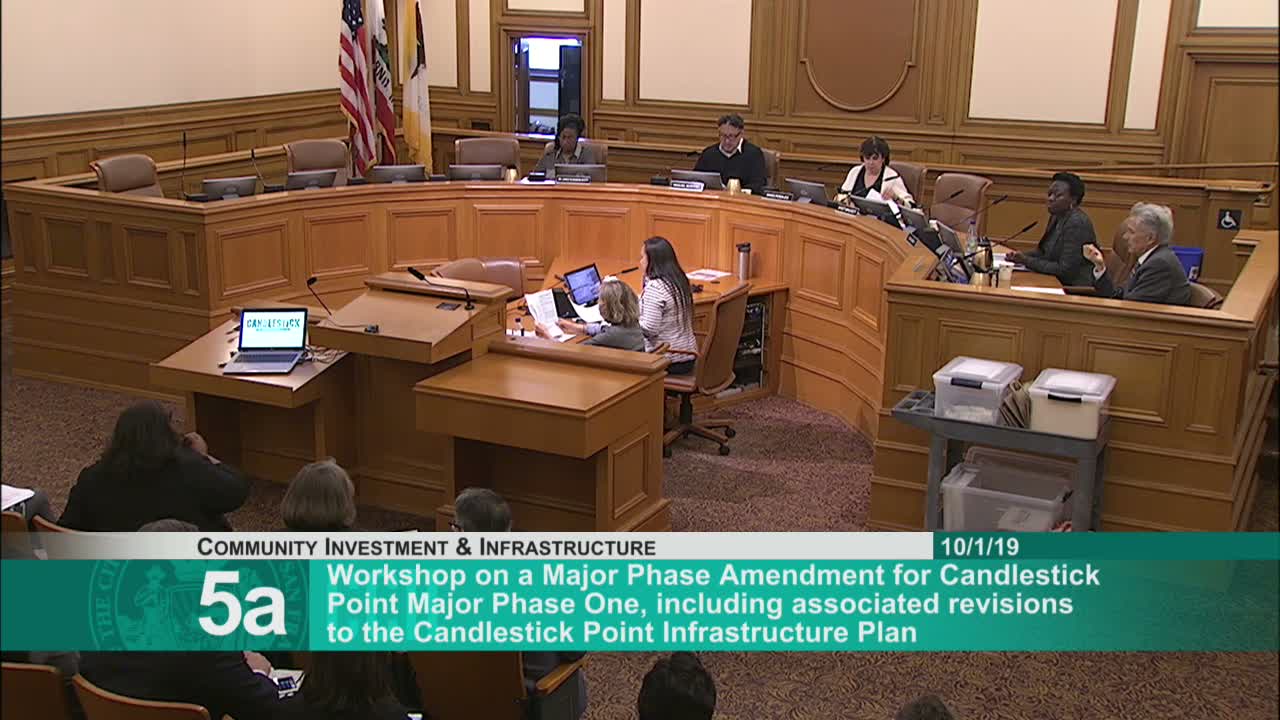
At a public workshop on Oct. 1, the Commission on Community Investment and Infrastructure reviewed proposed major-phase amendments to the Candlestick Point and Hunters Point Shipyard redevelopment plans that would shift the project mix toward housing and office space while reducing large-format retail.
Therese Brecky, senior director of planning at developer 5Point, told the commission the revised plan would accelerate housing and add office capacity after an anchor retail tenant withdrew. She said 337 families have already moved into Holmes and Alice Griffith and that, within the first major phase, 39% of units would be affordable. Across the Candlestick and Shipyard project areas, she said the plan contemplates about 3,345 affordable units, with more than half targeted at 60% area median income or lower.
Brecky said the amendments would allow conversion of retail to office and transfer up to 118,500 square feet of office from Hunters Point Shipyard to Candlestick Point to reflect current market conditions. The proposal also adds housing sub‑phasing, including roughly 428 new units in the revised land‑use plan and 104 senior housing units at 60% AMI or below, she said.
Design changes requested would update facade articulation and ground-floor activation standards to promote pedestrian engagement and local-serving retail and community spaces, Brecky said. The presentation also requests an increase in allowable building height along Aurelius Walker to 120 feet to enable additional housing; interior edges would be allowed up to about 85 feet while the Film Arts Center remains at 120 feet in the proposal.
Staff reviewed transportation and infrastructure updates. The transportation plan’s phasing schedule has been adjusted in coordination with the San Francisco Municipal Transportation Agency, and a roadway modification was proposed to improve bus turning movements. On infrastructure, staff said finished-floor elevation standards are being raised in response to updated sea-level-rise guidance: finished floor elevations would move from roughly 3.5 feet above the base flood elevation to about 5.5 feet, a two-foot increase the presenters said the project is already meeting in its grading assumptions.
Job estimates shift with more office space: Brecky presented an office-employment range (reported in the workshop as approximately 1,875 to 2,725 jobs) while other employment categories remain similar to prior projections. The team said they hope to have backbone infrastructure permitting in hand to continue or begin infrastructure work by fall 2020, with horizontal infrastructure work in 2020–2022 and vertical construction to follow.
Lila Hussain, OCII senior project manager, summarized the next procedural steps: after feedback at the Oct. 1 workshop the project will go to the Community Advisory Committee on Oct. 7 for recommendation and return to the commission on Oct. 15. Hussain said staff will bring three resolutions for commission action: (1) adoption of CEQA findings reflecting the sixth addendum to the EIR, (2) design-for-development amendments (height, massing, setbacks, guidelines), and (3) the major-phase amendments and changes to the infrastructure and transportation plans, including effectuating the 118,500-square-foot office transfer.
Public commenters and CAC representatives praised outreach and community benefits but urged stronger plans for local hiring, workforce training, child-care staffing and broader outreach to displaced-holder (COP/CLP) populations. Oscar James and others asked that developers and city partners expand apprenticeship and training programs tied to community colleges and local workforce providers so neighborhood residents can access new job opportunities. OCII staff said COP holders are in the DALIA applicant system and that they are continuing early outreach and application support.
No formal decisions were made at the workshop; staff will return with the requested resolutions following CAC consideration on Oct. 7 and the commission hearing on Oct. 15.