Get Full Government Meeting Transcripts, Videos, & Alerts Forever!
Get email alerts on the Csa Workplan topic
No spam. Unsubscribe anytime.
City audit committee adopts CSA work plan; asks for clearer public storytelling of bond and service work
Summary
The committee unanimously adopted the City Services Auditor's FY work plan after presentations by chief audit executive Tanya Ledesjewski and director Peg Stevenson, urging the CSA to improve public-facing explanations and dashboards that tie audits and bond projects to resident impacts.
The Go-Back Committee voted unanimously to adopt the City Services Auditor's work plan after a presentation on the office's organization, funding and planned audits.
Tanya Ledesjewski, chief audit executive for the City Services Auditor in the Controller's Office, told the committee the CSA is statutorily required under the city charter (Appendix F) and certain California Government Code provisions to perform audits and performance work. "We receive a budget set aside of 2 tenths of 1% of the city's budget," Ledesjewski said during the presentation, stating that the CSA's current fiscal-year allocation totals about $18,000,000 and the office has 68 full-time staff.
Peg Stevenson, director of city performance, described the CSA's two functional units—audits and city performance—and highlighted recent expansions such as a lean program and a Data Academy that offers staff training in Tableau, Excel, R and GIS. The CSA said its work plan is driven by charter mandates, risk analysis and capital/bond program oversight; planned engagements include construction and bond audits, information-technology and cyber audit work, joint monitoring of nonprofit contractors and multi-agency performance audits.
Committee members praised the work plan but pressed CSA staff to present more citizen-centered information. Commissioner (3) urged CSA to add "cross-cutting citizen oriented reviews" that look at services from users' perspectives rather than only from departmental missions. Member (6) suggested the CSA experiment with narrative or dashboard-based "stories" that explain how bond-funded projects and city services affect residents, saying in some cases the committee could fund communication efforts tied to a bond.
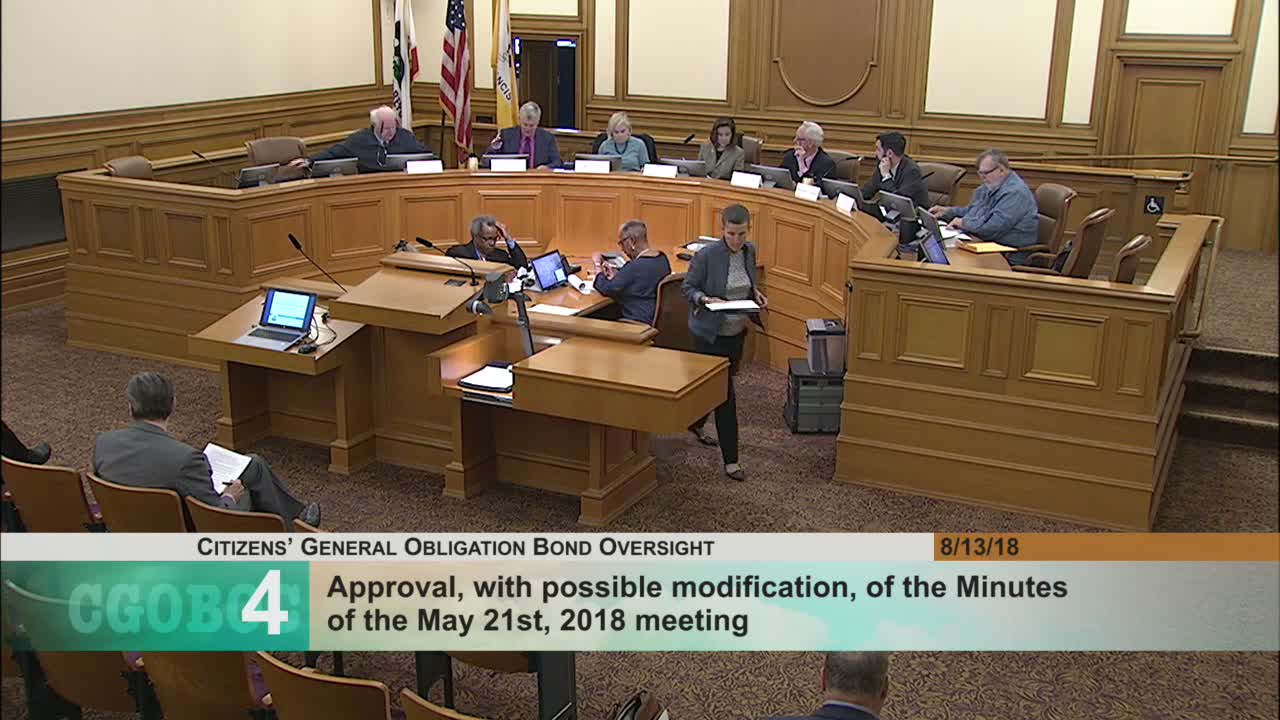
A procedural motion to adopt the work plan was moved and seconded, and the committee recorded unanimous voice votes. The chair announced, "Motion's passed." The committee also recorded other routine actions during the meeting, including election of Brenda Qui McNulty as chair and Kristen Chu as vice chair and approval of the May 21, 2018 meeting minutes.
The adoption directs CSA to proceed with the audits and performance initiatives outlined and to return as requested on how scorecards and the performance program can be used to inform cross-agency efforts and public communication.
The meeting record notes members' continuing interest in improving public reporting and coordination with bond liaisons and other agencies; the CSA said it will consider bringing focused proposals on performance scorecards and public-facing reporting to future meetings.